Pakistan’s general polls keep Karachi’s printing market busy

1 / 11
Muttahida Majlis-e-Amal (MMA), an alliance of the religo-political parties, has decorated its vehicles after strict implementation of Election Commission of Pakistan’s code of conduct, which prohibits display of banners on private and public properties. (AN photo by M.F.Sabir)
2 / 11
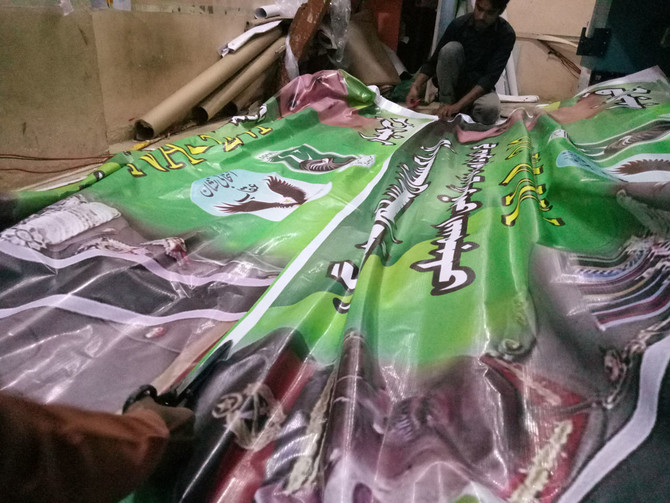
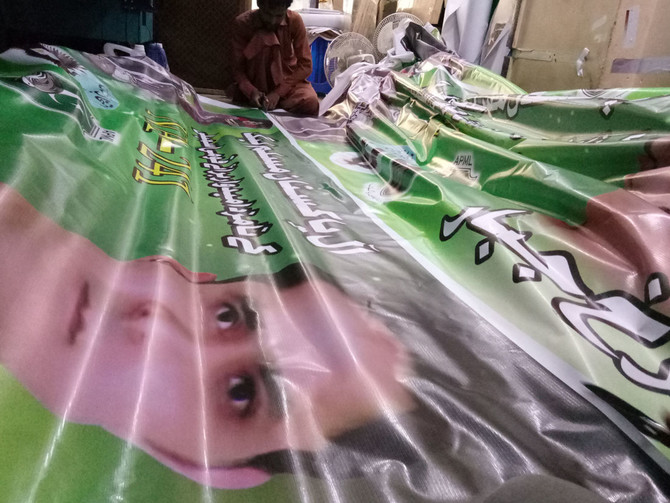
Staff at a printing press at Pakistan Chowk, Karachi, prepare banners for an All Pakistan Muslim League (APML) candidate. (AN photo by M.F.Sabir)
3 / 11
Staff at a printing press at Pakistan Chowk, Karachi, prepare banners for an All Pakistan Muslim League (APML) candidate. (AN photo by M.F.Sabir). General (Retd.) Pervez Musharraf has resigned as chief but will continue to be patron in chief of APML, according to party’s spokesman. (AN photo by M.F.Sabir)
4 / 11
A candidate for national assembly spends from Rs0.5million to Rs2million on printing material for his campaign, according to estimates by printing agents. (AN photo by M.F.Sabir)
5 / 11
Staff at a printing press at Pakistan Chowk, Karachi is preparing banners for a candidate of All Pakistan Muslim League (APML) here on Tuesday, June 26, 2018. General (R) Pervez Musharraf has resigned as chief but will continue to be patron in chief of APML, according to party’s spokesman. (AN photo by M.F.Sabir)
6 / 11
A printer shows candidates’ voter cards. (AN photo by M.F.Sabir)
7 / 11
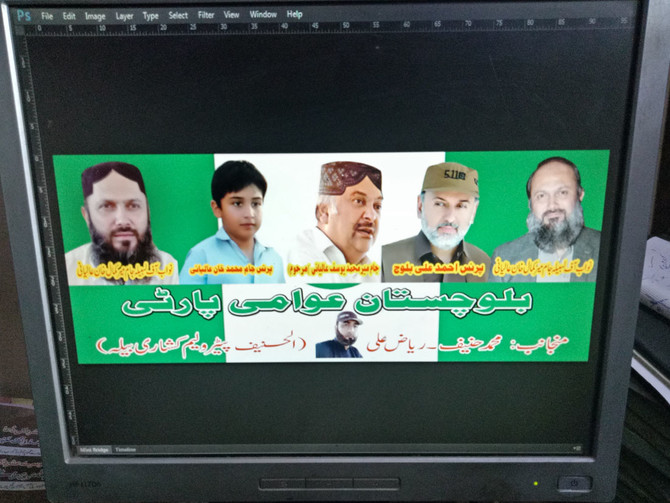
Candidates of recently formed Balochistan Awami Party (BAP) are also printing election material at Karachi’s Pakistan Chowk. (A photo by M.F.Sabir)
8 / 11
Adnan Qaiser, a printer at Pakistan Chowk, designing a poster for a candidate of the Awami National Party from Balochistan. (AN photo by M.F.Sabir)
9 / 11
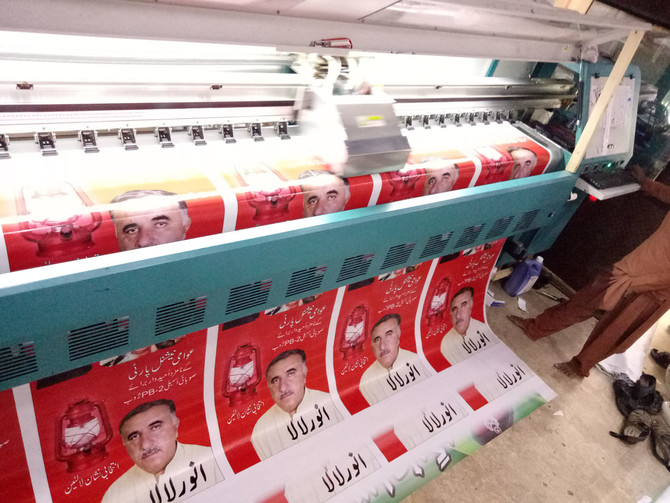
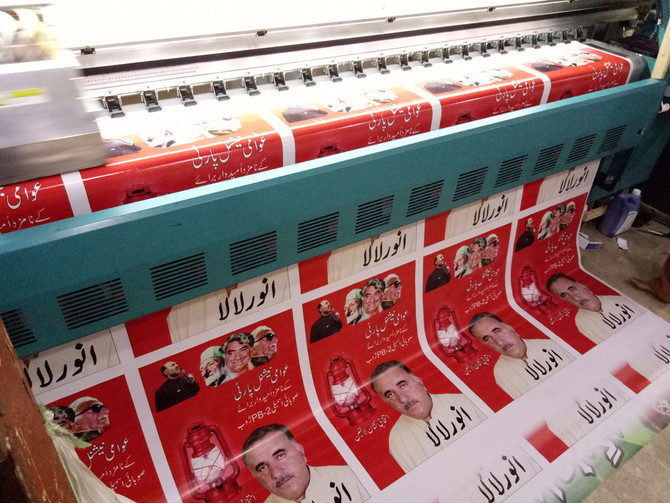
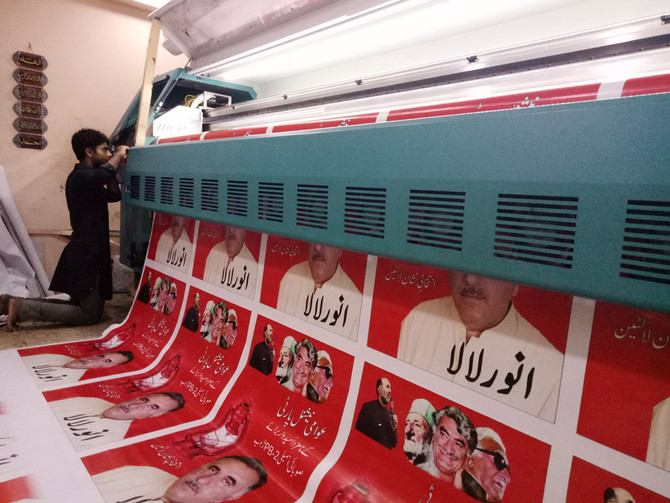
A printing machine at Pakistan Chowk, Karachi produces posters of Anwar Lala, an Awami National Party candidate from Zhob, Balochistan. (AN photo by M.F.Sabir)
10 / 11
A candidate for national assembly spends from Rs0.5million to Rs2million on printing material for his campaign, according to estimates by printing agents (AN photo by M.F.Sabir)
11 / 11
A printing machine at Pakistan Chowk, Karachi is processing posters of Anwar Lala, an Awami National Party’s candidate from Zhob, Balochistan here on Tuesday, June 26, 2018. (AN photo by M.F.Sabir)
Updated 26 June 2018
Follow

Pakistan’s general polls keep Karachi’s printing market busy

  • Nearly 7,000 candidates, including 2,100 from Karachi, are contesting 61 national and 130 provincial assembly seats from Sindh
  • Candidates spend between Rs 0.5 million to 2 million on printing election literature such as banners, hoardings, posters, pole banners, stickers, handbills, symbols, badges, flags and voters cards, says the printing agent

KARACHI: Printers at Pakistan Chowk Market in the seaside metropolis of Karachi are working until the small hours to keep up with demand for election campaign posters and fliers.

Pakistan is to hold general elections for national and four provincial assemblies on July 25, according to the Election Commission of Pakistan (ECP).

Final lists of the candidates will be issued in the next couple of days. However, according to ECP, nearly 7,000 candidates, including 2,100 from Karachi, have been cleared to contest 61 national and 130 provincial assembly seats from Sindh.

Those who know that they will be standing for election have already approached printing markets for printing of different display material, including banners, hoardings, hanging banners, symbols, handbills, badges, stickers and posters. Party flags and voter cards are also mandatory printing material, which have made the printers in several printing markets of the city busy.

“We close our press for four hours by 4am in the morning,” Adnan Qaiser, a printer at Pakistan Chowk told Arab News, adding as the election inches nearer, the work orders from clients will increase and there will be no break at all.

“Within the next couple of days, we will be working 24 hours a day and seven days a week,” Qaiser says. After the ECP issues final list of contenders everyone will start publicity, he adds.

Rehan Ahmed, a printing agent who collects orders from clients, said that a candidate for national assembly spends between Rs0.5million to Rs2million on campaign literature.

He added that influential candidates have a budget of up to Rs 2 million for printing, including thousands of banners, posters, steamers, pole banners and nearly 200,000 voters’ cards, which is distributed among electorates at their doorstep in advance.

Inquiry office, Landhi, Al-karam square Liaquatabad and Korangi industrial areas are other busiest places of printing in Karachi.

Pakistan Chowk, which the country’s largest market of digital and offset printing, receives printing orders from across Sindh and Balochistan provinces. 

“Although there printing presses in Quetta, most of the orders are placed in Karachi,” Ahmed told Arab News, who had printed material for former Chief Minister Balochistan, Sardar Sanaullah Zehri, besides other politicians during the last general elections.
Ahmed said that in Karachi the printing orders from MQM are down from the last election.

Qaiser said that in local government elections the independent candidates print most of the material, however, in general polls the political parties spend more on publicity.

Salman Ali, in-charge of printing for the Muttahida Majlis Amal (MMA), said the religious alliance has printed up to one lack square feet of material and printing is still under way.

He added that strict rules which prohibit candidates from displaying posters at public places and government properties have forced candidates to consider other options.

In the last general election the number of posters and banners was higher, but now the political parties and candidates are using funds to decorate election offices and vehicles.

The hike in dollar rates has increased the rates of Panaflex and other material imported from abroad, said Maqsood Ahmed, another printer in Pakistan Chowk market, who added that “neither the dollar rates nor the ECP code of conduct has shrunk the workload.”


Pakistan army chief meets world leaders in rare Davos appearance

Updated 6 sec ago
Follow

Pakistan army chief meets world leaders in rare Davos appearance

  • Field Marshal Asim Munir attends World Economic Forum alongside prime minister
  • Pakistan delegation holds meetings with US, Saudi and Azerbaijani leaders

ISLAMABAD: Pakistan’s Chief of Army Staff Field Marshal Syed Asim Munir is attending the World Economic Forum’s annual meeting in Davos this week alongside Prime Minister Shehbaz Sharif, marking a rare appearance by a serving army chief at the global gathering of political and business leaders.

Pakistan’s participation at Davos comes as Islamabad seeks to attract investment, project economic stability and deepen engagement with key international partners following recent reforms aimed at stabilizing the economy. 

While Pakistani leaders routinely attend the World Economic Forum, it is uncommon for a serving army chief to be present. In 2017, former army chief Raheel Sharif addressed the forum only after his retirement, while General Pervez Musharraf spoke at Davos on a number of occasions in his role as president, not as military chief. 

Pakistan’s governance structure has evolved in recent years, particularly through the expanded role of the military in economic decision-making through bodies such as the Special Investment Facilitation Council, a civil-military platform designed to fast-track foreign investment in sectors including minerals, energy, agriculture and technology.

“The Prime Minister and the Field Marshal met with the President of Azerbaijan Ilham Aliyev, United States Secretary of State Marco Rubio, and Saudi Arabia’s Foreign Minister Prince Faisal bin Farhan Al Saud,” Sharif’s office said in a statement.

Officials say the delegation’s engagements focused on strengthening economic ties and maintaining high-level contact with partners in the Middle East, Central Asia and the United States at a time of shifting global economic and strategic alignments.

The World Economic Forum’s annual meeting brings together heads of state, ministers, investors and corporate leaders to discuss global economic risks, investment trends and geopolitical challenges. Davos is not a military forum, and while security issues are discussed there, the physical presence of a serving military chief remains the exception, not the norm, across countries. When military figures do appear, it is usually because they are heads of state or government, retired and speaking as security experts or hold a civilian defense portfolio such as defense minister or national security adviser.