

Yemeni Vice President: Victory is just around the corner for Sanaa

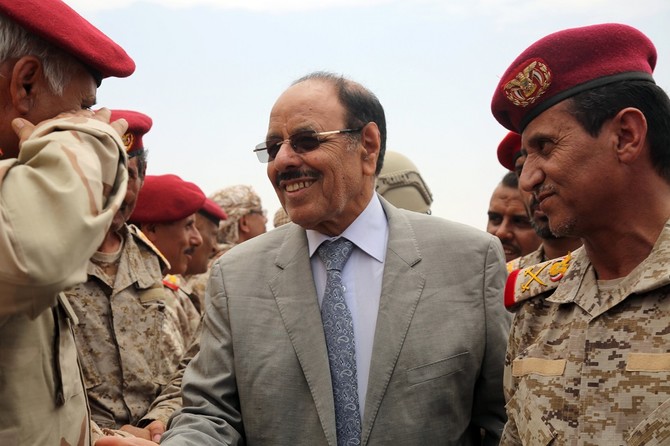
Yemeni Vice President General Ali Mohsen al-Ahmar (C) shakes hands with army officers as he visits military barracks in the eastern city of Marib on August 15, 2016. (File photo: AFP)
Updated 25 June 2018
Follow

Yemeni Vice President: Victory is just around the corner for Sanaa

  • Mohsen reiterated that the Yemeni government led by Abdrabbuh Mansur Hadi and the Arab coalition are determined to restore legitimacy and establish lasting peace
  • Meanwhile President Hadi had a meeting with senior officials in Hodeidah to discuss the situation there

Yemen’s Vice President, Lieutenant-General Ali Mohsen Al-Ahmar said the capital Sanaa will be “cleansed of the Houthi militias,” Saudi state TV Al-Ekhbariya reported on Monday.

The vice president’s statement came during a meeting with senior Yemeni army officials in Marib that was attended by the commander of the Saudi-led Arab coalition forces.

During the meeting, Al-Ahmar claimed that “victory was just around the corner” and that Sanaa would return to its Yemeni identity, stressing the need to "redouble efforts," "intensify training and rehabilitation" and "complete military tasks and plans."

Mohsen reiterated that the Yemeni government led by Abdrabbuh Mansur Hadi and the Arab coalition were determined to restore the legitimate government and establish lasting peace.

‘Imminent liberation’

Meanwhile Yemeni President Abdrabbuh Mansur Hadi had a meeting with senior officials and security leaders in Hodeidah on Sunday to discuss the situation there. The president discussed plans to arrange for humanitarian and relief aid to be delivered, along with preparations for a decisive solution in the battle to liberate the port city.

Hadi said the liberation of Hodeidah was imminent and that the Iran-backed Houthi militia would soon be defeated.

Hadi also stressed the importance of increased efforts by the leadership of the province and managers of basic services for the people.

He called on ministers to provide the necessary support for the people of the province in terms of logistics, relief, health and other fields.

Efforts are being made to provide relief and shelter for all areas of the west coast with the support of the KSRelief, the UAE and international organizations. Two planes loaded with relief supplies from KSRelief are expected to arrive with various supplies.

The Minister of Health, Nasser Baoum, said that 50 hospital beds were transferred to a field hospital in the west coast and a number of ambulances with their crews, in addition to medical supplies provided from China and India.

Minister of Water and the Minister of Social Affairs and Labor discussed a number of measures to ensure the continuity and provision of basic water and tents services.


Tehran residents keep up semblance of normality amid destruction

Updated 5 sec ago
Follow

Tehran residents keep up semblance of normality amid destruction

  • Chaotic scenes followed of panicked passers-by, parents scrambling to retrieve their children from school, queues at bakeries and endless traffic jams
  • A week on, the noise and energy have ebbed, giving way to a rare, disquieting calm in a capital usually thronging with 10 million people

TEHRAN: For a moment Tehran resembled a city at peace, with birdsong, joggers and tranquil views of the snow-capped Alborz mountains in the distance. Then the sound of another explosion ripped through the air.
A week ago, opening strikes by the US and Israel killed Iran’s supreme leader Ayatollah Ali Khamenei, upended residents’ lives and transformed the city streets into a battleground.
In Tehran’s west, a block that belonged to the security forces had been blasted apart, and the entire surrounding area was choked with rubble.
Bizarrely, a green gate and fence enclosing the site stood untouched.
None were surprised by the war, and few had believed the nuclear talks then taking place between Iran and the US would avert it.
The broad-daylight strike at the country’s power center was nevertheless a shock.
Chaotic scenes followed of panicked passers-by, parents scrambling to retrieve their children from school, queues at bakeries and endless traffic jams.
A week on, the noise and energy have ebbed, giving way to a rare, disquieting calm in a capital usually thronging with 10 million people.
The city is at times granted breaks of a few peaceful hours before another string of explosions shatters the air.


- Mushroom clouds -

Another block, this one in the city center, had also been gutted.
Men stood guard, some of them heavily armed despite their apparent youth.
The blast was powerful enough to sow chaos through a nearby primary school, breaking windows and carpeting the playground with rocks and rubble.
Dust coated a row of motorbikes parked nearby.
In another neighborhood, only the steel framework of a bombed-out building had survived, still supporting a massive antenna on the roof.
Local people busied themselves with clearing away the rubble and recovering a few possessions.
They loaded salvageable sofas and home appliances onto decrepit blue pickup trucks in the unmistakable 1960s design of local brand Zamyad.
On the horizon, yet another black mushroom cloud reached skywards.

- ‘Ramadan War’ -

In the first days of the war, Tehran could seem like a ghost town.
But pedestrians were again venturing outdoors: a father walking with his daughter on a scooter, children playing with a ball, or locals sunning themselves in a park.
Runners and cyclists resumed their exercise. More shops were open again.
But the semblance of normality is skin-deep.
Along major roads, armed men in plain clothes and others in military fatigues and body armor inspected random cars at checkpoints.
The blockades made for traffic jams on the avenues, where other traffic was mostly restricted to scooters and delivery riders.
Forbidding armored vehicles appeared on high alert, one of them flying the banner of the Islamic republic.
At prayer time, armed Revolutionary Guards checked the faithful as they filed into a mosque.
One week after his death, posters and placards bearing Khamenei’s image were everywhere on the streets.
Some walls bore street art-style portraits in his honor that appeared in recent days.
In a neighborhood grocery shop, one employee was anxiously following the latest in what state TV had dubbed the “Ramadan War” across the Middle East.