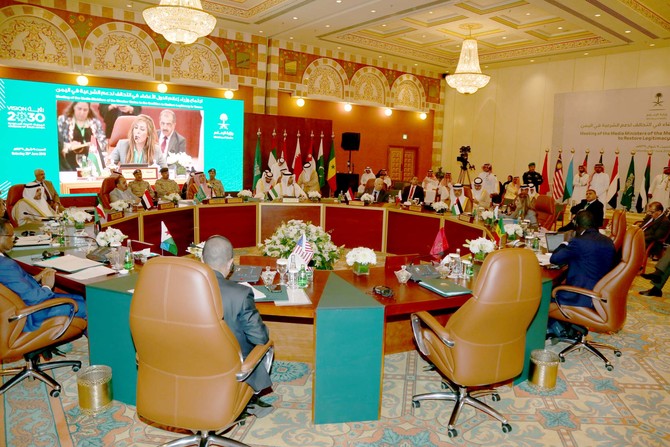
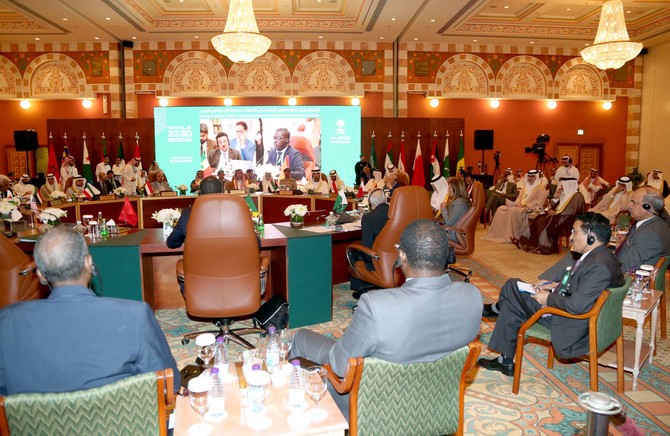
JEDDAH: Media ministers for member states of the coalition for supporting legitimacy in Yemen held their fourth meeting on Saturday to discuss the ways of coordinating efforts and providing media support for coalition countries.
Saudi Minister of Information Awwad Al-Awwad said: “Houthi militias are one of the tools of Iran to threaten the stability of the region, and their ambitions have not stopped at attacking Yemenis and seizing their lands, but they exceeded that to threaten the security of Saudi Arabia by launching more than 152 ballistic missiles intercepted by our air defense forces and prevented from reaching their targets.”
He added: “The coalition has managed to restore and liberate more than 85 percent of the Yemeni territory with its full commitment to the rules of engagement and the protection of civilians and support of the Yemeni people and its legitimate government in resisting the enemy.”
Al-Awwad pointed out that the coalition’s support has not been limited to military operations, but has extended to other economic, security, relief and service aspects, infrastructure development projects, paving roads, rehabilitating ports and increasing their capacity.
Al-Awwad told Arab News that the meeting highlighted the blatant interference of Iran in the region, especially in Yemen, through its support for the Houthi militias.
“Some news agencies transmit news that may not be authenticated,” he said. “We want to tell them that there are reliable sources… that can be consulted. Therefore, news agencies were told to coordinate and publication shall be consolidated.”
He continued: “You are aware of what media stations hostile to the coalition countries and the legitimate government in Yemen are doing to falsify, deceive, fabricate stories, propagate rumors, broadcast distorted information, influence minds and emotions, and downgrade Yemeni army and coalition force success in diplomatic and various fields.
Yemeni Information Minister Muammar Al-Iryani said: “The Houthis will not go to peace until their military stalemate is broken and we have no choice but to cut (off) Iran’s arm in Yemen.
“More than 13,000 journalists were kidnapped by the Houthis and we are demanding the international community seek their release.
Pakistan’s Ministry of Information Additional Secretary Shafqat Jaleel said: “Pakistan calls for unconditional restoration of the legitimate government of President Abd-Rabbu Mansour Hadi and withdrawal of rebel forces from the territories seized by them, including the capital Sanaa.
“Pakistan contributed $1 million in humanitarian aid to Yemen last year and welcomes the Saudi initiative of providing relief to war victims in Yemen. Pakistan supports all efforts for peace in Yemen and calls for a political settlement, which can ensure lasting peace in the country,” he added.
Sultan bin Ahmed Al-Jaber, chairman of the National Media Council of the UAE, said: “The restoration of the legitimate government … enhances the chances of reaching a peaceful solution and puts pressure on the Houthi militias to sit at the negotiating table and break the deadlock in the political process.”
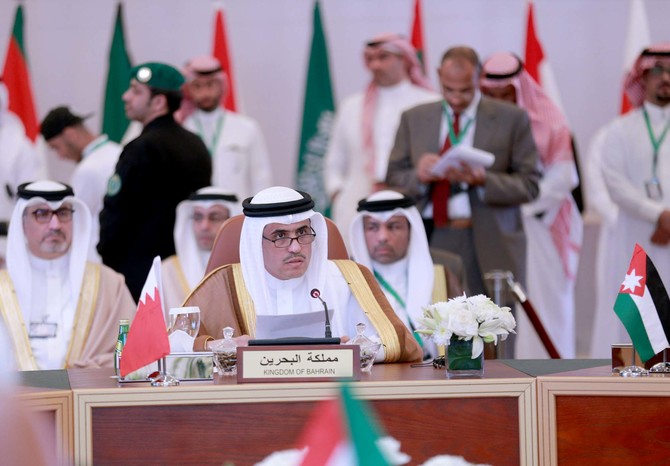
Bahraini Information Minister Ali bin Mohammed Al-Rumaihi stressed that “the security and stability of our Arab region, our identity, our unity and the sovereignty of our country, impose on all our media moral, professional and national responsibilities as a basic weapon and a strategic partner with our armed forces in the face of extremist terrorist organizations and blatant external interference.”
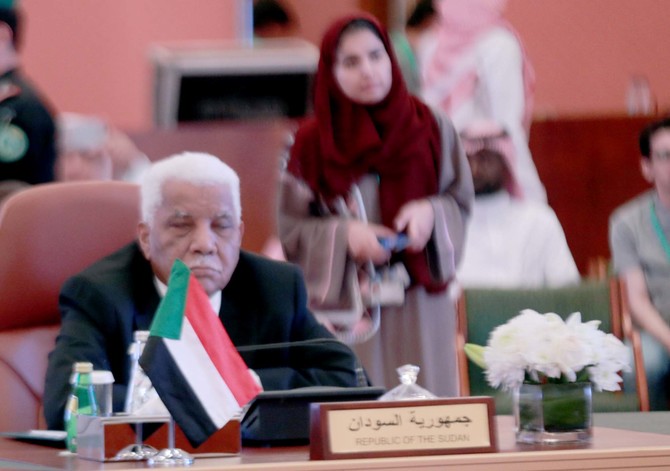
The conference was represented by media ministers from Saudi Arabia, the UAE, Sudan, Egypt, Kuwait, Bahrain, Jordan, Djibouti, Malaysia, Senegal, Yemen and Pakistan.


Ministers discuss winning media war in fight for Yemen’s legitimacy






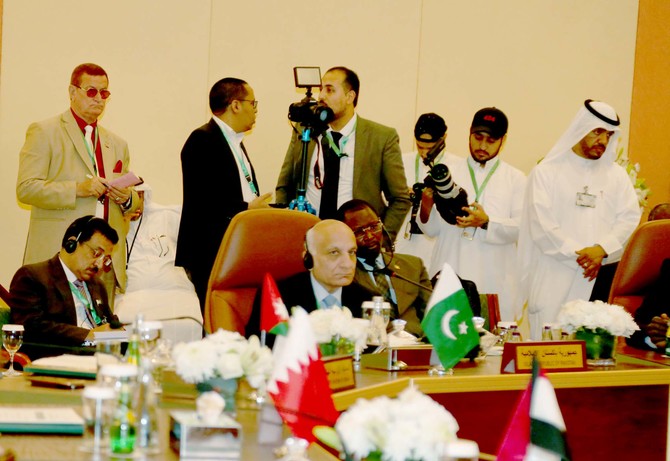

Ministers discuss winning media war in fight for Yemen’s legitimacy

- More than 13 journalists were kidnapped by the Houthis and we are demanding the international community seek their release
- The coalition has managed to restore and liberate more than 85 percent of the Yemeni territory


India and Saudi Arabia share robust defense partnership anchored in mutual trust, ambassador says
RIYADH: India and Saudi Arabia share a robust and steadily expanding defence partnership anchored in mutual trust, Indian Ambassador Suhel Ajaz Khan said.
Speaking to Arab News ahead of the World Defense Show in Riyadh, which will feature a major Indian presence, the ambassador said: “Saudi Arabia is one of India’s most trusted and valued strategic partners. Our ties are rooted in a rich tapestry of civilizational, cultural, and commercial connections that date back centuries. In recent years, the relationship has grown exponentially, evolving into a robust strategic partnership.
“The landmark state visit of Prime Minister Narendra Modi to the Kingdom in April 2025 was a true reflection of this deepening bond. He and Crown Prince Mohammed bin Salman had highly productive engagements in Jeddah, resulting in key outcomes — including the agreement on establishment of two India-Saudi joint venture refineries in India, and MoUs in space cooperation, health, sports, and postal cooperation, the envoy said.
“The second leaders’ meeting of the India-Saudi Arabia Strategic Partnership Council was also co-chaired by the two leaders during this visit. The council reviewed the work of the various committees, subcommittees and working groups under the SPC,” he added.
“On the defense side, India and Saudi Arabia share a robust and steadily expanding partnership, anchored in mutual trust and based on the Defense Cooperation Agreement signed in 2014 during the India visit of the then crown prince and defense minister King Salman,” Khan said.
“Over the past few years, this cooperation has deepened through regular high-level engagements, and enhanced interactions between the armed forces of both countries,” he said.
The most significant development has been the addition of a Ministerial Pillar of Defence Cooperation to the Strategic Partnership Council, chaired by the defense ministers, announced during the Jeddah visit of the Indian prime minister.
Seven rounds of discussions under the Joint Committee on Defense Cooperation have been held so far. The continued exchange of senior defence delegations reflects the priority accorded to defence cooperation under the framework of the Strategic Partnership Council.
“Over the last few years, we have seen two editions of naval exercises, Al Mohed Al Hindi and the first land forces exercises, Sada Tanseeq. There have also been regular port calls by Indian naval and coast guard vessels,” Khan said.
After a gap of nearly 12 years, the first ministerial delegation on the defence side visited Riyadh for WDS 2024, the delegation was headed by Minister of State for Defense Ajay Bhatt.
During that visit, an agreement was signed by Munitions India Ltd. for defence exports from India to Saudi Arabia worth $225 million, Khan said.
India will feature prominently at WDS 2026 being held from Feb. 8-12.
“We congratulate the Kingdom for its organization of WDS in recent years, which has grown significantly since its inception. While preparations are underway, we expect a high-level delegation for this event. The senior leadership of Indian Armed Forces will also be part of the delegation. There will be an India Pavilion set up by our Ministry of Defense in the show.
“While earlier, a number of Indian companies have participated in the WDS, this will be the first time an India Pavilion will be set up and will showcase India’s growing defence manufacturing capabilities,” the envoy said.
The past year has been particularly productive for India–Saudi defence relations.
“We witnessed, for the first time, service-to-service level staff talks, along with high-level visits from both sides, including the first visit of the Chief of General Staff of the Saudi Armed Forces Gen. Fayyad bin Ruwaili, to India in December 2025,” Khan said.
He noted that there are several areas between the two sides that reflect the depth of the partnership, one of the primary fields being military-to-military cooperation, including joint exercises, training exchanges, and service-to-service engagements.
“Amongst them maritime and naval cooperation is key, reflecting our shared interest in the security of the Indian Ocean region, the Red Sea, and critical sea lines of trade and communication. The two rounds of the naval exercises Al Mohed Al Hindi have provided an excellent base for continued collaboration in this area,” Khan said.
“Another rapidly expanding area of engagement is defence industry and industrial collaboration. India’s growing defense manufacturing ecosystem driven by the motto of ‘Make in India, Make for the World’ aligns closely with Saudi Arabia’s Vision 2030,” he added.
India’s defence industrial capabilities have grown exponentially in recent years, crossing $15 billion, with exports upwards of $2.7 billion.
“We have a large number of products which we can offer to the Saudi side,” the ambassador said.
Saudi Arabia has been sending cadets to India for training with the Indian Navy and the National Defense Academy, marking a significant boost in bilateral defense cooperation.
Khan said: “Training and capacity-building cooperation has emerged as an important pillar of the defence partnership between India and Saudi Arabia. The participation of Saudi cadets in professional military training institutions in India reflects the high level of trust and confidence between our armed forces.”
As part of a landmark initiative, six instructors and 55 cadets from the King Fahd Naval Academy of the Royal Saudi Naval Forces participated in Afloat Summer Training with the Indian Navy at Kochi in 2023, he said.
This was followed by an expanded engagement in 2024, when five instructors and 76 cadets from the same academy undertook similar training.
“We anticipate that this program will continue to grow and expand in the years ahead,” the ambassador said.
In 2023 and 2025, senior delegations from the National Defence College, New Delhi visited Saudi Arabia on study tours.
Officers from the Saudi armed forces have also attended NDC courses in the past.
“These training exchanges not only contribute to professional skill development and interoperability but also foster enduring institutional linkages between our armed forces. We see this cooperation as a valuable investment in the long-term strength of the India–Saudi Arabia defence partnership," the ambassador said.


