

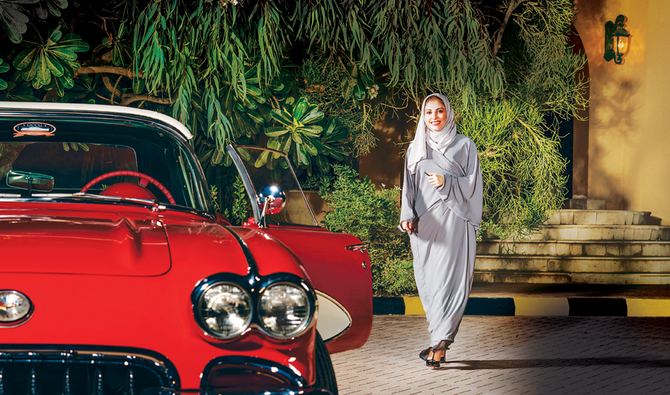

Women throughout Saudi Arabia waited for the stroke of midnight, turned the keys in the ignition, fired up their engines — and hit the road to a bright new future.
It was the moment they had waited for since King Salman issued the royal decree on September 26, 2017, to lift the driving ban on women.
Just after midnight on Saturday and in the first minutes of Sunday, Samah Algosaibi grabbed the keys to her family’s 1959 Corvette C1 and drove out of the driveway of her beach house in Khobar.
“We are witnessing history in the making as we look toward the dawn of a promising future,” said Algosaibi, the first female board member of Ahmad Hamad Algosaibi & Bros.
"It's our moment,' says businesswoman Hind Alzahid as #Saudi Arabia lifts driving ban. https://t.co/VzMhrMeKGo #SaudiWomenDriving #WhatChanged pic.twitter.com/6hQXvznc9j
— Arab News (@arabnews) June 23, 2018
“As a businesswoman in Saudi Arabia, I am grateful for the women’s empowerment movement taking place. Today, I am honored to be sitting behind the wheel of change.”
Another woman to hit the road after midnight was Lina Almaeena, a member of the Saudi Shoura Council. “It feels very liberating,” she said about driving her mother’s Lexus.
Almaeena, also the co-founder and director of Jeddah United Sports Co, had exchanged her UAE license for a Saudi one.
“I am thrilled!” Sarah Alwassia, 35, a nutritionist in Jeddah, told Arab News. “I learnt how to drive 18 years ago in the States where I got my driving license. I can’t believe that the day to drive in my own home town has come.”
Alwassia obtained her first American license when she was 18 years old in 2000, and had it exchanged for a Saudi license on June 6 in Jeddah. She explained that she is a mother, and this change provided comfort for her and her family. It also comes with various benefits, such as taking quick action in emergencies, and economic benefits such as saving money instead of paying for a driver when she needs to run errands.
“I will be driving my kids to school and picking them up in comfort and privacy,” she said.
Women in the Kingdom commented on how this event is changing the course of their lives. “Independence is a huge thing for me,” Alwassia said. “Driving is one small part of it. I am very optimistic of the change that our loving country has made.”
Alwassia applauds the efforts the country has made to support women. “I am confident that driving in the beginning will be pleasant, since our country has made all of the effort to support women and to protect them.
“I think our society was looking forward for this change, and I am sure the majority will adapt fast.
“I feel safe, our country did everything to make this transition pleasant and safe for every woman behind the wheel. I am really thankful to witness this historic moment and I am so happy for all the women in Saudi Arabia, especially my daughters.”
Sahar Nasief, 64, a retired lecturer from the European languages and Literature Department at King Abdulaziz University, said: “Nothing could describe my feelings. I can't wait to get on the road.”
Nasief received a very special gift from Ford for this occasion.
“They gave me a 2018 Expedition to drive for three days, a Mustang California Special,” she told Arab News.
Nasief obtained her Saudi license on June 7. She also holds a British license and two American licenses. “Now, I have my national license too,” she said.
She also said the lifting of the ban provided a sense of relief. “I feel that I can practice one of my rights, and I don't have to live at the mercy of my driver any more.”
Society has been demanding such a change for years, “as it will take the physical and economic burden off most men.”
Pointing to the anti-harassment law, Nasief said: “I feel very confident especially after announcing the strict harassment law.”
Joumana Mattar, 36, a Jordanian interior designer, exchanged her Jordanian driver’s license and obtained a Saudi one on June 11.
“I had my Jordanian license since I was 18 years old, and the moment I heard about the opening of exchanging foreign licenses, I immediately booked an appointment,” she said.
Mattar said she looks forward to the change in so many ways. “I'm finally in control of my time, schedule and privacy.”
Arab News going live on this historic day as Saudi women hit the streets for the first time. Tonight, we are with t… https://t.co/ZYucZuMJGz
— Arab News (@arabnews) June 23, 2018
Mattar said she is both confident and anxious about the event. “I'm anxious only for feeling that I'm part of a huge first step for women driving in the Kingdom, but I'm confident also because of the support that I'm getting from my husband and family.
“Every first step is the hardest. Society is facing a huge change, but I'm positive because this change is done and supported by the government and Vision 2030.”
Mattar said she feels secure now. “I'm in control of any case I'm facing.”
• Download our free #SaudiWomenCanDrive mobile phone background designed by renowned artist Malika Favre: https://startyourengines.21wallpaper.design


