


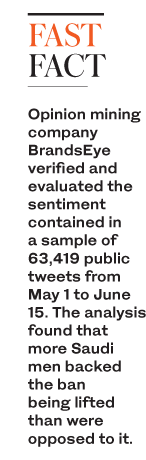
RIYADH: While the world watches women in Saudi Arabia gear up to take the wheel and make history on Sunday, many had thought that Saudi men opposed this new-found independence and would fight hard against it. The opposite proved true.
Arab News spoke with many Saudi men, and most of them hailed the royal decree announced by King Salman last September. Remarkably, many of them are just as excited as women are about the historic date of June 24, 2018, when women will be allowed to drive freely in the Kingdom.
“Women driving in Saudi Arabia is changing the narrative of our history,” said Hussein Abdurahman, a hotel employee. “It’s a new reform that could change many things. There might be a few hiccups in the beginning, as with any new transformation, but I have a good feeling about it.”
He elaborated: “I feel this reform is more in-depth: It’s not just about driving, it’s more about liberty. I was born in an era where women didn’t drive and have never witnessed a woman driving here before. It will be exciting to see that happen!”
 Many conservative families are still hesitant about the decision. Abdul Kareem Youssef, a Saudi businessman, explained: “We have been waiting for a long time. We have been longing for this decision. When it comes to a micro-family level, I’m definitely on board. However, I come from a conservative family, and there’s a huge difference in thinking in our generations. They are not against women driving but against riding the wave in the beginning. They want to wait it out.”
Currently, Youssef is teaching his wife to drive in their neighborhood, when the streets are empty, and discreetly, considerate of both their family’s feelings yet being part of the change that is happening in Saudi. “It has to be low profile, until our families approve,” he said.
The new generation of Saudis are more open to the world and amassing rights that were not given in the past. “We are a generation of global citizens that carry our values,” Youssef said. “These values that we carry — being obedient, good and considerate as much as possible with our families — that’s of high level importance to us.”
He expects conservative families to eventually accept women driving in Saudi Arabia, saying: “Transformations, in the beginning, are rejected then resisted and later on accepted. We are speaking on a worldwide level and not only inclusive to Saudi Arabia.”
In the past some women have driven in Saudi Arabia discreetly when necessary. Faris M.J. laughs while recalling the story of how one female family member took the lead when he had to return home and there was no one to take him.
“A female family member just returned from the States, and she used to drive there. She was itching to take the steering wheel into her own hands but couldn’t. At that time, I was at their house and there was no one to return me back home. She took the initiative, pulled her hair in a bun, put on a hoodie and told me to jump in the car. Mind you, she drove in the middle of the night, in the midst of one the most crowded streets in Jeddah — Tahlia, with all confidence and exuberance. She drove like a pro. We got some looks, but she didn’t care. I still can’t believe that it happened!”
Faris continued: “My only issue is that yes, they have licenses and yes, they have experience, but not driving in Saudi Arabia. We have different laws and different types of drivers, that’s what concerns me. It’s both exciting and scary! Exciting because they have attained their right, scary because of the number of new drivers that will hit the road.”
Some families in Saudi Arabia can’t afford drivers and are exhausted from all the errands they have to run and the pick-ups they must do to meet their family’s needs.
Khalid Turkestani, a government employee, explained: “It’s financially draining to have a driver. I can’t afford one. Both me and my wife work, and life is demanding with family and social obligations. It’s more practical for women to drive freely and independently. My only concerns are about the chaotic drivers that pose a danger and threat to not only male drivers, such as before, but female drivers now.”
Nizar Aqeel, a legal researcher, recalled nostalgically how his mother foretold the future: “Long before when women were not allowed to drive, my mother would ask me to get her groceries. Reluctantly and grudgingly would I get her the things needed. And after much back and forth, me telling her to tell my other brothers to retrieve the items, she would look me straight in the eye and say, ‘You just wait and see, one day I will drive in Saudi Arabia! But until then you still have to get me my groceries … and without fuss.”
Aqeel added: “This is a Saudi woman’s right and should’ve been implemented a long time ago. She has the right to be independent without relying on anyone, whether it be a driver or relative.”
Saleh Hamza, an independent artist, said it best: “We’ve been waiting for this for 80 years. Why ask a man what he thinks about what women should do? We have always been involved in everything regarding them. It’s their right and their time to shine. For once, it’s men’s turn to take a back seat and let women lead the way.”


