

Azzedine Alaia exhibition at London’s Design Museum captures the essence of his creative spirit

1 / 3
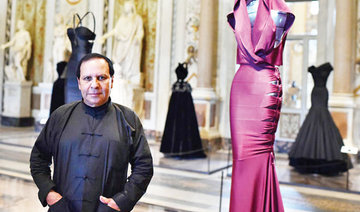
The Azzedine Alaia exhibition, showing at London’s Design Museum. (Photo courtesy: Mark Blower)
2 / 3
The Azzedine Alaia exhibition, showing at London’s Design Museum. (Photo courtesy: Mark Blower)
3 / 3
The Azzedine Alaia exhibition, showing at London’s Design Museum. (Photo courtesy: Mark Blower)
Updated 21 June 2018
Follow

Azzedine Alaia exhibition at London’s Design Museum captures the essence of his creative spirit

LONDON: For lovers of fashion, a visit to the Azzedine Alaia exhibition, showing at London’s Design Museum until 7 October, is a must. Looking at the wonderful displays there is a sense of loss at his passing in November last year, but this is a great retrospective of the Tunisian designer’s life and work, which allows you to go right up to the garments on display and take in the breathtaking quality and detail of Alaia’s designs.

Alaia, born in 1935, trained as a sculptor at the School of Fine Art in Tunis. That background is evident in many of his figure-hugging designs — particularly the stunning, pared-down evening gowns.

When you look at the super slim-line garments on display it can be a bit disheartening when you see the tiny hips and waists. It makes you think of the remark attributed to Wallis Simpson: “You can never be too rich or too thin.”

But Alaia’s world was not for ordinary mortals — it was an extraordinary place for beautiful people living a dream. In the film made by Ellen von Unwerth during the preparation, staging and aftermath of an Alaia show in 1990, you see Naomi Campbell, Helena Christensen  and Christy Turlington at the height of their beauty and fame reminding us of the ‘supermodel’ era, when these women dominated the international tabloid press.

Alaia himself said, “I make clothes, women make fashion.” And you only have to think of stars such as Rihanna and Penelope Cruz wearing his designs on the red carpet to understand what he means.

The film of models walking in his designs is mesmerising – each model is filmed in sequence with close up shots of what she is wearing — an excellent way of showing the fabrics, cut, patterns and innovation and how they are all brought alive through movement. Alaia’s designs flatter the female form and seem enhance women’s beauty.

The influence of Arab architecture is evident in some of his designs. His use of lace and perforated fabrics, especially broderie anglaise and punched or laser-cut leather, recalls the mashrabiya.

His ability to transform leather into such a soft, wearable, high-fashion fabric was stunning to see up close.

Also notable was his avoidance of surface embellishment such as embroidery or applied decoration. Instead, Alaia keyed pattern into the very fabric of his garments, making it an integral part of their structure, altering both their weight and form.

His fascination with African influences is also evident in his use of unusual materials including flax rope, raffia, shells or Nile crocodile skin and animal patterns.

Alaia was also deeply inspired by Spanish culture — his earliest fashion memories were reportedly of the girls in Diego Velazquez’s 1656 paining, “Las Meninas” and his voluminous ball gowns evoke the formality of the hooped gowns of the Spanish royal court during that time. He also took inspiration from Spain’s vibrant folk costumes, as seen in the effusive flamenco-inspired ruffles of some of his designs.

Through the photographs mapping his life you get a sense of the creative process and hard work that went into his couture. You also realize that this was a man who was at the top of his profession for several decades.

The exhibition does a fine job of conveying Alaia’s creative energy, and reminds visitors that his legacy lives on in the inspiration his work provides for young designers today.

‘The Wild Within’ sees artists breathe new life into Mideast buildings

Updated 16 December 2025
Follow

‘The Wild Within’ sees artists breathe new life into Mideast buildings

DUBAI: Lens-based artist Ryan Koopmans and digital artist Alice Wexell are staging a showcase at Dubai’s Leila Heller Gallery that breathes new life into regional buildings.

The series of digital artworks is part of the exhibition “The Wild Within,” featuring images of old structures in Beirut, Istanbul, and Abu Dhabi filled with wild flowers.

Two of the largest works, “Heartbeats” and “The Wish,” are displayed using Ventana, a microLED architectural display surface created by visual technology company Megapixel.

'Around Us' by Ryan Koopmans and Alice Wexell. (Supplied) 

The former artwork depicts the entrance hall of Qasr Al-Watan, the UAE’s presidential palace in Abu Dhabi, while the latter reimagines the upper floors of the Emirates Palace Mandarin Oriental in Abu Dhabi.

“Each building we work with comes to us through a combination of research, travel, and intuition,” the artists told Arab News in a joint statement.

'Constellations' by Ryan Koopmans and Alice Wexell. (Supplied) 

“We are drawn to structures that carry both emotional and historical resonance, often buildings that once embodied human ambition and now exist in a state of quiet transformation.”

Koopans and Wexell made sure to research the context of each building they choose to recreate, saying “an old villa in Jeddah or a former school in Sharjah each hold their own cultural memory, influencing everything from the lighting and atmosphere to the plants and flowers that we digitally sculpt and implement into the photographs.”

'Heart of Sharjah' by Ryan Koopmans and Alice Wexell. (Supplied) 

The hypnotic works depict the interior of buildings in the region, with digitally rendered flowers carpeting the floor in a bid to “(reimage) these spaces (and) explore the relationship between nature, place, and time, while celebrating each site as a unique work of architecture with its own spirit and story,” the artists said.

Koopmans is of dual Canadian and Dutch heritage, while Wexell is Swedish and based in Stockholm, so it is noteworthy that both artists chose to explore the Middle East for their latest project.

'Blossom of the Ancestors' by Ryan Koopmans and Alice Wexell. (Supplied) 

“In the Middle East especially, the architecture reflects a layered past that merges different styles and eras, while also expressing a sense of renewal and forward-looking energy, particularly in the region’s fantastic contemporary buildings. We are drawn to the symmetry, geometry and patterns that are found not only in nature itself, but in the architectural language of the region both past and present,” they said.

The series — featuring works such as “Adore You,” “Between Worlds,” and “Blossom of the Ancestors” — explores contrasts between the natural world and human-made forms, as well as the traditional and contemporary worlds.

“We are interested in how these elements coexist and merge into one another, creating a sense of hyperrealism that feels both familiar and imaginary. By merging photography with digital sculpture, the artworks question where the boundary lies between documentation and invention, and how technology can extend rather than replace our sense of the natural world.”

'Under the Rain of Light' by Ryan Koopmans and Alice Wexell. (Supplied) 

Although the scale of the artworks ensures they leave the viewer entranced, it did pose challenges, according to the artists.

“Presented at a large scale, every texture in these artworks becomes visible, which can be demanding but is also incredibly rewarding. The magnified detail allows the visceral and atmospheric layers of the pieces to come through with greater impact,” they said, adding that each piece took “many months” to create.

“Ultimately, we want our collectors to experience a sense of wonder and contemplation, as if they are standing inside a dream that feels both entirely real yet unreal.”

The exhibition runs until Jan. 15, 2026.