



LONDON: When Daesh ransacked Mosul Museum in February 2015, the world watched in horror as cultural treasures were pushed from plinths and relics from ancient civilizations smashed to the floor.
Priceless pieces of Iraq’s history were lost, taking thousands of years of heritage with them while the militant group tried to wipe out pre-Islamic past and destroy all memory of the ancient civilizations Iraq is built on.
Rescuing the artefacts that escaped the group’s savagery and restoring Iraq’s archaeological ancestry has become part of the healing process as the country emerges from the trauma of Daesh rule and pieces its identity back together following a decade of turmoil.
Programs to train Iraq’s archaeologists in emergency heritage management are being supported by overseas institutions, including the British Museum in London, where a new exhibition will delve into an era when Iraq was at the center of a great Assyrian empire.
Priceless treasures from the archaeological archives of ancient Assyria will go on display at the museum in November for the first major exhibition on the kingdom’s last great ruler, King Ashurbanipal.
Described as the most powerful person on earth during his reign in the 7th-century BC, Ashurbanipal ruled with an iron fist from his seat in Nineveh, now northern Iraq.
He presided over a vast territory that stretched from the shores of the eastern Mediterranean to the summits of western Iraq and was known, according to the exhibition, as a “Warrior. Scholar. Empire-builder. King-slayer. Lion-hunter. Librarian.”

A map showing the extent of the Assyrian Empire (in pink). (Courtesy Paul Goodhead)
His feats on the battlefield, which included conquering Egypt and crushing the state of Elam, established his military might but the Assyrian king also cultivated an intellectual prestige, amassing the largest library in existence to showcase his scholarship.
For Ashurbanipal, the ruthless ruler, harnessing the power of learning to build his status as “King of the World, King of Assyria,” was equally important in cowing his enemies.
Among the notable pieces in his extraordinary collection, which predated the famous Library of Alexandria, was the Epic of Gilgamesh, a poem from ancient Mesopotamia considered the earliest surviving work of great literature.
About 30,000 of these texts are in the hands of the British Museum, where they tell the story of life at Ashurbanipal’s famously extravagant court in ancient cuneiform script, hammered out on clay tablets.
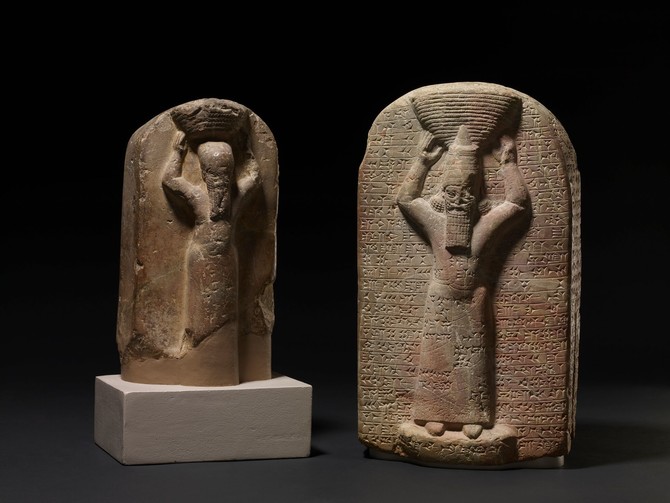
These are among the 200 rarely-seen objects due to be displayed at the museum, which has brought together pieces from across the world, from the History Museum of Armenia, Yerevan to the Musée du Louvre in Paris to supplement its existing collection of artefacts from the glory days of ancient Assyria.
Huge stone statues, delicately-carved reliefs, rare wall paintings and elaborate armory give a sense of the opulence of Ashurbanipal’s palace, which stood as a symbol of the vast wealth and influence he wielded, flanked by expansive gardens where an elaborate canal network reached 50 kilometers into the mountains.
Recent speculation has suggested that the Hanging Gardens of Babylon — one of the Seven Wonders of the Ancient World — were in fact those at Nineveh.
Some of the the artefacts have been brought up from a decommissioned basement gallery at the British Museum, where few have had the opportunity to lay eyes on them for 20 years.
Brought together for the first time, they capture the scale and splendor of the era before Ashurbanipal’s empire fell to the Babylonians and recalls an era when the influence of Assyrian monarchs reached across the world.
Hartwig Fischer, director of the British Museum, said: “This exhibition will bring visitors face to face with a king whose reign shaped the history of the ancient world.”
Many of the items on display originate from archaeological sites in Iraq, including Nineveh and Nimrud, cities recently ravaged by Daesh when the group stormed the ancient sites armed with sledgehammers and drills.
Gareth Brereton, exhibition curator, said: “As present-day Iraq looks to recover the history of damaged sites at Nineveh and Nimrud, this exhibition allows us to appreciate and relive the great achievements of an ancient world and celebrate its legacy.”


