Philippines’ Duterte says no ‘justice’ for families of drugs war casualties

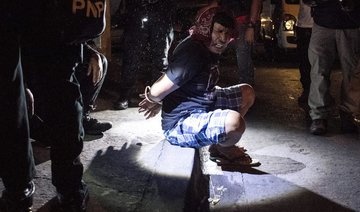
More than 4,200 suspected drug dealers have been killed by police in Philippine President Rodrigo Duterte’s anti-narcotics campaign since June 2016. (Reuters)
Updated 19 June 2018
Follow

Philippines’ Duterte says no ‘justice’ for families of drugs war casualties

MANILA: Outspoken Philippine President Rodrigo Duterte said on Monday the families of people killed in his controversial war on drugs will not receive “justice,” rejecting calls from rights groups seeking redress for the thousands of deaths.
More than 4,200 suspected drug dealers have been killed by police in Duterte’s anti-narcotics campaign since June 2016, as well as several thousand more by unknown gunmen who authorities have described as vigilantes, or rival gang members.
Rights groups and critics of the campaign say some of the killings were summary executions.
Police deny the allegations, saying they had to use deadly force because the suspects were armed and had resisted arrest. They also deny activist allegations that they have falsified reports, staged crime scenes and systematically murdered small-time peddlers and users.
“If you think that you can get justice simply because you lost somebody who’s a bullshit into drugs, I’m sorry to tell you I will not allow it,” Duterte said in a speech on Monday.
He also reiterated that he would not allow the police and the military to go to jail for killing drug users and pushers.
“If you are shot and I know you are a drug lord, I will run over you five times,” said Duterte, who won the presidency in May 2016 on a platform of fighting corruption, crime and drugs.
Duterte has stopped police anti-drugs operations twice due to questions over the conduct of the force, including the killing of a teenager in a supposed anti-drug operation in 2017.
The 73-year old leader’s popularity had not diminished, according to opinion polls, despite drawing international criticism for his bloody war on drugs and human rights record.


Row erupts in UK over support for British-Egyptian activist Alaa Abd El-Fattah

Updated 54 min 52 sec ago
Follow

Row erupts in UK over support for British-Egyptian activist Alaa Abd El-Fattah

  • Arab Spring campaigner’s ‘abhorrent’ social media posts resurface after he arrived in Britain following release from Egyptian prison
  • PM Starmer criticized for glowing welcome to activist who had previously been supported by both Tory and Labour governments

LONDON: The UK prime minister is facing criticism after he celebrated the return to Britain of a human rights activist who was recently released from an Egyptian prison but whose past social media posts apparently contained violent and antisemitic language.
Successive British governments have campaigned for the release of Alaa Abd El-Fattah, a dual national who had been imprisoned in Egypt for most of the past 14 years. He returned to the UK on Friday after Egyptian authorities lifted a travel ban that had forced him to remain in the country since he was freed in September.
But a senior member of the opposition Conservative Party on Saturday criticized Prime Minister Keir Starmer for giving a “personal, public endorsement” to Abd El-Fattah when Starmer said he was “delighted” the activist had been reunited with his family in Britain.
Robert Jenrick, the Conservative spokesman on justice issues, demanded to know whether Starmer knew about historical social media posts in which Abd El-Fattah allegedly endorsed killing “Zionists’’ and police. Jenrick also called on Starmer to condemn Abd El-Fattah’s statements and withdraw his “unalloyed endorsement” of the activist.
“Nobody should be imprisoned arbitrarily nor for peaceful dissent,’’ Jenrick wrote. “But neither should the prime minister place the authority of his office behind someone whose own words cross into the language of racism and bloodshed.”
The Foreign, Commonwealth and Development Office said in a statement that it had been “a long-standing priority” of governments under both major parties to work for Abd El-Fattah’s release. But that does not imply an endorsement of his social media posts, the spokesman said.
“The government condemns Mr. El-Fattah’s historic tweets and considers them to be abhorrent,” the statement said, using a slightly different style for his last name.
Abd El-Fattah’s family in the UK had vigorously campaigned for his release, arguing that he had spent most of the past 14 years behind bars because of his opposition to the government of President Abdel-Fattah El-Sisi.
His mother, Laila Soueif, 69, staged a 10-month hunger strike to pressure British authorities to do more to secure her son’s release.
Starmer on Friday paid tribute to Abd El-Fattah’s family and all the others who campaigned for his freedom.
“I’m delighted that Alaa Abd El-Fattah is back in the UK and has been reunited with his loved ones, who must be feeling profound relief,” Starmer said.
But soon after Abd El-Fattah arrived at London’s Heathrow Airport, critics began circulating historical social media posts in which he appeared to endorse the killing of Zionists and police.
The Times of London reported that Abd El-Fattah has previously said the comments were taken out of context and were part of a “private conversation” that took place during an Israeli offensive in the Gaza Strip.
Abd El-Fattah’s press team didn’t immediately response to a request for comment, and it was not immediately clear whether the posts were authentic.