

Zimbabwe’s split opposition helping Mugabe’s successor to victory

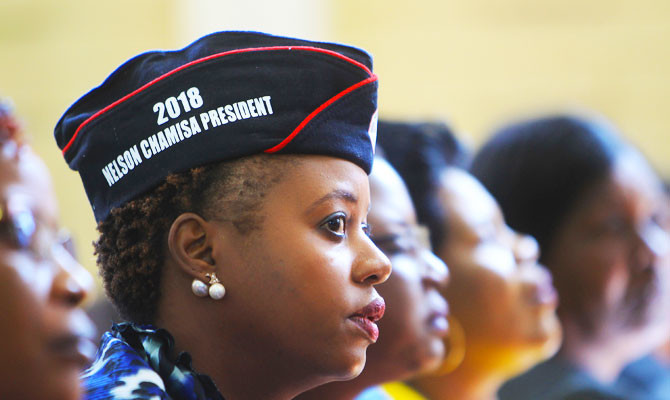
Supporters of Zimbabwe's opposition leader, Nelson Chamisa sit, during the launch of the party's election manifesto in Harare, Thursday, June, 7, 2018. (AP)
Updated 18 June 2018
Follow

Zimbabwe’s split opposition helping Mugabe’s successor to victory

  • Twenty-three candidates — the highest number in the country’s election history — are in the running for the presidential race after haggling over the allocation of parliamentary seats
  • In May the party held a so-called “healing session” to appease disgruntled members who had threatened to “donate” their votes to the opposition

HARARE: Zimbabwe’s divided opposition could bolster the long ruling party’s chances of victory after failing to forge a solid coalition for the country’s first elections without Robert Mugabe.
Twenty-three candidates — the highest number in the country’s election history — are in the running for the presidential race after haggling over the allocation of parliamentary seats, scuttling a plan by the opposition to form a united front in general elections due on July 30.
But the real battle is seen to be between the ruling Zanu-PF and the main opposition Movement for Democratic Change (MDC), the party which has posed the most formidable challenge to Zanu-PF’s grip on power.
The main presidential candidates are Zanu-PF’s Emmerson Mnangagwa, 75, who succeeded Mugabe after a brief military takeover last November and Nelson Chamisa, 40, who took over as leader of the MDC following the death of opposition veteran Morgan Tsvangirai in February.
“The unprecedented numbers of aspiring candidates is an indication of the opening of political space and an interest by Zimbabweans to take part in politics,” said Rushweat Mukundu, of Zimbabwe Democracy Institute.
Mnangagwa who took over from Mugabe, ending his nearly four-decade rule in which he presided over the country’s economic and political decline, has vowed to hold clean elections and break from past history of violence-tainted polls.
Zanu-PF “has created the impression that it has broken from its past of violent and contestable elections, hence the unprecedented numbers of those who have come out to contest,” said Harare-based independent analyst Alexander Rusero, adding many have no following “beyond their small cliques and the churches they attend.”
“At best this is counterfeit democracy,” which festers confusion among the opposition while Mnangagwa enjoys the benefit of incumbency.
Mnangagwa’s ruling Zanu-PF party, riven by factionalism which began as a battle over Mugabe’s succession, is also battling to stay together.

In May the party held a so-called “healing session” to appease disgruntled members who had threatened to “donate” their votes to the opposition, or stand as independents amid accusations of rigging and favoritism during primary elections.
“It’s not the number of candidates that’s worrying but the phenomenon of rebels who are insisting on standing without the blessing of their parties,” according to University of Zimbabwe’s Eldred Masunungure.
“This is going to have an impact on both Zanu-PF and the MDC Alliance.”
Some 5.6 million people are registered to vote in the election which has attracted the interest of many first-time voters desperate for change in a country ruled by Zanu-PF rule since independence from Britain in 1980.
“I was born under Zanu-PF and all I have known is poverty and suffering,” said Harare street vendor, Takudzwa Mutepeya “for us this is a vote for change.”
Mnangagwa has pledged to revive the country’s moribund economy which took a toll from years of misrule, and to mend fences with Zimbabwe’s former Western allies who severed ties over the Mugabe regime’s tainted human rights record.
Chamisa has said, if elected, he will create a $100-billion economy in a decade.

Other candidates include Mugabe’s former deputy Joice Mujuru, ex-cabinet minister Nkosana Moyo, Thokozani Khupe from a breakaway faction of the MDC, and musician and sculptor Taurai Mteki.
Businesswoman Violet Mariyacha, 61, returned home after 25 years in Britain, to join the presidential race.
“I could not continue watching my people suffering,” she told AFP. “I came to be the new face of Zimbabwe’s politics.”
Human rights activist and presidential candidate Lovemore Madhuku is in the election “to introduce an alternative voice. We are fed up with ... having two dominant parties that are simply doing nothing except fighting each other.”
Previous elections have been marred by violence, intimidation and charges of electoral fraud including stuffing of the electoral roll with phantom voters including long-deceased people.
In 2008 the then opposition leader Tsvangirai withdrew from a presidential run-off election citing the deaths of scores of his supporters.
The lead-up to the election has so far been calm. For the first time the state broadcaster covered the launch of the main opposition MDC’s manifesto live on television while police allowed a march calling for reforms including giving foreign-based citizens to right to vote without having to travel back home.


Trump accepts Nobel medal from Venezuelan opposition leader Machado

Updated 9 sec ago
Follow

Trump accepts Nobel medal from Venezuelan opposition leader Machado

  • Trump wrote: “Maria presented me with her Nobel Peace Prize for the work I have done. Such a wonderful gesture of mutual respect“
  • Machado said the gift was in recognition of what she called his commitment to the freedom of the Venezuelan people

WASHINGTON: Venezuelan opposition leader Maria Corina Machado gave her Nobel Peace Prize medal to US President Donald Trump on Thursday during a White House meeting, in a bid to influence his efforts to shape her country’s political future.
A White House official confirmed that Trump intends to keep the medal.
In a social media post on Thursday evening, Trump wrote: “Maria presented me with her Nobel Peace Prize for the work I have done. Such a wonderful gesture of mutual respect. Thank you Maria!“


Machado, who described the meeting as “excellent,” said the gift was in recognition of what she called his commitment to the freedom of the Venezuelan people.
The White House later posted a photo of Trump and Machado with the president holding up a large, gold-colored frame displaying the medal. Accompanying text read, “To President Donald J. Trump In Gratitude for Your Extraordinary Leadership in Promoting Peace through Strength,” and labeled the gesture as a “Personal Symbol of Gratitude on behalf of the Venezuelan People.”
Machado’s attempt to sway Trump came ⁠after he dismissed the idea of installing her as Venezuela’s leader to replace the deposed Nicolas Maduro.
Trump openly campaigned for the prize before Machado was awarded it last month and complained bitterly when he was snubbed.
Though Machado gave Trump the gold medal that honorees receive with the prize, the honor remains hers; the Norwegian Nobel Institute has said the prize cannot be transferred, shared or revoked.
Asked on Wednesday if he wanted Machado to give him the prize, Trump told Reuters: “No, I didn’t say that. She won the Nobel Peace Prize.”
The Republican president has long expressed interest in winning the prize and has at times linked it to diplomatic achievements.
The lunch meeting, which appeared to last slightly over ⁠an hour, marked the first time the two have met in person.
Machado then met with more than a dozen senators, both Republican and Democratic, on Capitol Hill, where she has generally found more enthusiastic allies.
During the visit, White House press secretary Karoline Leavitt said Trump had looked forward to meeting Machado, but stood by his “realistic” assessment that she did not currently have the support needed to lead the country in the short term.
Machado, who fled the South American nation in a daring seaborne escape in December, is competing for Trump’s ear with members of Venezuela’s government and seeking to ensure she has a role in governing the nation going forward. After the United States captured Maduro in a snatch-and-grab operation this month, opposition figures, members of Venezuela’s diaspora and politicians throughout the US and Latin America expressed hope for Venezuela to begin a process of democratization.

HOPES OF A MOVE TO DEMOCRACY
Democratic Senator Chris Murphy, one of the senators who met with Machado, said the opposition leader had told senators that repression in Venezuela was no different now ⁠than under Maduro.
Venezuela’s interim President Delcy Rodriguez is a “smooth operator” who was growing more entrenched by the day thanks to Trump’s support, he said.
“I hope elections happen, but I’m skeptical,” said Murphy, of Connecticut.
Trump has said he is focused on securing US access to the country’s oil and economically rebuilding Venezuela. Trump has on several occasions praised Rodriguez, Maduro’s second-in-command, who became Venezuela’s leader upon his capture. In an interview with Reuters on Wednesday, Trump said, “She’s been very good to deal with.”
Machado was banned from running in Venezuela’s 2024 presidential election by a top court stacked with Maduro allies.
Outside observers widely believe Edmundo Gonzalez, an opposition figure backed by Machado, won by a substantial margin, but Maduro claimed victory and retained power. While the current government has freed dozens of political prisoners in recent days, outside groups and advocates have said the scale of the releases has been exaggerated by Caracas. In an annual address to lawmakers, Rodriguez called for diplomacy with the United States and said should she need to travel to Washington, she would do so “walking on her feet, not dragged there.”
She also said she would propose reforms to her country’s oil industry aimed at increasing access for foreign investors.
