PSARADES, Greece: Greece and Macedonia on Sunday signed a historic preliminary agreement to rename the country the Republic of North Macedonia, ending a row that has poisoned relations between the two neighbors since 1991.
"This is a brave, historic and necessary step for our peoples," said Greek Prime Minister Alexis Tsipras.
"We are here to heal the wounds of time, to open a path for peace, fraternisation and growth for our countries, the Balkans and Europe," he said.
"Our two countries should step out of the past and look to the future," said Macedonia Prime Minister Zoran Zaev.
"Our peoples want peace... we will be partners and allies," he said.
The accord begins to unravel one of the world's longest -- and arguably most arcane -- diplomatic disputes, which began 27 years ago with Macedonia's declaration of independence but whose roots date back centuries.
"The time has come again to sing happy songs in the Balkans," Tsipras said, moments before the document was signed by the two countries' foreign ministers.
Zaev and several of his ministers arrived by speedboat at the picturesque fishing village of Psarades under a sunny sky, on the southern bank of Lake Prespa that is one of the natural boundaries between the two countries.
Tsipras and Zaev embraced on the village dock and entered the large tent where the deal was signed to a standing ovation from gathered dignataries and officials.
UN under-secretary-general for political affairs Rosemary DiCarlo, longterm UN negotiator Matthew Nimetz, EU diplomatic chief Federica Mogherini and EU enlargement commissioner Johannes Hahn were at hand.
Nimetz, who turned 79 on Sunday and also signed Sunday's agreement, had been trying to broker a solution since 1994, first as a US envoy and subsequently on behalf of the United Nations.
But it was the election of Zaev in 2017, replacing nationalist PM Nikola Gruevski, that proved crucial.
An economist and former mayor of Strumica, Zaev made rapprochement with Greece a priority to secure his country's membership of the European Union and NATO, blocked by Athens for years.
After the signature, Tsipras will cross over to the Macedonian side of Lake Prespa for lunch, becoming the first Greek prime minister to visit the neighbouring state.
Since 1991, Athens has objected to its neighbour being called Macedonia because it has its own northern province of the same name, which in ancient times was the cradle of Alexander the Great's empire -- a source of intense pride for modern-day Greeks.
The two premiers, born just months apart in 1974, have bucked strong hostile reactions at home to push ahead with the agreement.
Tsipras has been accused of treachery by Greek hardliners, and on Saturday defeated a vote of censure against his government amid protests and clashes with police outside parliament.
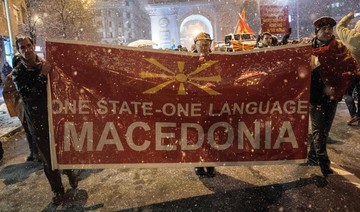
In Macedonia, President Gjorge Ivanov plans to exercise a one-time veto option to block the deal that the nationalist opposition has called a "capitulation".
The Macedonian parliament is scheduled to start debating the agreement next week.
The accord still needs to be approved by Macedonia's parliament and then pass a referendum.
Under the terms of the deal, the Macedonian constitution must also be revised by the end of the year, before Greece's parliament is called to ratify it.
Tsipras' domestic critics say he has bargained away Greece's diplomatic advantages -- the power of veto over EU and NATO accession -- for a deal that could backfire.
Specifically, by officially recognising a Macedonian language and nationality, it is almost certain that the country will be called Macedonia by the broader world, instead of North Macedonia, opponents of the deal argue.
Officials in Athens insist that the deal will help stabilise the historically volatile Balkan region, permitting Greece to focus on other regional challenges, Turkey among them.
They also note that Greece had already been criticised by the International Court of Justice for blocking Macedonia's membership of NATO.
In a 2011 ruling, the top UN court said Greece had "breached its obligation" under a provisional agreement reached in 1995 to end the dispute over the name of the former Yugoslav republic.
Macedonia was admitted to the United Nations in 1993 under the provisional name of the "Former Yugoslav Republic of Macedonia", but more than 120 countries including Russia and the United States have recognised the Balkan country under the name of "Republic of Macedonia".
Skopje hopes to secure a date to begin European Union accession talks at an EU summit in late June and an invitation to join NATO in mid-July.


![]()

Greece, Macedonia sign historic deal to end name row
Greece, Macedonia sign historic deal to end name row
- The accord begins to unravel one of the world's longest -- and arguably most arcane -- diplomatic disputes
- Since 1991, Athens has objected to its neighbour being called Macedonia because it has its own northern province of the same name

Latest updates


© 2026 SAUDI RESEARCH & PUBLISHING COMPANY, All Rights Reserved And subject to Terms of Use Agreement.