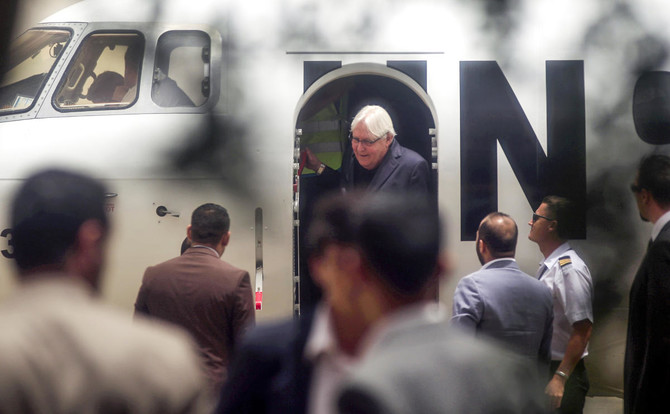
UN envoy in Yemen for Hodeidah crisis talks

1 / 3
UN envoy to Yemen Martin Griffiths (L) listens to the undersecretary of Houthi-led government’s foreign ministry, Faisal Amin Abu-Rass upon his arrival at Sanaa airport in Sanaa, Yemen June 16, 2018. (Reuters)
2 / 3
UN envoy to Yemen Martin Griffiths listens to the undersecretary of Houthi-led government’s foreign ministry, Faisal Amin Abu-Rass upon his arrival at Sanaa airport in Sanaa, Yemen June 16, 2018. (Reuters)
3 / 3
Martin Griffiths (C), the UN special envoy for Yemen, disembarks from a plane upon his arrival at Sanaa international airport on June 16, 2018 for talks on the key aid port of Hodeidah where Houthi rebel fighters are battling a regional coalition. (AFP)
Updated 17 June 2018
Follow

UN envoy in Yemen for Hodeidah crisis talks

  • UN envoy for Yemen has a plan to halt fighting around the key aid port of Hodeidah where Houthi militia have been battling a regional coalition
  • Martin Griffiths was expected to propose to militia leaders that they cede control of the Red Sea port to a UN-supervised committee

SANAA: The UN envoy for Yemen carried a plan to halt fighting around the key aid port of Hodeidah where Houthi militia have been battling a regional coalition as he arrived Saturday in the rebel-held capital Sanaa for emergency talks.
Martin Griffiths was expected to propose to militia leaders that they cede control of the Red Sea port to a UN-supervised committee and halt heavy clashes against advancing government troops backed by Saudi Arabia and the United Arab Emirates.
The envoy did not make any statement on his arrival at Sanaa international airport.
More than 70 percent of Yemeni imports pass through Hodeidah’s docks and the fighting has raised UN fears of humanitarian catastrophe in a country already teetering on the brink of famine.
Yemen’s government and its allies launched their offensive on Wednesday, after at least 139 combatants have been killed, according to medical and military sources.
The Iranian-backed Houthi militia have controlled the Hodeidah region with its population of some 600,000 people since 2014.
The capture of Hodeidah would be the coalition’s biggest victory of the war so far, and militia leader Abdel Malek Al-Houthi on Thursday called on his forces to put up fierce resistance and turn the region into a quagmire for coalition troops.
The Yemeni army on Saturday claimed it had seized control of the militia base at Hodeidah’s disused airport, which has been closed since 2014.
An AFP correspondent on the front line could not confirm the report and a spokesman for the coalition, which has troops taking part in the offensive, did not respond to repeated requests for comment.
But military sources later denied that the army had entered the airport.
They told AFP, however, that sporadic clashes were underway at the airport’s southern gate.
The highway between Hodeidah and the government-held port of Mokha was also the scene of fighting, they said, adding that loyalist forces had suffered “losses.”
The United Nations and relief organizations have warned that any all-out assault on Hodeidah would put hundreds of thousands of people at risk.
The fighting is already nearing densely populated residential areas, the Norwegian Refugee Council warned, and aid distributions have been suspended in the west of the city.
The International Committee of the Red Cross said thousands were likely to flee if the fighting continued.
On Thursday, the UN Security Council demanded that Hodeidah port be kept open to vital food shipments but stopped short of backing a Swedish call for a pause in the offensive to allow for talks on a militia withdrawal.


Aleppo Citadel is a witness to the city’s great history and legacy

This aerial view shows the Citadel of Aleppo overlooking the northern Syrian city on December 11, 2024. (AFP)
Updated 11 sec ago
Follow

Aleppo Citadel is a witness to the city’s great history and legacy

  • Parts of military fortress date back nearly 2 millennia
  • Historian Abdullah Hajjar provides an extensive study

DAMASCUS: Towering above the old city, the Aleppo Citadel has stood for centuries as both a military stronghold and symbol of the location’s layered history.

After years of closure, neglect, and damage during the war, the Aleppo Citadel reopened to visitors on Sept. 27 following months of restoration.

The site has been listed as a UNESCO World Heritage landmark since 1986.

Rising around 38 meters above its surroundings, the fortress has played a central role in Aleppo’s political, military, and urban development.

Surrounded by a deep defensive moat, the citadel reflects advanced military engineering.

According to historian Abdullah Hajjar in his book “Archaeological Landmarks of Aleppo,” first published in 2010, the moat was excavated and reinforced during the reign of Ayyubid ruler Al-Zahir Ghazi.

At times it was 22 meters deep and about 30 meters wide, and filled with water to strengthen defenses.
Parts of the citadel date back nearly two millennia.

The lower section of its main entrance originates from the third century A.D., while the upper additions were made in the 15th century. Most of the towers and walls were built or expanded between the 13th and 16th centuries.

The citadel has repeatedly been damaged and rebuilt over the centuries. It was destroyed by the Sassanids in 540 A.D., but later restored.

Inside its walls, the citadel contains mosques, military structures, and residential buildings, offering a rare glimpse into daily life within a medieval fortress.

Among its landmarks are the Ibrahim Al-Khalil Mosque, the Great Mosque, defensive towers, barracks, and several historic houses.

Archaeological excavations have uncovered remains from multiple eras. This includes a ninth-century B.C. temple, Roman and Byzantine sarcophagi, and water cisterns dating to the reign of Byzantine Emperor Justinian, who rebuilt Aleppo’s fortifications in the sixth century against Persian invaders.

The citadel flourished during the Mamluk period, when it was restored by Sultan Baybars after the 1260 Battle of Ain Jalut.

Later inscriptions document victories by Mamluk rulers over Crusader and Mongol forces.

Under Ottoman rule, following the Battle of Marj Dabiq in 1516, the fortress gradually lost its military role and became an administrative and residential site.

The book outlines the various stages of restoration of the Aleppo Citadel over the centuries.

It highlights that Al-Zahir Ghazi, son of Saladdine Ayyubi, excavated the moat, reinforced the entrance with three wrought-iron gates, and built a large mosque within the fortress.

Later, Al-Zahir Baybars restored the citadel after the Mongol invasion, and in 1417, Sultan Al-Mu’ayyad Shaykh repaired its walls following their destruction by Timur in 1401.

The Aleppo Citadel has also survived powerful earthquakes, including a devastating quake in 1138 and another in 1822, each followed by major restoration efforts led by regional rulers of the time.

Beyond the citadel itself, Hajjar’s research documents Aleppo’s wider architectural heritage, including historic bathhouses and caravanserais that once supported the city’s role as a major trade center.