KARACHI: “I am looking for new currency notes, but the prices being charged are unreasonably high,” said Muhammad Farooq, father of four, who was trying to keep up the tradition of giving ‘Eidi’ to his children for Eid Al-Fitr — the Muslim festival that follows the holy month of Ramadan.
Eidi is a deep-rooted tradition in Pakistan. Elders are expected to give money — the amount depends on their financial status — to children as part of the celebration.
This tradition also increases the demand for new banknotes of various denominations. Every year, Pakistan’s central bank issues billions of rupees to meet this ever-growing demand, though it seems that banks across the country still find it difficult to provide enough.
“We have bought everything as part of Eid shopping, but the most important part, which is to get new currency notes, is still pending,” Farooq said, adding: “Children flatly refuse to accept old notes and insist they need new ones.”
The State Bank of Pakistan launched a new SMS service announcing the issuance of fresh notes for Eid Al-Fitr on May 31. In a statement, the bank said that around 2.3 million people had booked new notes within four days of the launch "against the arrangement made at 1,535 branches in 132 cities as compared to 1,018 branches nominated in 120 cities on Eid Al-Fitr in 2017."
As the demand for fresh notes increases every year, the central bank has also increasing its limit on the number of people who can book them.
“The total booking limit of 2.7 million customers has also been increased this year by 50 percent as compared to the 1.8 million customer limit last year,” the SBP added.
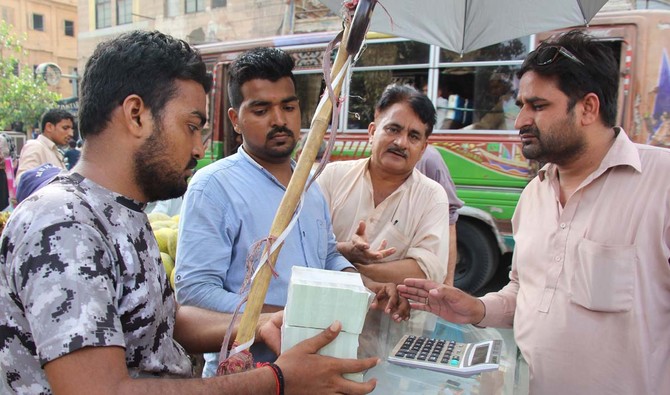
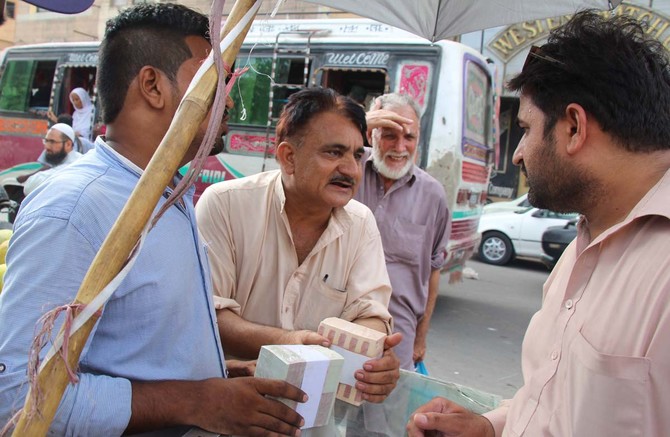
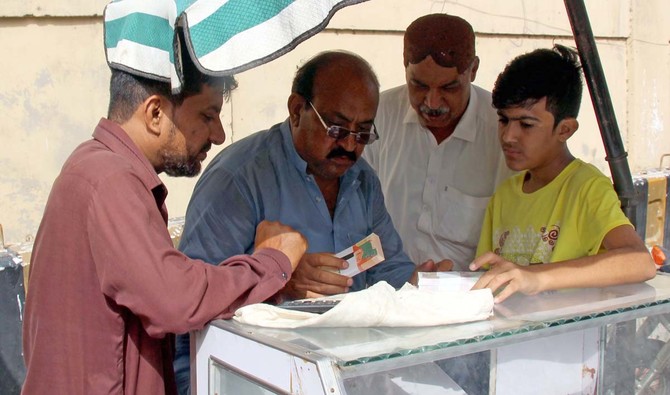
As the demand-supply gap widens, many people resort to the currency market, where notes of various denominations are bought and sold at different prices. “On the occasion of Eid, the demand for a bundle containing 100 notes of PKR 10 remains high and it mainly comes from the lower-middle classes,” Muhammad Saleem Memon, a currency dealer at Karachi’s Bolton Market, told Arab News. “We charge up to PKR 200 (profit) for a single bundle of this denomination,” he added.
Demand for other denominations also remains high, primarily from the middle- and upper-classes. “The peak-hour (additional) rate for a bundle of PKR 50 notes is PKR 300 while PKR 500 is charged for every packet of PKR 100. Each packet contains 100 notes,” Shahreyar Ahmed, a currency dealer, told Arab News.
Not everyone is a fan of the tradition, however. Some have labeled it a waste of time and resources.
“The intrinsic value of both new and old currency notes is equal. We should not encourage such activities in the name of tradition,” said Zeeshan Siddiqui, a banker.
The central bank issued PKR 342 billion of fresh banknotes last year through its own windows and commercial banks across the country. This year, that amount is expected to climb to around PKR 360 billion, although exact figures will not be released until after Eid.


![]()
![]()
![]()
![]()
![]()

Brand new banknotes hot sellers in Pakistan at Eid

Brand new banknotes hot sellers in Pakistan at Eid
- Pakistanis give billions of rupees to children at Eid every year Dealers struggle to meet demand for fresh banknotes
- Around PKR 360 billion in fresh notes expected to be sold this year Notes of various denominations are bought and sold on the open market
Latest updates


Recommended


© 2026 SAUDI RESEARCH & PUBLISHING COMPANY, All Rights Reserved And subject to Terms of Use Agreement.