


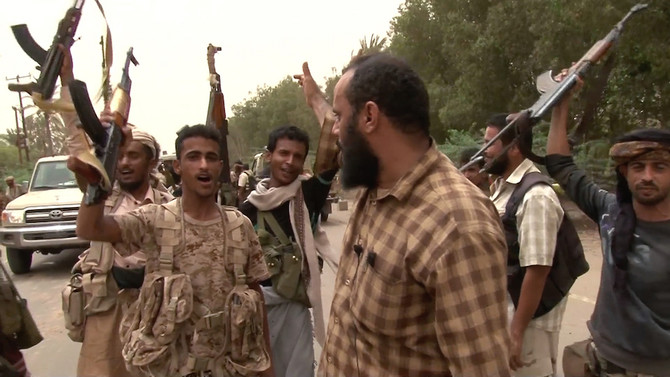

ADEN: Forces from the Arab Coalition entered the airport in Yemen's main port city on Saturday, the coalition-backed Yemeni military said, in the biggest offensive of the coalition's war against the Iran-aligned Houthis.
Victory for the coalition in their first attempt to capture a strategic part of a well-defended city could put the Houthis in their weakest position since the conflict erupted three years ago.
A defeat would also cut off supply lines to the Houthi-controlled capital, Sanaa, and possibly force the movement to negotiate.
"Army forces backed by the resistance and the Arab coalition freed Hodeidah international airport from the grip of the Houthi militia," the media office of the pro-alliance Yemeni military said on Twitter on Saturday.
Troops have surrounded the main airport compound but have not seized it, a Yemeni military source and residents said.
"We need some time to make sure there are no gunmen, mines or explosive in the building," the military source said. The military's media office said technical teams were de-mining the surrounding area.
Fighting in the airport area led to the closure of the northern entrance of Hodeidah, which leads to Sanaa, residents said.
That has blocked a key exit out of the city and made it more difficult to transport goods from the port, the country's largest, to mountainous regions.
UN envoy lands in Hodeidah
The UN envoy for Yemen arrived in the militia-held capital Sanaa for talks on the key aid port.
Martin Griffiths is expected to propose to militia leaders that they cede control of the Red Sea port to a UN-supervised committee to avoid further fighting with advancing government troops which are backed by the Arab coalition.
Seized entrance
Yemeni forces backed by Arab states seized the entrance to the airport in Yemen’s main port city on Friday, in an offensive against the Houthi militia.
The swift advance was an important early success for the Yemeni forces, which launched the operation in Hodeidah four days ago and says it can liberate the city quickly enough to avoid interrupting aid to millions facing starvation.
“We saw the resistance forces in the square at the northwestern entrance to the airport,” said a Hodeidah resident, referring to Yemeni allies of the coalition. Two Yemeni military officials allied to the coalition confirmed it.
Yemeni forces tweeted that they had also seized the airport’s southern entrance, advancing down a main road toward the seaport.
Residents in the city, controlled by the Houthis, said battles had been fought in the Manzar neighborhood, which abuts the wall surrounding the airport.
“There have been terrifying bombing runs since the morning when they struck Houthi positions near the airport,” said fish vendor Ammar Ahmed.
Apache attack helicopters hovered over Manzar, firing at Houthi snipers and fighters in schools and other buildings, said another Hodeidah resident, who asked not to be identified.
Houthi militia had entered homes overlooking the main road to go onto the roofs. Dozens of Manzar residents fled to the city center on motorcycles, the resident said.
Streets elsewhere in the city were empty despite the Eid holiday.
“We are at the edges of the airport and are working to secure it now,” the Arab coalition said in a statement.
“Operational priority is to avoid civilian casualties, maintain the flow of humanitarian aid, and allow for the UN to press the Houthis to evacuate the city.”
“I urge all parties to the conflict to meet their obligations to protect civilians and civilian infrastructure and take active steps to respect international humanitarian law,” said David Beasley, executive director of the UN World Food Programme.
Liberating Hodeidah would give the Arab coalition the upper hand in the war, which it has fought since 2015 to restore the internationally recognized government led by President Abed Rabbo Mansour Hadi. But a successful operation would require swiftly liberating a city of 600,000 people, without inflicting damage that would destroy the port.


