

Trump says Kim has agreed to complete denuclearization of peninsula

1 / 6
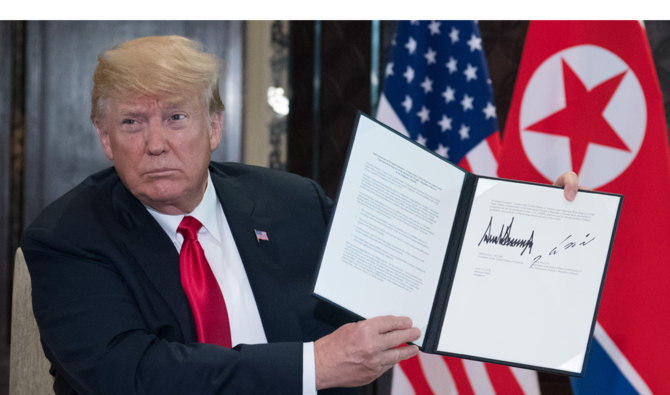
US President Donald Trump holds up a document signed by him and North Korea’s leader Kim Jong Un following a signing ceremony during their historic summit Singapore on Tuesday, June 12. (AFP)
2 / 6
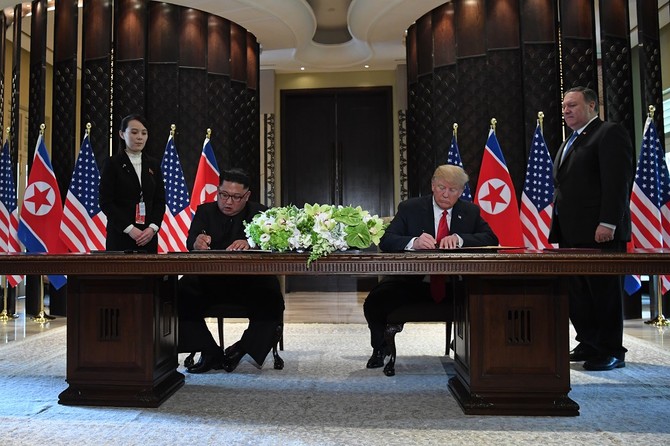
US President Donald Trump, right, and North Korea's leader Kim Jong Un, left, sign documents as US Secretary of State Mike Pompeo, second right, and the North Korean leader's sister Kim Yo Jong, second left, look on during the signing ceremony on Tuesday, June 12. (AFP)
3 / 6
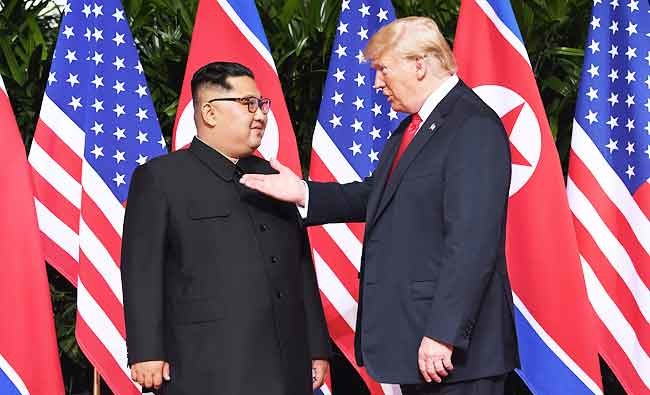
North Korea's leader Kim Jong Un (L) shaking hands with US President Donald Trump (R) as they sit down for the historic US-North Korea summit. (AFP)
4 / 6
US President Donald Trump shakes hands with North Korean leader Kim Jong Un at the Capella Hotel on Sentosa island in Singapore on Tuesday. (REUTERS)
5 / 6
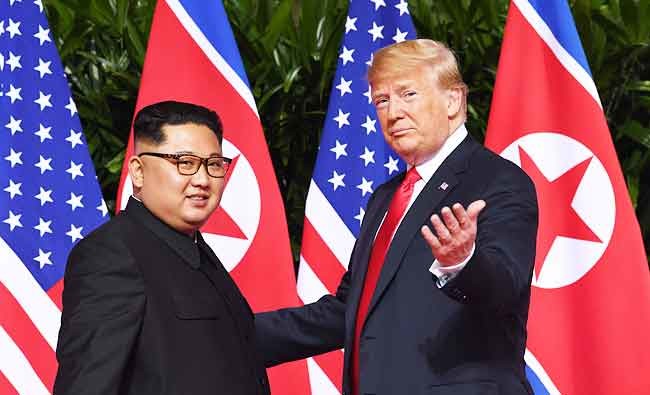
US President Donald Trump (R) gestures as he meets with North Korea's leader Kim Jong Un (L) at the start of their historic US-North Korea summit, at the Capella Hotel on Sentosa island in Singapore on June 12, 2018. (AFP)
6 / 6
US President Donald Trump (R) gestures as he meets with North Korea's leader Kim Jong Un (L) at the start of their historic US-North Korea summit, at the Capella Hotel on Sentosa island in Singapore on June 12, 2018. (AFP)
Updated 13 June 2018
Follow

Trump says Kim has agreed to complete denuclearization of peninsula

  • Despite being quizzed by journalists several times, Trump was unable to give a clear deadline or a clear process of denuclearization
  • Trump told reporters that both leaders will pay courtesy calls to each other’s respective countries “at the appropriate time”

SINGAPORE: US President Donald Trump has confirmed that North Korean leader Kim Jong Un has agreed to “an unwavering and complete denuclearization of the Korean peninsula,” although there is no clear deadline for nuclear disarmament.
He made the statement during a press conference at the Trump-Kim Summit in Singapore on Tuesday.
The summit at a luxury hotel on the island of Sentosa saw the two leaders expressing their commitment to “vigorous negotiations to implement the agreement as soon as possible” at their first meeting.
Despite being quizzed by journalists several times, Trump was unable to give a clear deadline or a clear process of denuclearization.
However, Trump said that North Korea had already destroyed a major missile engine testing site and that it has not had a nuclear test for the past seven months. “When he lands, he would start the denuclearization process right away,” Trump told reporters.
Keith Fitzgerald, negotiation and conflict management expert and managing director of Sea-Change Partners, commented: “The Trump White House has not shared much information about their plans. If the White House had a strategy, it’s not clear to most analysts what that strategy was.”
Professor James Chin, director of the Asia Institute at the University of Tasmania, agreed that the only strategy the denuclearization talks involved is “the willingness to compromise.”

“There will not be a comprehensive agreement, but it will be more like a roadmap to agreement, and perhaps a statement on the end of war,” added Prof. Chin.
Trump’s negotiating style is guided more by “his personal instincts” than by any strategy, added Fitzgerald. The Trump-Kim talks had gone from words about “complete, verifiable, irreversible denuclearization” to talk of making a good start, as the summit approached. Trump praised Kim for taking “the first bold step for a bright full future,” adding that the meeting with the North Korean leader was “honest, direct and productive.”
“He is very talented,” said Trump, adding that 26-year-old Kim was able to “run it tough.” North Korea is infamous for its human rights atrocities, including running a state-sanctioned gulag against its own citizens.
“He wants to do the right thing,” said Trump, adding that human rights were part of the discussion despite being discussed “relatively briefly”. In its 2018 report the Human Rights Watch described North Korea as “one of the most repressive authoritarian states in the world.”
Trump told reporters that both leaders will pay courtesy calls to each other’s respective countries “at the appropriate time.”
“It is a strange thing to see an American president have better relationships with North Korea and Russia than with Germany and Canada,” Fitzgerald told Arab News.
Before Trump’s press conference took place, a sleek, propaganda video resembling a big-budgeted Hollywood trailer was shown hailing Trump and Kim as heroes who would “advance” North Korea.
The video was made by a Los Angeles-based, award-winning production house Destiny Pictures, and commissioned by the US government.



Rubio says technical talks with Denmark, Greenland officials over Arctic security have begun

Updated 29 January 2026
Follow

Rubio says technical talks with Denmark, Greenland officials over Arctic security have begun

  • US Secretary of State on Wednesday appeared eager to downplay Trump’s rift with Europe over Greenland

WASHINGTON: Technical talks between the US, Denmark and Greenland over hatching an Arctic security deal are now underway, Secretary of State Marco Rubio said on Wednesday.
The foreign ministers of Denmark and Greenland agreed to create a working group aimed at addressing differences with the US during a Washington meeting earlier this month with Vice President JD Vance and Rubio.
The group was created after President Donald Trump’s repeated calls for the US to take over Greenland, a Danish territory, in the name of countering threats from Russia and China — calls that Greenland, Denmark and European allies forcefully rejected.
“It begins today and it will be a regular process,” Rubio said of the working group, as he testified before the Senate Foreign Relations Committee. “We’re going to try to do it in a way that isn’t like a media circus every time these conversations happen, because we think that creates more flexibility on both sides to arrive at a positive outcome.”
The Danish Foreign Ministry said Wednesday’s talks focused on “how we can address US concerns about security in the Arctic while respecting the red lines of the Kingdom.” Red lines refers to the sovereignty of Greenland.
Trump’s renewed threats in recent weeks to annex Greenland, which is a semiautonomous territory of a NATO ally, has roiled US-European relations.
Trump this month announced he would slap new tariffs on Denmark and seven other European countries that opposed his takeover calls, only to abruptly drop his threats after a “framework” for a deal over access to the mineral-rich island was reached, with NATO Secretary-General Mark Rutte’s help. Few details of the agreement have emerged.
After stiff pushback from European allies to his Greenland rhetoric, Trump also announced at the World Economic Forum in Davos, Switzerland, last week that he would take off the table the possibility of using American military force to acquire Greenland.
The president backed off his tariff threats and softened his language after Wall Street suffered its biggest losses in months over concerns that Trump’s Greenland ambitions could spur a trade war and fundamentally rupture NATO, a 32-member transatlantic military alliance that’s been a linchpin of post-World War II security.
Rubio on Wednesday appeared eager to downplay Trump’s rift with Europe over Greenland.
“We’ve got a little bit of work to do, but I think we’re going to wind up in a good place, and I think you’ll hear the same from our colleagues in Europe very shortly,” Rubio said.
Rubio during Wednesday’s hearing also had a pointed exchange with Sen. Tim Kaine, D-Virginia, about Trump repeatedly referring to Greenland as Iceland while at Davos.
“Yeah, he meant to say Greenland, but I think we’re all familiar with presidents that have verbal stumbles,” Rubio said in responding to Kaine’s questions about Trump’s flub — taking a veiled dig at former President Joe Biden. “We’ve had presidents like that before. Some made a lot more than this one.”