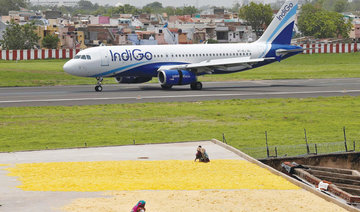
BENGALURU/NEW DELHI: The slow pace of fitting out regional airports risks delaying Indian Prime Minister Narendra Modi’s ambitious plan to launch more flights connecting smaller towns and cities and get millions more people using air travel.
The program, flagged off by Modi last year, aims to boost economic growth by refurbishing idled colonial-era airstrips or building newer airports, and incentivizing airlines to offer discounted fares to connect them with bigger cities.
But work on building new airports in small towns and upgrading existing facilities has failed to keep pace, two government officials said, and could knock off course the government’s lofty goal of bringing 100 million more passengers to the skies in the next five years.
Under Modi’s “regional connectivity scheme,” the government planned to open 31 new airports by the end of 2017, but only 16 are operational so far. Some states have said they do not have enough funds to purchase basic equipment such as mandatory fire tenders, one of the officials said.
In other cases, it was taking longer than planned to build air traffic control towers or set up terminal buildings equipped with baggage scanners and security systems, said the official.
The federal government has now stepped in, and will procure much of the equipment itself and lease it to state governments to get the 15 remaining airports operational by end-June.
“It is a trade-off. We either keep adding more flights or calibrate the existing ones with the capacity we have,” the official said.
The delays highlight the hurdles Modi — who has campaigned on his ability to successfully implement growth-boosting reforms — faces as he seeks re-election in 2019.
Passenger traffic in India has grown at about 20 percent annually in recent years, making the world’s fastest-growing aviation market lucrative for large and small planemakers.
When launching the scheme in early 2017, the government said it wanted to make flying affordable for the common man wearing simple flip-flops by reviving more than 400 unused and under-utilized airstrips in the country’s vast hinterlands.
The civil aviation ministry has given approvals, in two phases, to nearly a dozen airlines, including start-ups like Air Deccan and Air Odisha as well as established carriers like IndiGo, Jet Airways and SpiceJet, to start flights on more than 450 routes covering 56 new airports.
But with even the first phase still behind schedule — flights have begun on just 60 of the 128 planned routes — the government plans to delay the start of phase three, the two officials said.
One of the officials said that the civil aviation ministry had not expected such a large response to the program, and was now scrambling to get airports ready on time.
“If the pace of development of smaller airports is not accelerated and it does not meet the targets, it will be a major challenge for airlines,” said Arindam Som, an analyst at India Ratings, a Fitch Group company.
Som said that some airlines were looking at these regional routes to feed into their wider network and boost growth.
Air Odisha and Air Deccan complain that the problems are not confined to small airports — bigger ones such as Mumbai and Delhi are already choked and have few landing slots available.
Both carriers have acquired aircraft on lease but are yet to begin operations on more than 30 of the 40 regional routes they received approval for, making it difficult to generate enough revenue to staunch losses, officials at the airlines said.
“These airports are dragging their feet,” said G.R. Gopinath, founder and chairman of Air Deccan.
Airports generally get more revenue when international or larger domestic flights land, bringing in more passengers who can pay for airport services. But most regional carriers operate small planes, with some having as few as 19 seats, and are also exempt from paying landing and parking charges under the scheme.
Gopinath said these considerations play a role in airports giving landing slots.
While a spokesman for Mumbai airport declined to comment on the cost implications of allotting slots for regional routes, he said it was working to incorporate more flights to meet demand.
A spokesman for Delhi airport, which has given some slots to regional airlines, said the movement of smaller aircraft adversely impacts already congested airspace.
Start-up airline TruJet has begun flights on all regional routes it got approval for under the program’s first phase by taking a noon time slot from Mumbai — a period with relatively lighter air traffic, its commercial chief, Senthil Raja, said.
SpiceJet, too, has started operating on several routes.
French planemaker ATR, which recently won a 50-aircraft order from IndiGo, said it was not yet feeling any major impact of the infrastructure constraints in India’s aviation sector.
“Today it does not prevent us from selling aircraft ... but it is certainly a challenge the government needs to pay attention to,” said Guillaume Huertas, head of sales for South Asia at ATR.


Modi’s plan to get millions more Indians flying faces turbulence

Modi’s plan to get millions more Indians flying faces turbulence
- Work on building new airports in small towns and upgrading existing facilities has failed to keep pace
- Airports generally get more revenue when international or larger domestic flights land, bringing in more passengers who can pay for airport services


Acwa signs key terms to develop 5GW of renewable energy capacity in Turkiye
JEDDAH: Saudi utility giant Acwa has signed key investment agreements with Turkiye’s Ministry of Energy and Natural Resources to develop up to 5 gigawatts of renewable energy capacity, starting with 2GW of solar power across two plants in Sivas and Taseli.
Under the investment agreement, Acwa will develop, finance, and construct, as well as commission and operate both facilities, according to a press release.
The program builds on the company’s first investment in Turkiye, the 927-megawatt Kirikkale Independent Power Plant, valued at $930 million, which offsets approximately 1.8 million tonnes of carbon dioxide annually, the statement added.
A separate power purchase agreement has been concluded with Elektrik Uretim Anonim Sirketi for the sale of electricity generated by each facility.
Turkiye aims to boost solar and wind capacity to 120GW by 2035, supported by around $80 billion in investment, while recent projects have already helped prevent 12.5 million tonnes of CO2 emissions and reduced reliance on imported natural gas.
Turkiye’s energy sector has undergone a rapid transformation in recent years, with renewable power emerging as a central pillar of its strategy.
Raad Al-Saady, vice chairman and managing director of ACWA, said: “The signing of the IA (implementation agreement) and PPA key terms marks a pivotal moment in Acwa’s partnership with Turkiye, reflecting the country’s strong potential as a clean energy leader and manufacturing powerhouse.”
He added: “Building on our long-standing presence, including the 927MW Kirikkale Power Plant commissioned in 2017, this step elevates our partnership to a new level,” Al-Saady said.
In its statement, Acwa said the 5GW renewable energy program will deliver electricity at fixed prices, enhancing predictability for grid planning and supporting long-term industrial investment.
By replacing imported fossil fuels with domestically generated clean energy, the initiative is expected to reduce Turkiye’s exposure to global energy market volatility, strengthening energy security and lowering long-term power costs.
The company added that the economic impact will extend beyond the anticipated investment of up to $5 billion in foreign direct investment, with thousands of jobs expected during the construction phase and hundreds of high-skilled roles created during operations.
The energy firm concluded that its existing progress in Turkiye reflects a strong appreciation for Turkish engineering, construction, and manufacturing capacity, adding that localization has been a strategic priority, and it has already achieved 100 percent local employment at its developments in the country.


