Saudi Arabia, Kuwait and UAE approve $2.5bn aid package for Jordan at emergency Gulf summit

1 / 5
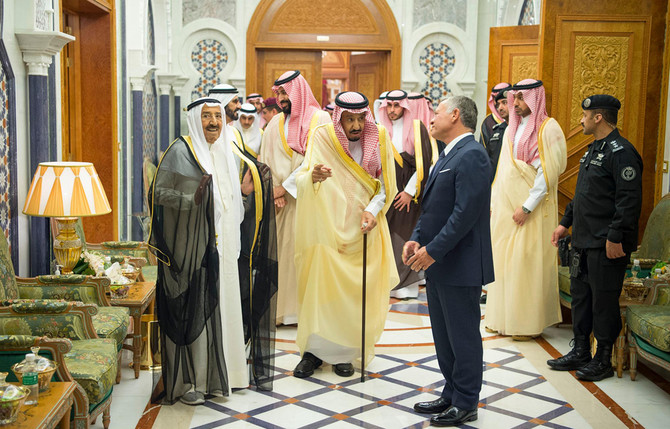
Saudi King Salman (left) meeting with Jordan's King Abdullah II (center), UAE Prime Minister Sheikh Mohammed bin Rashid (right) and Kuwaiti Emir Sheikh Sabah Al-Ahmad Al-Jaber Al-Sabah (back toward the camera) at the Safa Palace in Makkah early Monday. (SPA)
2 / 5
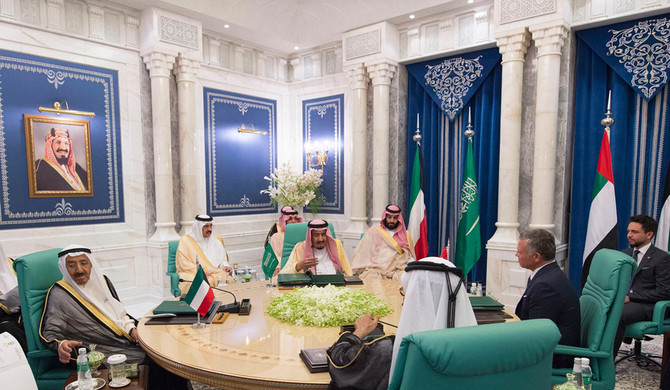
Clockwise from left: Kuwaiti Emir Sheikh Sabah Al-Ahmad Al-Jaber Al-Sabah, Saudi King Salman, Jordan's King Abdullah II and UAE Prime Minister Sheikh Mohammed bin Rashid (back toward the camera). (SPA)
3 / 5
Left to right: UAE Prime Minister Sheikh Mohammed bin Rashid, Kuwaiti Emir Sheikh Sabah Al-Ahmad Al-Jaber Al-Sabah, Saudi King Salman and Jordan's King Abdullah II during a meeting at the Safa Palace in Makkah early Monday. (SPA)
4 / 5
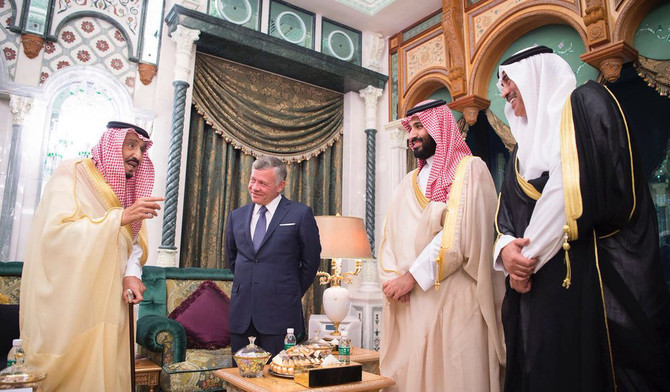
Jordan's King Abdullah II, Saudi Crown Prince Mohammed bin Salman and Kuwaiti Foreign Minister Sabah Al Khalid Al Sabah listen as King Salman speaks at the close of the Makkah Summit early Monday. (SPA)
5 / 5
Aftermath of the summit. (SPA)
Updated 11 June 2018
Follow

Saudi Arabia, Kuwait and UAE approve $2.5bn aid package for Jordan at emergency Gulf summit

  • The package will include a deposit in the Jordanian central bank, World Bank guarantees, budgetary support over five years and financing for development projects.
  • King Salman called the meeting to muster support for ally Jordan, which had been rocked by mass protests against price rises and a proposed tax hike in recent days.

JEDDAH: Saudi Arabia, Kuwait and the United Arab Emirates agreed on Monday to provide an economic aid package worth $2.5 billion for Jordan, which is facing an economic crisis following anti-austerity protests.

The package, announced at a summit of the four nations in the holy city of Makkah, will include a deposit in the Jordanian central bank, World Bank guarantees, budgetary support over five years and financing for development projects, said a summit communique carried by the Saudi Press Agency.

The summit, called by Saudi King Salman, was attended by Jordan’s King Abdullah II along with UAE's Prime Minister Sheikh Mohammed bin Rashid Al-Maktoum and Kuwaiti Emir Sheikh Sabah Al-Ahmad Al-Jaber Al-Sabah.

King Salman called the meeting to garner support for ally Jordan, which had been rocked by mass protests against price rises and a proposed tax hike in recent days.

The statement noted that funding for Jordan's economic crisis comes from contributory funds for development projects in the Kingdom.

Following the meeting, King Abdullah II offered his gratitude to King Salman, Kuwait and the UAE for their support. Jordan is struggling to curb its debt after securing a $723 million loan from the International Monetary Fund (IMF) in 2016.

Austerity measures tied to the loan have seen prices of basic necessities rise across the Kingdom of Jordan — culminating in a week of angry protests over tax proposals that forced prime minister Hani Mulki to resign.

The authorities on Thursday announced they were withdrawing the unpopular legislation, but still face a mammoth task to balance popular demands with the need to reduce the public debt burden.

Jordan blames its economic woes on instability rocking the region and the burden of hosting hundreds of thousands of refugees from war-torn Syria, complaining it has not received enough international support.

The World Bank says Jordan has “weak growth prospects” this year, while 18.5 percent of the working age population is unemployed.
Saudi Arabia and the United States are two of the major donors providing vital economic assistance to Jordan.

(With AFP and Reuters)


Saudi deputy FM attends OIC ministers’ meeting on Somalia situation

Updated 11 January 2026
Follow

Saudi deputy FM attends OIC ministers’ meeting on Somalia situation

JEDDAH: Saudi Arabia Vice Minister of Foreign Affairs Waleed Elkhereiji has reaffirmed the Kingdom’s full support for Somalia’s sovereignty, unity and territorial integrity, while strongly rejecting any actions that undermine the country’s stability.

Speaking at an extraordinary meeting of foreign ministers from member states of the Organization of Islamic Cooperation, Elkhereiji condemned the declaration of mutual recognition between Israeli occupation authorities and the Somaliland region, describing it as a unilateral separatist move that violated international law, the UN Charter and the OIC Charter.

He stressed the Kingdom’s categorical rejection of any attempts to impose parallel entities that contradict Somalia’s unity and territorial integrity, or that seek to divide or diminish its sovereignty. Elkhereiji also reiterated Saudi Arabia’s support for Somalia’s legitimate state institutions and its commitment to preserving the country’s stability and the security of its people.

Elkhereiji called on the OIC and its member states to adopt a firm and unified Islamic position rejecting any recognition of, or engagement with, separatist entities in Somalia. He urged coordinated action in international forums to affirm Somalia’s unity and prevent what he described as dangerous precedents that could threaten the sovereignty of OIC member states.

He further called for holding the Israeli entity fully responsible for any political or security consequences resulting from such actions, and for rejecting any cooperation arising from the declaration of mutual recognition.

During the meeting, he also reiterated the Kingdom’s position on the Palestinian cause, emphasizing its centrality and Saudi Arabia’s support for efforts to secure a ceasefire in the Gaza Strip. He said this would enable the Palestinian people to exercise their right to self-determination and establish an independent state along the 1967 borders, with East Jerusalem as its capital.