Peace burgers with kimchi feed frenzy for Trump-Kim’s Singapore summit

1 / 2
Restaurants in Singapore gear up for Tuesday's meeting between US President Donald Trump and North Korean leader Kim Jong Un by serving up Kim and Trump-themed dishes. (Arab News photos)
2 / 2
Singapore's Prime Minister Lee Hsien Loong gestures towards the media as he meets with North Korea's leader Kim Jong Un at the Istana in Singapore on June 10, 2018. (REUTERS/Edgar Su)
Updated 11 June 2018
Follow

Peace burgers with kimchi feed frenzy for Trump-Kim’s Singapore summit

  • Restaurants in Singapore cook up fusion dishes ahead of the historic summit, symbolizing the hope of reaching reconciliation through food
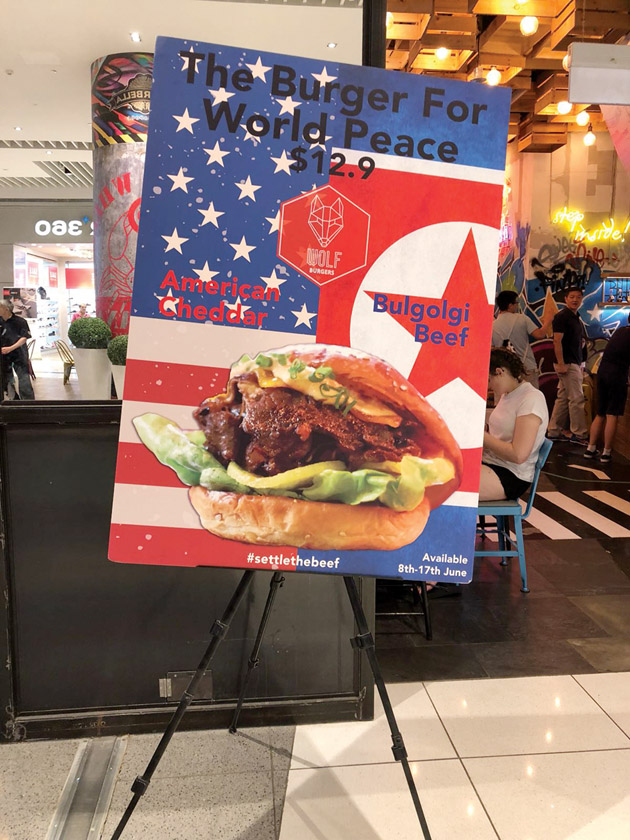
  • A personal invitation has also been sent to Trump and Kim inviting them to taste “The Burger for World Peace,” the restaurant’s blend of US and Korean flavors using bulgogi, kimchi mayo and US sharp cheddar.

SINGAPORE: There’s a buzz in the air as restaurants in Singapore gear up for the much-anticipated meeting between US President Donald Trump and North Korean leader Kim Jong Un on Tuesday, dishing up Korean “fire meat” burgers with a side of kimchi mayo and American cheese.

On social media local fast-food restaurant Wolf Burgers has urged the two leaders to #SettleTheBeef. 

A personal invitation has also been sent to Trump and Kim inviting them to taste “The Burger for World Peace,” the restaurant’s blend of US and Korean flavors using bulgogi (Korean grilled beef, meaning literally fire meat), kimchi mayo and US sharp cheddar.

“I don’t know if they actually saw it, or if they will acknowledge it, but it would be really, really awesome if they did,” said Sarah Lin, the 32-year-old head chef and co-owner of Wolf Burgers, who came up with the idea.

The limited edition burger has stirred a lot of interest among Wolf’s customers, she said, adding: “It has definitely helped put Wolf Burgers out there, especially since we are a home-grown brand, so it has helped us on an international level.”

As more than 3,000 journalists from all over the world descend on the city-state of Singapore to cover the denuclearization talks between Washington and Pyongyang, all eyes will be on the luxurious Capella Hotel on the resort island of Sentosa. Here, for the first time in history, a sitting US president will meet a North Korean leader face-to-face. 

“I think it’s fantastic that this ‘peace conference’ is happening here,” said James Cheah, a British diner at Wolf Burgers. “It’s a wonderful opportunity for Singapore to prove to the world that it’s a hub not just for finance and tech opportunities, but also on the political stage,” said Cheah.

“Do I think the talks are going to be successful? I think they are going to be as successful as the combination of bulgogi beef and American cheddar cheese. I think it’s going to be a terrible mess,” he said. 

“Whatever happens, which I think will be very little, it will be a huge propaganda win for North Korea and my heart bleeds for the North Koreans.”
His friend Hugh McKee, an Irish engineer who has been living here for four years, admitted he was neither a Trump fan, nor was he familiar with North Korean politics.

“I don’t know what’s to come, but definitely, Singapore’s going to be a winner,” he said. He thinks the high-profile event will “put Singapore on the world map for future conferences.” Maybe Round Two of a Trump-Kim summit? Or perhaps the Canadians, Mexicans and Europeans will also be looking to meet Trump here, he said, tongue-in-cheek.

Wolf Burgers is not the only restaurant to be joining the summit frenzy. Over at Harmony Nasi Lemak restaurant, the crew spent a month researching, before coming up with their fusion dish. The Trump Kim-chi Nasi Lemak not only combines the flavors of American dry-aged beef with fried Korean kimchi, it also blends together the tastes of Singapore’s Indian, Chinese, Malay and Eurasian cultures.

Its Singaporean co-founder, Zach Wen, explained: “We wanted to make Trump feel welcome, and because he has been very protective of beef exports from the US, we decided to use American beef in our dish.”

To pay tribute to Singapore’s four main ethnic groups, the dish uses Indian basmati rice cooked in Chinese chicken soup, combined with traditional Malay homemade sambal chilli, topped with a European sunny-side-up egg, fried to a crisp.
“This forms the foundation of Singapore,” the 34-year-old said philosophically, “and as Singapore holds the summit, it holds together the beef symbolizing the US and the kimchi, symbolizing North Korea.”

But what happened when Trump canceled the Singapore summit?

“We continued to brainstorm, because it was not perfect. We didn’t give up,” he told Arab News.

As Trump has always been known to be a good dealmaker, Wen is hoping the US President will “close the deal.”

“In Southeast Asia, a lot of people think this is a joke, but it’s not a joke. Nuclear is a serious thing and the Koreans and Japanese feel it more than us.”

Asked if he would be watching the summit live on Tuesday morning, when Trump and Kim finally meet, he replied with a laugh: “I think I need some sleep.”


Sheikha Al-Mayassa talks cultural patronage at Art Basel Qatar Conversations panel

Updated 04 February 2026
Follow

Sheikha Al-Mayassa talks cultural patronage at Art Basel Qatar Conversations panel

DOHA: Cultural leaders at the inaugural edition of Art Basel Qatar in Doha have discussed how patronage is reshaping art ecosystems, with Qatar’s own long-term cultural vision at the center.

The opening panel, “Leaders of Change: How is patronage shaping new art ecosystems?” brought together Sheikha Al-Mayassa bint Hamad bin Khalifa Al-Thani, chair of Qatar Museums, and Maja Hoffmann, founder and president of the Luma Foundation, in a discussion moderated by Hans Ulrich Obrist, artistic director of the Serpentine Galleries in London. The talk formed part of the Art Basel Conversations x Qatar Creates Talks program, coinciding with the debut of Art Basel Qatar which runs in Doha until Feb. 8.

Sheikha Al-Thani framed Qatar’s cultural project as a strategic, long-term endeavor anchored in national development. “Qatar has a national vision called 2030 where culture was one of the main pillars for socioeconomic development and human development,” she said. “We have always invested in culture as a means of human development.”

That vision, she explained, underpins the decision to welcome a major international fair like Art Basel to Doha after turning away many previous proposals.

“For the longest time, I can’t tell you how many art fairs came to us wanting to be here, and we never felt it was the right time,” she said. “However, this is an important year for us and we felt, with the surplus of talent and the growing gallery scene we had here, that it was time to bring industry to talent, because that’s how we will spur the economic diversification from hydrocarbon to a knowledge-based society.”

She was also keen to stress that Art Basel Qatar was not conceived as a conventional marketplace.

 “This is not your typical art fair … It’s a humane art fair where engagement is more important than transaction, discourse more important than division, and curiosity more important than conviction,” she added.

That ethos extends to the fair’s artistic leadership. Al-Thani described how the decision to have an artist — Wael Shawky — serve as artistic director emerged collaboratively with Art Basel’s team.

“He’s a global artist who’s now become a very local artist, very invested in our local art scene. And really, I think that’s the beauty of partnerships … There is a safe space for us to critique each other, support each other, and really brainstorm all the possibilities … and then come to a consensus of what would make sense for us,” she said.

Collecting art, she added, has long been embedded in Qatari society: “My grandmother is almost 100 years old. She was collecting in the 60s when Qatar was a very poor country. It’s in our DNA … always with this notion of investing in knowledge and human development.”

Today, that impulse translates into comprehensive, multi-disciplinary collections: “We are both collecting historical objects, contemporary objects, modern objects, architecture, archival material, anything that we feel is relevant to us and the evolution of this nation towards a knowledge-based economy.”

Looking ahead, Al-Thani outlined a new cultural triangle in Doha — the National Museum of Qatar, the Museum of Islamic Art and the forthcoming Art Mill Museum — as engines for both economic diversification and intellectual life.

 “That ecosystem will enhance the economic growth and diversification, but also the knowledge that’s available, because the diversity in the collections between these three institutions will no doubt inspire young people, amateurs, entrepreneurs to think outside the box and inform their next business,” she said.

The panel closed with a focus on the future of large-scale exhibitions with Rubaiya, Qatar’s new quadrennial, timed to coincide with the anniversary of the 2022 World Cup.

“Every four years in memory of the opening of the World Cup, we will open the quadrennial. This year, the theme is ‘Unruly Waters.’ At the center of the theme is Qatar’s trading route to the Silk Road,” explained Al-Thani.

“It’s important for us to trace our past and claim it and share it to the rest of the world, but also show the connectivity that Qatar had historically and the important role it has been playing in diplomacy.”