

Frustrated Afghans in a long march for peace

1 / 4
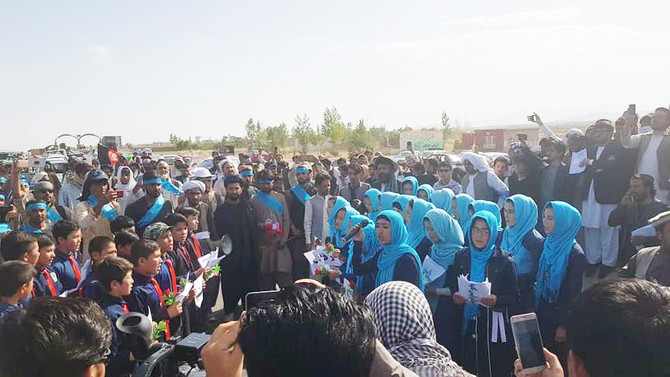
The “convoy of peace” was conceived in March by villagers in the southern Helmand province. (Photo courtesy: Iqbal Khaibar, an organizer of the march)
2 / 4
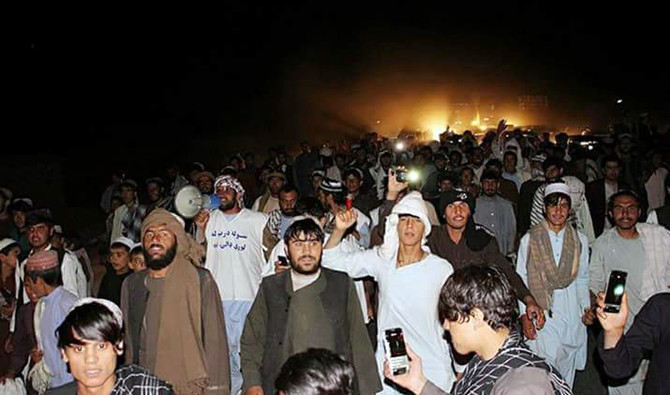
The “convoy of peace” was conceived in March by villagers in the southern Helmand province. (Photo courtesy: Iqbal Khaibar, an organizer of the march)
3 / 4
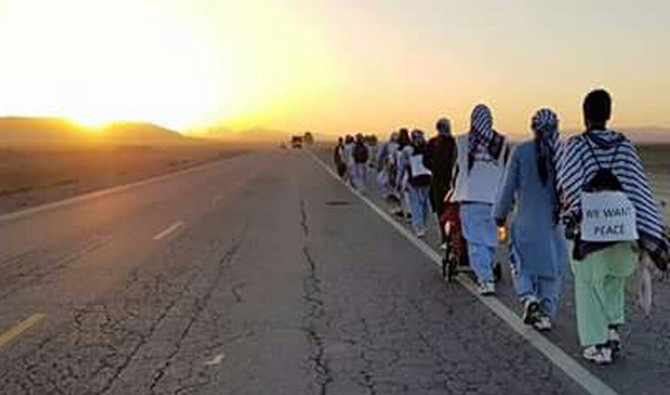
The “convoy of peace” was conceived in March by villagers in the southern Helmand province. (Photo courtesy: Iqbal Khaibar, an organizer of the march)
4 / 4
The “convoy of peace” was conceived in March by villagers in the southern Helmand province. (Photo courtesy: Iqbal Khaibar, an organizer of the march)
Updated 10 June 2018
Follow

Frustrated Afghans in a long march for peace

  • For weeks, a growing group has walked from Helmand to neighboring provinces to mobilize public pressure on the government and the Taliban to end the war. 
  • The group plans to march to Kabul to pass on a proposal to the government, the UN and the US-led coalition. Most of the marchers have lost at least one family member to the war.   

KABUL: Under blistering sun, a group of fasting Afghans has been marching for peace for nearly a month, mobilizing people in villages and towns.

The “Convoy of Peace” was conceived in March by villagers in southern Helmand province, after more than a dozen people were killed when an explosives-laden vehicle went off during a wrestling match as part of Afghan new-year celebrations.

The villagers walked for nearly 200 km to talk with government commanders and Taliban members to agree to a truce.

When their message fell on deaf ears, they set up a sit-in tent, then began a nationwide march at the start of Ramadan. 

Braving the heat and attacks, the group has marched from Helmand to the adjacent provinces of Kandahar, Zabul and Ghazni.

The route is part of a Taliban stronghold, and witnesses routine clashes between it and US-backed Afghan forces.

The marchers “have been welcomed by villagers who give them food, shelter and medical care,” Roozi Mohammad Zabuli, a coordinator of civil society groups in Zabul, told Arab News.

“They’re telling the people that peace is in the hands of ordinary people, and that they can achieve it by putting pressure on the warring sides. People are exhausted here and thirsty for peace, and have hailed the initiative.” 

The march began with seven people but now includes 50. One is a sports champion, another has a master’s degree, and two are physically disabled.

Sardar Mohammad re-joined the march after leaving to attend the funeral of his brother, who was killed in an attack in Kandahar. Most of the marchers have lost at least one family member to the war.

Hamidullah Tokhi, a lawmaker from Zabul, said the group prefers to avoid engaging with local authorities because it does not want to be seen to be favoring one side.

“It’s a big initiative. People are happy. You’ll see a gradual but concrete impact on the minds of people that they have to take charge of their own destiny rather than wait for others to bring them peace,” he told Arab News.

“We can call it the start of a revolution. Revolutions always begin with a small number of people and ambitious goals. They have the determination and will to work for peace.”

Government officials and the Taliban endorse the march, saying they will support any move than can bring security to Afghanistan.

The marchers plan to head to Kabul to pass on a proposal to the government, the UN and the US-led coalition for a cease-fire, the establishment of an Islamic government that includes the Taliban, and a timetable for the withdrawal of foreign forces.

“If the two sides don’t accept our demands, we’ll go to other provinces and tell people to join us and mount pressure on who’s at fault,” Iqbal Khaibar, an organizer of the march, told Arab News.

In Kabul, “we’ll be telling the international community humbly: ‘We’re human just like you. All our mothers are mourning here every day. Do your mothers and your blood differ from ours? Let us have peace’,” he added.

Zabuli said: “When there’s national pressure, foreign troops will pull out. We just need to give people the mentality that they have to stand and take charge of their lives and stop the war.”

Khaibar said: “The Taliban says foreign troops should leave then it’ll talk with the government, while foreign troops say there should be peace then they’ll leave. We have to find a solution to this, and that’s exactly what the marchers are after.”


Hundreds in London protest against Beijing ‘mega embassy’

Updated 3 sec ago
Follow

Hundreds in London protest against Beijing ‘mega embassy’

  • Protesters, their faces mostly covered with scarves or masks, chanted “No to Chinese embassy“
  • The latest protest came ahead of an expected decision this week

LONDON: Hundreds of people on Saturday rallied in London against Beijing’s controversial new “mega” embassy, days ahead of a decision on the plan.
Protesters, their faces mostly covered with scarves or masks, chanted “No to Chinese embassy” and waved flags reading “Free Hong Kong. Revolution now.”
Others held up placards with slogans such as “MI5 warned. Labour kneeled,” referring to the UK’s domestic intelligence agency and Prime Minister Keir Starmer’s ruling party.
Others read: “CCP (Chinese Communist Party) is watching you. Stop the mega embassy.”
China has for several years been trying to relocate its embassy, currently in the British capital’s upmarket Marylebone district, to the sprawling historic site in the shadow of the Tower of London.
The move has sparked fierce opposition from nearby residents, rights groups and critics of China’s ruling Communist Party.
The latest protest came ahead of an expected decision this week.
Benedict Rogers, head of the human rights group Hong Kong Watch said if it got the go-ahead it was “highly likely” that the site “will be used for espionage,” citing the sensitive underground communications cables close to the site.
He said China had already been “carrying out a campaign of transnational repression against different diaspora communities” and other critics and predicted that that would “increase and intensify.”

Beijing ‘operations base’ -

A protester who gave his name only as Brandon, for fear of reprisals, said the plans raised a “lot of concerns.”
The 23-year-old bank employee, originally from Hong Kong but now living near Manchester in northwestern England, said many Hong Kongers had moved to the UK “to avoid authoritarian rule in China.”
But they now found there could be an embassy in London serving as an “operations base” for Beijing.
“I don’t think it’s good for anyone except the Chinese government,” he said.
Another demonstrator, who did not to give her name, called on Starmer to “step back and stop it (the plan) because there is a high risk to the national security of the UK, not only Hong Kongers.”
The 60-year-old warehouse worker, also originally from Hong Kong and now living in Manchester, said the embassy would be a “spy center not only to watch the UK but the whole of Europe.”
Speakers at the rally throwing their weight behind the campaign to stop the embassy included Kemi Badenoch, leader of the main opposition Conservative Party.
British MPs voiced major security concerns earlier this week after a leading daily reported the site would house 208 secret rooms, including a “hidden chamber.”
The Daily Telegraph said it had obtained unredacted plans for the vast new building which would stand on the historical site of the former Royal Mint.
It showed that Beijing reportedly plans to construct a single “concealed chamber” among “secret rooms” underneath the embassy which would be placed alongside the underground communications cables.