

‘This is why we protest’: Jordan family struggles in tough economy

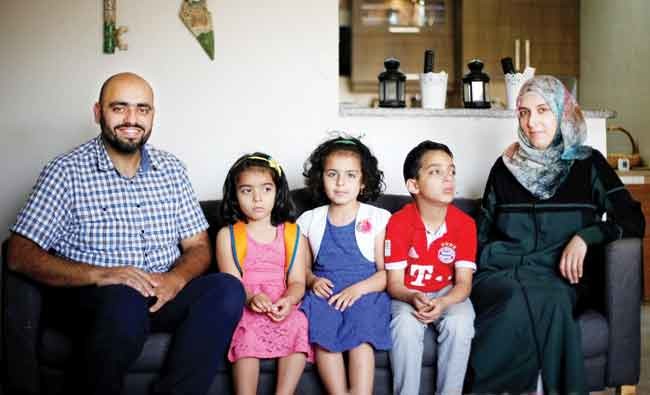
Ahmad Samara and Bayan Samara are struggling to keep their family afloat in Jordan’s sluggish economy. Reuters
Updated 09 June 2018
Follow

‘This is why we protest’: Jordan family struggles in tough economy

  • Public anger has grown since the end of bread subsidies and a rise in the general sales tax this year under an IMF plan
  • Jordan a US ally that has mostly escaped the turmoil that is rocking much of the region.

AMMAN: Bayan Samara’s children often asked her why she could not buy them new clothes or toys. So the Jordanian teacher took them to a rally in the capital.
“It breaks my heart,” she said in her living room in Amman. “So we help them understand that these are tough times, because we have a government that includes ‘bad guys’, like my son says.”
Samara, 30, and her husband Ahmad are struggling to keep their family afloat in Jordan’s sluggish economy.
Along with thousands of young people and families, they have hit the streets in a rare wave of protests that led the prime minister to resign on Monday.
In the past two years, steep price hikes forced the couple to move their children into lower quality public schools and to slash their health insurance. Together, they barely make enough to cover housing loans and daily expenses for their son and two daughters, ages 6 to 8, Samara said.
They blame a build-up of economic policies and tax reforms, which have sparked the biggest protests in years in Jordan, a US ally that has mostly escaped the turmoil that is rocking much of the region.

Public anger has grown since the end of bread subsidies and a rise in the general sales tax this year under an IMF plan to cut the Arab nation’s $37 billion debt.
“I’m worried that despite all this hope, things will stay exactly the same,” Samara said. “People are under pressure. There’s a feeling of defeat in the family.”
“At the end of the day, we had to make do with the reality,” she added. “This is why we protest, for a better future for our children, for us.”

‘Afraid of change’
The government has said it needs funds for public services and says the reforms would reduce social disparities. Critics accuse it of squandering public money, on top of imposing policies that hit the poor and squeeze the middle class.
“My dream was to build myself in this country that I love,” said Ahmad, who sells vending machines but whose business is plagued by bribery and low demand.
After staying in Saudi Arabia for years, he came home to Amman to launch his own business and live closer to relatives. Now, he fears having to go abroad again.
Jordan’s King Abdullah urged broad talks over taxes this week after replacing his premier to defuse public frustration.
The king appointed Omar Al-Razzaz, a former World Bank economist, who said on Thursday he would drop a planned income tax law — a main demand of the demonstrators.
Some protests have dwindled since then as people welcomed the move and said they would wait to see if the new cabinet would help stop price hikes.
But for others, like Ahmad and his wife, the root of their troubles will not go away without deeper, democratic change in government, they say.
“There is some optimisim...but this is about the approach in running the country,” Ahmad said. “(Razzaz) alone can not change this even though he is a very competent man.”
He said they did not want the upheaval that the 2011 uprisings trigerred in other Arab countries, but only sought to pressure the new government to make better decisions.
At a late night rally near the Cabinet office this week, hundreds of people around Ahmad waved flags and chanted: “Bread, freedom, social justice.”
“I brought my children with me so they will know there is a possiblity for change,” he said. “I don’t want them to be afraid of change.”


First responders enter devastated Aleppo neighborhood after days of deadly fighting

Updated 12 January 2026
Follow

First responders enter devastated Aleppo neighborhood after days of deadly fighting

  • The US-backed SDF, which have played a key role in combating the Daesh group in large swaths of eastern Syria, are the largest force yet to be absorbed into Syria’s national army

ALEPPO, Syria: First responders on Sunday entered a contested neighborhood in Syria’ s northern city of Aleppo after days of deadly clashes between government forces and Kurdish-led forces. Syrian state media said the military was deployed in large numbers.
The clashes broke out Tuesday in the predominantly Kurdish neighborhoods of Sheikh Maqsoud, Achrafieh and Bani Zaid after the government and the Syrian Democratic Forces, the main Kurdish-led force in the country, failed to make progress on how to merge the SDF into the national army. Security forces captured Achrafieh and Bani Zaid.
The fighting between the two sides was the most intense since the fall of then-President Bashar Assad to insurgents in December 2024. At least 23 people were killed in five days of clashes and more than 140,000 were displaced amid shelling and drone strikes.
The US-backed SDF, which have played a key role in combating the Daesh group in large swaths of eastern Syria, are the largest force yet to be absorbed into Syria’s national army. Some of the factions that make up the army, however, were previously Turkish-backed insurgent groups that have a long history of clashing with Kurdish forces.
The Kurdish fighters have now evacuated from the Sheikh Maqsoud neighborhood to northeastern Syria, which is under the control of the SDF. However, they said in a statement they will continue to fight now that the wounded and civilians have been evacuated, in what they called a “partial ceasefire.”
The neighborhood appeared calm Sunday. The United Nations said it was trying to dispatch more convoys to the neighborhoods with food, fuel, blankets and other urgent supplies.
Government security forces brought journalists to tour the devastated area, showing them the damaged Khalid Al-Fajer Hospital and a military position belonging to the SDF’s security forces that government forces had targeted.
The SDF statement accused the government of targeting the hospital “dozens of times” before patients were evacuated. Damascus accused the Kurdish-led group of using the hospital and other civilian facilities as military positions.
On one street, Syrian Red Crescent first responders spoke to a resident surrounded by charred cars and badly damaged residential buildings.
Some residents told The Associated Press that SDF forces did not allow their cars through checkpoints to leave.
“We lived a night of horror. I still cannot believe that I am right here standing on my own two feet,” said Ahmad Shaikho. “So far the situation has been calm. There hasn’t been any gunfire.”
Syrian Civil Defense first responders have been disarming improvised mines that they say were left by the Kurdish forces as booby traps.
Residents who fled are not being allowed back into the neighborhood until all the mines are cleared. Some were reminded of the displacement during Syria’s long civil war.
“I want to go back to my home, I beg you,” said Hoda Alnasiri.