Airbus set to close deal for majority stake in Bombardier Cseries

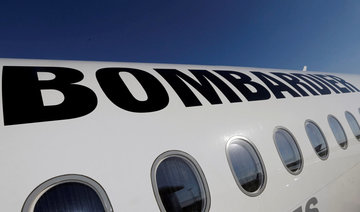
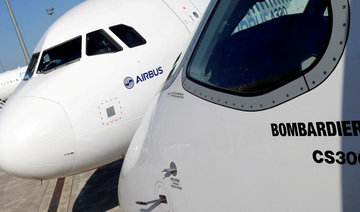
Above, an Airbus A320neo aircraft and a Bombardier CSeries aircraft are park in Colomiers near Toulouse in October 2017, during the announcement of Bombardier’s sale to Airbus a 50.01 percent stake in its flagship commercial jet for a symbolic Canadian dollar. (Reuters)
Updated 08 June 2018
Follow

Airbus set to close deal for majority stake in Bombardier Cseries

SYDNEY: Airbus is set to close a deal to take a controlling stake in Bombardier Inc’s CSeries jetliner program, effective July 1, the companies said on Friday, in a move expected to kickstart the European planemaker’s ability to put its marketing and cost-cutting muscle into the Canadian plane program.
Bombardier agreed in October to sell Airbus a 50.01 percent stake in its flagship commercial jet for a symbolic Canadian dollar, as the plane program battled sluggish sales and low production, which made it harder to keep a lid on costs.
Airbus, by contrast, will be able to offer airlines deals by packaging the CSeries with its own jets and is expected to use its purchasing prowess to drastically cut the price of parts, along with improving efficiencies internally.
Bombardier will now own about 31 percent, while Investissement Quebec, the investment arm of the province of Quebec, will hold a 19 percent stake.
The Quebec government, through its financing arm, took a 49 percent stake in the CSeries program in 2015 for $1 billion. Quebec’s share, most recently worth 38 percent, slipped to 19 percent following the deal with Airbus.


European gas prices soar almost 50% as Iran conflict halts Qatar LNG output

Updated 02 March 2026
Follow

European gas prices soar almost 50% as Iran conflict halts Qatar LNG output

  • Analysts warn prolonged disruption could push prices higher
  • Some shipments of oil, LNG through Strait of Hormuz suspended
  • Benchmark Asian LNG price up almost 39 percent

LONDON: ​Benchmark Dutch and British wholesale gas prices soared by almost 50 percent on Monday, after major liquefied natural gas exporter Qatar Energy said it had halted production due to attacks in the Middle East.

Qatar, soon to cement its role as the world’s second largest LNG exporter after the US, plays a major role in balancing both Asian and European markets’ demand of LNG.

Most tanker owners, oil majors and ‌trading houses ‌have suspended crude oil, fuel and liquefied natural ​gas shipments ‌via ⁠the ​Strait of ⁠Hormuz, trade sources said, after Tehran warned ships against moving through the waterway.

Europe has increased imports of LNG over the past few years as it seeks to phase out Russian gas following Russia’s invasion of Ukraine.

Around 20 percent of the world’s LNG transits through the Strait of Hormuz and a prolonged suspension or full closure would increase global competition for other ⁠sources of the gas, driving up prices internationally.

“Disruptions to ‌LNG flows would reignite competition between ‌Asia and Europe for available cargoes,” said ​Massimo Di Odoardo, vice president, gas ‌and LNG research at Wood Mackenzie.

The Dutch front-month contract at the ‌TTF hub, seen as a benchmark price for Europe, was up €14.56 at €46.52 per megawatt hour, or around $15.92/mmBtu, by 12:55 p.m. GMT, ICE data showed.

Prices were already some 25 percent higher earlier in the day but extended gains ‌after QatarEnergy’s production halt.

Benchmark Asian LNG prices jumped almost 39 percent on Monday morning with the S&P Global ⁠Energy Japan-Korea-Marker, widely used ⁠as an Asian LNG benchmark, at $15.068 per million British thermal units, Platts data showed.

“If LNG/gas markets start to price in an extended period of losses to Qatari LNG supply, TTF could potentially spike to 80-100 euros/MWh ($28-35/mmBtu),” Warren Patterson, head of commodities strategy at ING, said. The British April contract was up 40.83 pence at 119.40 pence per therm, ICE data showed.

Europe is also relying on LNG imports to help fill its gas storage sites which have been depleted over the winter and are currently around 30 percent full, the latest data from Gas Infrastructure ​Europe showed. In the European carbon ​market, the benchmark contract was down €1.10 at €69.17 a tonne