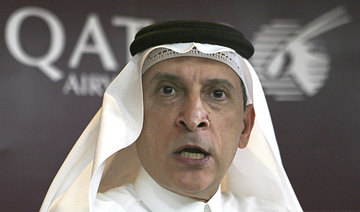
Qatar Airways boss apologizes for remarks on women CEOs

Qatar Airways chief executive Akbar Al-Baker, foreground, took back his comments on why women could not do his job, for which International Air Transport Association chief executive Alexandre de Juniac, background, said the airline chief has expressed his apologies. (AFP)
Updated 06 June 2018
Follow

Qatar Airways boss apologizes for remarks on women CEOs

SYDNEY: The head of Qatar Airways apologized on Wednesday for saying that a woman could not do his job, while global airlines pledged to speed up efforts to break down gender imbalances in aviation.
Qatar Airways Chief Executive Akbar Al-Baker said his remarks at the closing of a global airlines gathering on Tuesday had been intended as a joke and taken out of context.
He defended his airline’s record of gender diversity, saying 44 percent of its staff were female including some in senior positions.
“Quite frankly I think the press took it out of context. They ... blew it out of proportion. It was just a joke...I apologize for it,” Al-Baker told a CAPA-Center for Aviation conference in Sydney.
Asked on Tuesday about female employment among Middle East airlines and why his job as CEO could not be done by a woman, Al-Baker had said: “Of course it has to be led by a man because it is a very challenging position.”
He made the comments at a news conference following a meeting of airlines group International Air Transport Association (IATA), moments after being elected its chairman.
The remarks drew criticism on social media.
The issue of gender imbalance in aviation was a hot topic at the three-day annual meeting of IATA — only six of whose 280-member airlines, or 2 percent, have female chief executives.
Al-Baker later said Qatar Airways was the first carrier in the Middle East to have female pilots.
On Wednesday, the director-general of IATA noted that Al-Baker had earlier apologized for his comments.
“But the immediate reaction illustrated that expectations for change are high. And it is absolutely clear that aviation has a lot of work to do on gender balance at senior levels,” Alexandre de Juniac added in a blog on IATA’s website.
Al-Baker is one of the airline industry’s most outspoken figures, known for provocative and often humorous criticism of rival airlines or suppliers, but he has also drawn criticism over the judgment of some of his declarations.
In 2017 he apologized after calling US flight attendants “grandmothers” during a trade row with US airlines, prompting an airline union to accuse him of sexism and age discrimination.
In 2014, Qatar Airways defended policies on pregnancy and marriage for cabin crew after coming under fire over working conditions in the conservative Gulf emirate.
Asked at Wednesday’s CAPA conference whether he truly believed that only a man could do his job, Al-Baker said, “No, I don’t believe that. As a matter of fact (at) Air Italy the majority shareholder has shortlisted women to be CEO and as minority shareholder we are actively encouraging that.”
Sharing a podium, Willie Walsh, the head of British Airways owner IAG, said the industry had a long way to go in promoting women, starting with IATA, a quasi-international organization with two women on its 31-person board.
“This whole debate should encourage more,” Walsh said.
“If you look at the board it is predominantly middle-aged white men from Europe. We have more diversity on the board now than we have had for a long time, and we have to strive to improve that situation.”
Al-Baker pledged to bring more women onto IATA’s board, but said there had been few applicants. Board members must be a CEO. IATA says just 3 percent of airlines have a female leader.
Delegates said seats are also divided up by region, meaning some national airlines may have to release influential board seats to favor a female candidate from their own region, but a woman in one region could not benefit from a vacancy in another.
“Bridging the gap at senior levels will not be simple,” de Juniac wrote.
The gender row comes amid a deeper debate about whether airlines based on different national social models, recruitment policies and wage structures can compete on equal terms.
US and some European airlines have accused Gulf carriers of unfair competition based on subsidies and social policies, but Walsh — whose group counts Qatar Airways as a shareholder — said he believed Gulf airlines competed on an equal footing.


First EU–Saudi roundtable on critical raw materials reflects shared policy commitment

Updated 16 January 2026
Follow

First EU–Saudi roundtable on critical raw materials reflects shared policy commitment

RIYADH: The EU–Saudi Arabia Business and Investment Dialogue on Advancing Critical Raw Materials Value Chains, held in Riyadh as part of the Future Minerals Forum, brought together senior policymakers, industry leaders, and investors to advance strategic cooperation across critical raw materials value chains.

Organized under a Team Europe approach by the EU–GCC Cooperation on Green Transition Project, in coordination with the EU Delegation to Saudi Arabia, the European Chamber of Commerce in the Kingdom and in close cooperation with FMF, the dialogue provided a high-level platform to explore European actions under the EU Critical Raw Materials Act and ResourceEU alongside the Kingdom’s aspirations for minerals, industrial, and investment priorities.

This is in line with Saudi Vision 2030 and broader regional ambitions across the GCC, MENA, and Africa.

ResourceEU is the EU’s new strategic action plan, launched in late 2025, to secure a reliable supply of critical raw materials like lithium, rare earths, and cobalt, reducing dependency on single suppliers, such as China, by boosting domestic extraction, processing, recycling, stockpiling, and strategic partnerships with resource-rich nations.

The first ever EU–Saudi roundtable on critical raw materials was opened by the bloc’s Ambassador to the Kingdom, Christophe Farnaud, together with Saudi Deputy Minister for Mining Development Turki Al-Babtain, turning policy alignment into concrete cooperation.

Farnaud underlined the central role of international cooperation in the implementation of the EU’s critical raw materials policy framework.

“As the European Union advances the implementation of its Critical Raw Materials policy, international cooperation is indispensable to building secure, diversified, and sustainable value chains. Saudi Arabia is a key partner in this effort. This dialogue reflects our shared commitment to translate policy alignment into concrete business and investment cooperation that supports the green and digital transitions,” said the ambassador.

Discussions focused on strengthening resilient, diversified, and responsible CRM supply chains that are essential to the green and digital transitions.

Participants explored concrete opportunities for EU–Saudi cooperation across the full value chain, including exploration, mining, and processing and refining, as well as recycling, downstream manufacturing, and the mobilization of private investment and sustainable finance, underpinned by high environmental, social, and governance standards.

From the Saudi side, the dialogue was framed as a key contribution to the Kingdom’s industrial transformation and long-term economic diversification agenda under Vision 2030, with a strong focus on responsible resource development and global market integration.

“Developing globally competitive mineral hubs and sustainable value chains is a central pillar of Saudi Vision 2030 and the Kingdom’s industrial transformation. Our engagement with the European Union through this dialogue to strengthen upstream and downstream integration, attract high-quality investment, and advance responsible mining and processing. Enhanced cooperation with the EU, capitalizing on the demand dynamics of the EU Critical Raw Materials Act, will be key to delivering long-term value for both sides,” said Al-Babtain.

Valere Moutarlier, deputy director-general for European industry decarbonization, and directorate-general for the internal market, industry, entrepreneurship and SMEs at European Commission, said the EU Critical Raw Materials Act and ResourceEU provided a clear framework to strengthen Europe’s resilience while deepening its cooperation with international partners.

“Cooperation with Saudi Arabia is essential to advancing secure, sustainable, and diversified critical raw materials value chains. Dialogues such as this play a key role in translating policy ambitions into concrete industrial and investment cooperation,” she added.