

Pashto cinema fighting to make a comeback

Pashto film is attempting a comeback after having suffered because of terrorism in the past decade. This year four new Pashto movies will be released. (AN photo)
Updated 04 June 2018
Follow

Pashto cinema fighting to make a comeback

  • Pashto Cinema suffered during the wave of terrorism in the past decade. This year four new Pashto films are to be released on the Eid festival

PESHAWAR: The Pakistan cinema industry is going through a difficult period but Pashto filmmakers are still reeling to keep the business alive.
“We are expecting to release four films for the upcoming Eid festival,” Shahid Khan, famous actor and director, told Arab News.
Eid-ul-Fitr is just round the corner now and Shahid Khan is busy editing his new release.
“My film is based on social issues, rivalry and romance.” These are old topics, Khan admitted, “but we have no other choice,” as people want to these see films.
“It is very difficult for us to go for experiments because new ideas demand more time and financial resources, whereas nobody from outside is willing to invest in the Pashto film industry,” Khan said.
“There was a time when we had dozens of movies on festivals, particularly on Eid. Now many of the filmmakers have either stopped making films or switched to other businesses.”
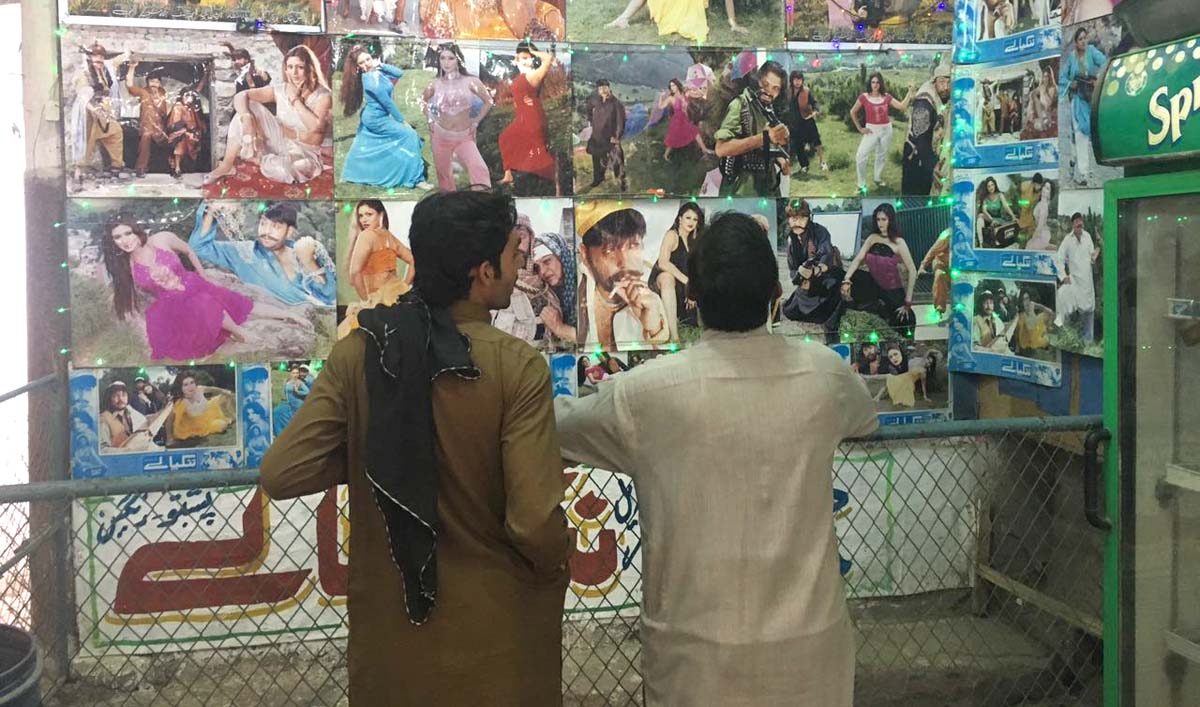


Pashto films still have an audience in cities such as Peshawar, Quetta, Banu, Karachi, Swat and Rawalpindi. (AN photo)

“We produced five films in 2015 and seven last year (2017). This year are able to bring only four in the market,” says Khan.
Other than financial constraints; during the wave of terrorism in the past decade films and other cultural festivities struggled all over Pakistan, particularly in northwestern parts of the country.
In recent years many owners have demolished cinemas that were decades old and constructed commercial plazas.
Habib-ur-Rehman has been associated with the film industry since 1978. He manages the Picture House cinema in Peshawar and complains that easy access to the Internet and mobile phones “shattered” the cinema business.
“People can find everything, whatever they like on their mobile phone screen,” added Rehman.
At the moment in Peshawar, only three cinemas are running new movies; the rest show old ones. Rehman said: “Most of the viewers are local people and Afghans,” adding that it is still a source of entertainment for some people.
“I’ve been in Peshawar for the past seven days. I was feeling weary so I came here to watch a film to kill the time,” Akbar Ullah, who belongs to the Kohat district, told Arab News.
“The beauty of watching a film is only at the cinema,” Hameed Khan, a regular Pashto film viewer, said.
“Movies were simple in our times. People came to watch our films with great enthusiasm. But after the 1980s the whole society became extremist, which also affected our film industry,” another film viewer told Arab News.
Faqeer Hussain, another manager who works at Naz cinema in Peshawar, said: “It takes at least three months to make a Pashto film. We are trying to put new story ideas, but that needs investment.”
Despite some challenges Shahid Khan is optimistic that his film will attract “a good crowd at Eid as usual.”



Imran Khan not a ‘national security threat,’ ex-PM’s party responds to Pakistan military

Updated 06 December 2025
Follow

Imran Khan not a ‘national security threat,’ ex-PM’s party responds to Pakistan military

  • Pakistan’s military spokesperson on Friday described Khan’s anti-army narrative as a “national security threat”
  • PTI Chairman Gohar Ali Khan says words used by military spokesperson for Khan were “not appropriate”

ISLAMABAD: Former prime minister Imran Khan’s Pakistan Tehreek-e-Insaf (PTI) party on Saturday responded to allegations by Pakistan military spokesperson Lt. Gen. Ahmed Sharif Chaudhry from a day earlier, saying that he was not a “national security threat.”

Chaudhry, who heads the military’s media wing as director general of the Inter-Services Public Relations (ISPR), spoke to journalists on Friday, in which he referred to Khan as a “mentally ill” person several times during the press interaction. Chaudhry described Khan’s anti-army narrative as a “national security threat.”

The military spokesperson was responding to Khan’s social media post this week in which he accused Chief of Defense Forces Field Marshal Asim Munir of being responsible for “the complete collapse of the constitution and rule of law in Pakistan.” 

“The people of Pakistan stand with Imran Khan, they stand with PTI,” the party’s secretary-general, Salman Akram Raja, told reporters during a news conference. 

“Imran Khan is not a national security threat. Imran Khan has kept the people of this country united.”

Raja said there were several narratives in the country, including those that created tensions along ethnic and sectarian lines, but Khan had rejected all of them and stood with one that the people of Pakistan supported. 

PTI Chairman Gohar Ali Khan, flanked by Raja, criticized the military spokesperson as well, saying his press talk on Thursday had “severely disappointed” him. 

“The words that were used [by the military spokesperson] were not appropriate,” Gohar said. “Those words were wrong.”

NATURAL OUTCOME’

Speaking to reporters earlier on Saturday, Pakistan’s Defense Minister Khawaja Asif defended the military spokesperson’s remarks against Khan.

“When this kind of language is used for individuals as well as for institutions, then a reaction is a natural outcome,” he said. 

“The same thing is happening on the Twitter accounts being run in his [Khan’s] name. If the DG ISPR has given any reaction to it, then I believe it was a very measured reaction.”

Khan, who was ousted after a parliamentary vote of confidence in April 2022, blames the country’s powerful military for removing him from power by colluding with his political opponents. Both deny the allegations. 

The former prime minister, who has been in prison since August 2023 on a slew of charges he says are politically motivated, also alleges his party was denied victory by the army and his political rivals in the 2024 general election through rigging. 

The army and the government both deny his allegations.