

Rohingya refugee crisis threatens biodiversity of Bangladesh’s Cox’s Bazar

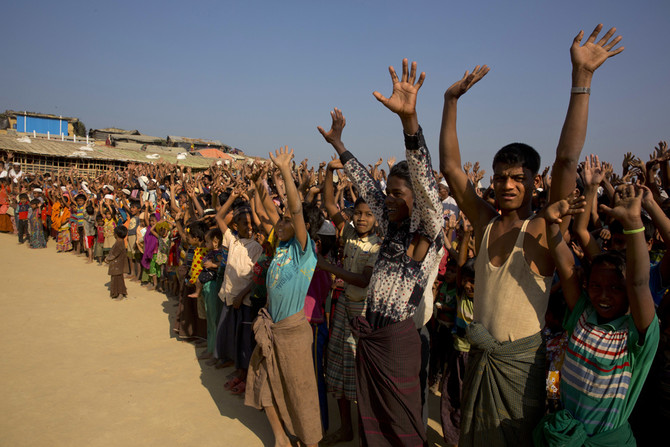
In this Jan. 22, 2018, file photo, Rohingya children and refugees raise their hands and shout that they won't go back to Myanmar during a demonstration at Kutupalong near Cox's Bazar, Bangladesh. Cutting of firewood by Rohingya refugees in Cox's Bazar is putting great stress to the region's biodiversity, according to a report. (AP Photo/Manish Swarup, File)
Updated 03 June 2018
Follow

Rohingya refugee crisis threatens biodiversity of Bangladesh’s Cox’s Bazar

  • 2,000 hectares of forestland has disappeared due to refugees cutting trees for firewood
  • Bangladesh government plans to start reforestation once 1,00,000 refugees are shifted to the new island Bhashan Char (Floating island).

DHAKA: Some 2,000 hectares of forestland — equivalent to four football fields — around Cox’s Bazar, Bangladesh, has disappeared due to Rohingya refugees cutting trees for firewood, according to a report by the Inter Sector Coordination Group (ISCG).

It added that 86 percent of drinking-water wells have been contaminated with the E.coli bacteria from fecal matter.

Due to the “extreme level” of deforestation, the area’s biodiversity has been jeopardized, said Saiful Islam, assistant director of the environmental office in Cox’s Bazar.

The government will implement a reforestation plan once 100,000 Rohingya are relocated to Bhashan Char island in the Bay of Bengal, he added. “This relocation process is supposed to start very soon,” he said.

Hosting more than one million Rohingya refugees from Myanmar “has created extraordinary pressure on our resources, as the population of Cox’s Bazar has more than doubled in a short span of time,” Islam added.

Rakibul Amin, country manager for the International Union for Conservation of Nature (IUCN), told Arab News: “Due to deforestation, the biodiversity of Cox’s Bazar is under severe threat.”

He added: “It has destroyed a popular corridor for wild elephants, increasing the number of man-animal encounters.” Some rare wildlife species are at risk due to the deforestation, he said.

Agricultural land near the refugee camps is facing siltation and contamination from fecal matter, according to the ISCG report.

Bishwajit Sen, an environmentalist in Cox’s Bazar, said: “This deforestation has made this coastal district more vulnerable to climate change.”

He added: “We should have done better and systematic management of the environment from the outset of the refugee crisis.”

To reduce dependence on firewood, some aid agencies have started arranging alternative fuel sources, the report said.


Bangladesh sends record 750,000 workers to Saudi Arabia in 2025

Updated 56 min 35 sec ago
Follow

Bangladesh sends record 750,000 workers to Saudi Arabia in 2025

  • Latest data shows 16% surge of Bangladeshis going to the Kingdom compared to 2024
  • Bangladesh authorities are working on sending more skilled workers to Saudi Arabia

DHAKA: Bangladesh sent over 750,000 workers to Saudi Arabia in 2025, marking the highest overseas deployment to a single country on record, its labor bureau said on Friday.

Around 3.5 million Bangladeshis live and work in Saudi Arabia, sending home more than $5 billion every year. They have been joining the Saudi labor market since the 1970s and are the largest expatriate group in the Kingdom.

Last year, Saudi Arabia retained its spot as the top destination for Bangladeshi workers, with more than two-thirds of over 1.1 million who went abroad in 2025 choosing the Kingdom.

“More than 750,000 Bangladeshi migrants went to Saudi Arabia last year,” Ashraf Hossain, additional director-general at the Bureau of Manpower, Employment and Training, told Arab News.

“So far, it’s the highest number for Bangladesh, in terms of sending migrants to Saudi Arabia or any other particular country in a single year.”

The latest data also showed a 16 percent increase from 2024, when about 628,000 went to the Kingdom for work, adding to the largest diaspora community outside Bangladesh.

Authorities have focused on sending more skilled workers to Saudi Arabia in recent years, after the Kingdom launched in 2023 its Skill Verification Program in Bangladesh, which aims to advance the professional competence of employees in the Saudi labor market.

Bangladesh has also increased the number of certification centers, allowing more candidates to be verified by Saudi authorities.

“Our focus is now on increasing safe, skilled and regular migration. Skilled manpower export to Saudi Arabia has increased in the last year … more than one-third of the migrants who went to Saudi Arabia did so under the Skill Verification Program by the Saudi agency Takamol,” Hossain said.

“Just three to four months ago, we had only been to certify 1,000 skilled workers per month. But now, we can conduct tests with 28 (Saudi-approved) centers across the country, which can certify around 60,000 skilled workforces (monthly) for the Kingdom’s labor market.”

On Thursday, the BMET began to provide training in mining, as Bangladesh aims to also start sending skilled workers for the sector in Saudi Arabia.

“There are huge demands for skilled mining workers in Saudi Arabia as it’s an oil-rich country,” Hossain said.

“We are … trying to produce truly skilled workers for the Saudi labor market.”

In October, Saudi Arabia and Bangladesh signed a new employment agreement, which enhances worker protection, wage payments, as well as welfare and health services.

It also opens more opportunities in construction and major Vision 2030 projects, which may create up to 300,000 new jobs for Bangladeshi workers in 2026.