AMMAN: Attempts by Jordan’s government to quell mounting unrest by backtracking on planned fuel price rises appear to have failed with widespread street protests lasting until the early hours of Saturday morning.
As protesters warned that nightly demonstrations would continue, political analysts said the issue had become larger than the fuel price hikes and a draft income tax law, and was now centered on general disillusionment with the government’s economic policies.
Late-night protests were described as “an explosion waiting to happen” and “the beginning of Jordan’s Arab spring II” by political observers.
A meeting on Friday night between the speaker of the lower house of Parliament, Atef Tarawneh, Prime Minister Hani Mulqi, and members of the professional unions failed to produce a breakthrough on the tax issue.
Musa Maaytah, Jordan’s minister of political and parliamentary affairs, told Arab News that more than 80 members of Parliament had signed a petition saying they would vote against the income tax law.

“This is only one of many ideas that we will discuss, but the exact date of an extraordinary session of the Parliament is the king’s prerogative.”
In a press conference after the meeting, Mulqi said: “We are going to continue talking until we reach agreements. We understand each other better.
“We spoke to unions about the economic situation in Jordan and told them we have completed 70 percent of the economic plan agreed to with the International Monetary Fund and that to complete it Jordan has to approve a modern tax law that protects the lower and middle class.”
Ali Abbous, head of the Jordanian Professional Unions Association, said that no agreement had been reached on the income tax law.
Jawad Dweidar, a member of the Hirak Shabibi (youth movement), told Arab News that nightly protests will continue until there is a shift in government direction.
“What we want is a clear change in policy, not a change of persons here and there,” Dweidar said.

Government policies were forcing people to protest: “If the government retracts the moves, the streets will quieten.”
Dweidar said that he will not be directly affected by the draft income tax law but feared those affected would pass on the increase to consumers and poorer people.
“This income tax law will affect all of us,” he said.
A video of the protests showed demonstrators early on Saturday shaking hands with police and asking their forgiveness for forcing them to work late.
Musa Shteiwi, director of the strategic studies center at Jordan University, told Arab News that people want a “responsive and transparent government that can include the public in all its discussions.”
The political analyst said the protests were more than “a storm in a tea cup.”
“This could be an Arab Spring II for Jordan,” he said. “After the first Arab spring we saw some political movements, but many of these accomplishments have been rolled back and the public hasn’t seen any economic improvement, while the political class has thrived at the expense of the poor.”
Studies have shown that trust in the government has plummeted in the past two years and was now at an all-time low.
Head of the left-wing Hashd party, Abla Abu Elba, said the protests were “an explosion waiting to happen.”
“The flames of the fire have reached both lower and upper classes of society. We have asked for debates and discussions with the government, but have been rebuffed. People simply can’t take what is happening,” she said.
Tarek Khoury, an opposition member of Parliament, expressed doubts about Parliament rejecting the income tax law.
“I prefer that the government withdraws this law because I can’t count on the conscience of some in regards to upholding the desires of our great people,” he wrote on Twitter.

Jordan’s growing protests ‘an explosion waiting to happen’
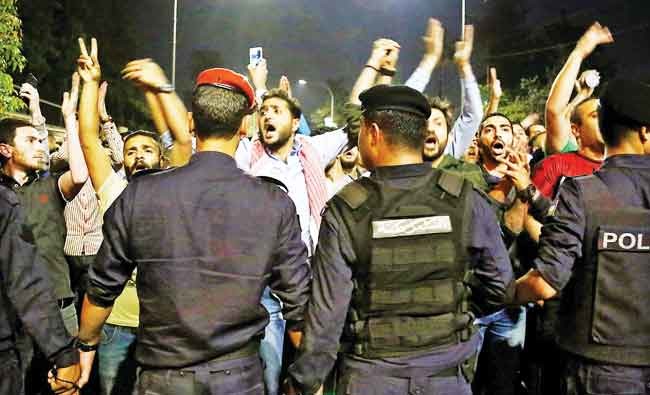
- Studies have shown that trust in the government has plummeted in the past two years and was now at an all-time low
- The flames of the fire have reached both lower and upper classes of society
Tourism on hold as Middle East war casts uncertainty
- Cancelled flights, postponed trips and a great deal of uncertainty: the war in the Middle East is casting a long shadow over the tourism outlook for the region
PARIS: Cancelled flights, postponed trips and a great deal of uncertainty: the war in the Middle East is casting a long shadow over the tourism outlook for a region that has become a prized destination for travelers worldwide.
“My last group of tourists left three days ago, and all the other groups planned for March have been canceled,” said Nazih Rawashdeh, a tour guide near Irbid, in northern Jordan.
“This is the start of the high season here. It’s catastrophic,” he told AFP.
“And yet there’s no problem in Jordan. It’s perfectly safe.”
Across the world, tour operators are scrambling to find solutions for clients stranded in the region or who had trips planned there.
“The priority is getting those already there back home,” said Alain Capestan, president of the French tour operator Comptoir des Voyages.
He said however that the war was also affecting customers who have traveled to other parts of the world, as the Gulf region is home to several major aviation hubs — Dubai, Abu Dhabi and Doha.
Like other companies, the German tour operators surveyed by AFP — Alltours, Dertour, Schauinsland-Reisen — announced they would cover the cost of extra nights for clients stranded in the Middle East. They also canceled trips to the UAE and Oman until at least March 7.
Swiss operator MSC Cruises, which has a ship stranded in Dubai, told AFP on Thursday it was sending five charter flights to airlift nearly 1,000 passengers.
The firm said it expected the passengers to be out of the region by Saturday, without specifying the destinations of the flights or the nationalities of the holidaymakers.
The British travel industry association ABTA said agencies “would not be sending customers to the region for as long as the British Foreign Office advises against all non-essential travel.”
Customers whose holidays were canceled in recent days will be able to rebook or receive a refund, it said.
- Economic impact -
The war is disrupting a sector that had been booming in the region.
According to UN Tourism, in 2025 around 100 million tourists visited the Middle East — nearly seven percent of all international tourists recorded worldwide. That figure had grown three percent year-on-year and 39 percent compared to the pre-pandemic period.
Depending on the destination, Europeans make up a large share of visitors, followed by tourists from South Asia, the Americas, and other Middle Eastern countries.
For example, nearby markets accounted for 26 percent of total visitors to Dubai in 2025, according to its Ministry of Tourism and Economy.
Against this backdrop analysts Oxford Economics warns that “a decline in tourist flows to the region will deal a more severe economic blow than in the past, as tourism’s share of GDP has grown, as has employment in the sector.”
“We estimate inbound arrivals to the Middle East could decline 11-27 percent year-on-year in 2026 due to the conflict, compared to our December forecast that projected 13 percent growth,” said Director of Global Forecasting Helen McDermott.
That would translate, according to the firm, to between 23 and 38 million fewer international visitors compared to the prior scenario, and a loss of $34 to $56 billion in tourist spending.
After Covid and then the conflict in Gaza, tourists had been coming back, said Rawashdeh, the Jordanian tour guide.
“For the past six months, people working in tourism here had hope. And now there’s a war. This is going to be terrible for the economy,” he said.
“We’ve definitely noticed an understandable slowdown in new bookings from our partners right now, but we fully expect that to bounce back as soon as things settle down and travelers feel more confident,” said Ibrahim Mohamed, marketing director of Middle East Travel Alliance, which offers direct tours to American and British operators.
He remains optimistic: “The Middle East has always been an incredibly resilient market, and demand always bounces back fast once stability returns.”
“My last group of tourists left three days ago, and all the other groups planned for March have been canceled,” said Nazih Rawashdeh, a tour guide near Irbid, in northern Jordan.
“This is the start of the high season here. It’s catastrophic,” he told AFP.
“And yet there’s no problem in Jordan. It’s perfectly safe.”
Across the world, tour operators are scrambling to find solutions for clients stranded in the region or who had trips planned there.
“The priority is getting those already there back home,” said Alain Capestan, president of the French tour operator Comptoir des Voyages.
He said however that the war was also affecting customers who have traveled to other parts of the world, as the Gulf region is home to several major aviation hubs — Dubai, Abu Dhabi and Doha.
Like other companies, the German tour operators surveyed by AFP — Alltours, Dertour, Schauinsland-Reisen — announced they would cover the cost of extra nights for clients stranded in the Middle East. They also canceled trips to the UAE and Oman until at least March 7.
Swiss operator MSC Cruises, which has a ship stranded in Dubai, told AFP on Thursday it was sending five charter flights to airlift nearly 1,000 passengers.
The firm said it expected the passengers to be out of the region by Saturday, without specifying the destinations of the flights or the nationalities of the holidaymakers.
The British travel industry association ABTA said agencies “would not be sending customers to the region for as long as the British Foreign Office advises against all non-essential travel.”
Customers whose holidays were canceled in recent days will be able to rebook or receive a refund, it said.
- Economic impact -
The war is disrupting a sector that had been booming in the region.
According to UN Tourism, in 2025 around 100 million tourists visited the Middle East — nearly seven percent of all international tourists recorded worldwide. That figure had grown three percent year-on-year and 39 percent compared to the pre-pandemic period.
Depending on the destination, Europeans make up a large share of visitors, followed by tourists from South Asia, the Americas, and other Middle Eastern countries.
For example, nearby markets accounted for 26 percent of total visitors to Dubai in 2025, according to its Ministry of Tourism and Economy.
Against this backdrop analysts Oxford Economics warns that “a decline in tourist flows to the region will deal a more severe economic blow than in the past, as tourism’s share of GDP has grown, as has employment in the sector.”
“We estimate inbound arrivals to the Middle East could decline 11-27 percent year-on-year in 2026 due to the conflict, compared to our December forecast that projected 13 percent growth,” said Director of Global Forecasting Helen McDermott.
That would translate, according to the firm, to between 23 and 38 million fewer international visitors compared to the prior scenario, and a loss of $34 to $56 billion in tourist spending.
After Covid and then the conflict in Gaza, tourists had been coming back, said Rawashdeh, the Jordanian tour guide.
“For the past six months, people working in tourism here had hope. And now there’s a war. This is going to be terrible for the economy,” he said.
“We’ve definitely noticed an understandable slowdown in new bookings from our partners right now, but we fully expect that to bounce back as soon as things settle down and travelers feel more confident,” said Ibrahim Mohamed, marketing director of Middle East Travel Alliance, which offers direct tours to American and British operators.
He remains optimistic: “The Middle East has always been an incredibly resilient market, and demand always bounces back fast once stability returns.”
© 2026 SAUDI RESEARCH & PUBLISHING COMPANY, All Rights Reserved And subject to Terms of Use Agreement.


