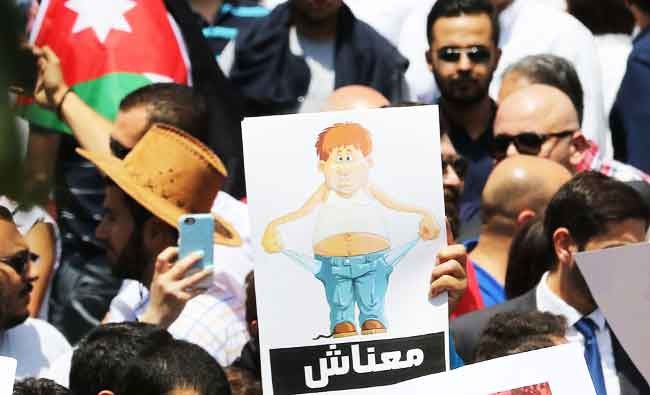
AMMAN: Jordan’s government has halted a controversial rise in fuel prices after a week of mass street protests led to a dramatic intervention by King Abdullah yesterday.
Gasoline prices are subject to regular review by the government and were due to increase significantly this month, following a smaller rise in May. But hundreds of angry people chanting anti-government slogans descended on the prime minister’s office late on Thursday night, forcing the king to step in and attempt to defuse tensions.
The state news agency Petra quoted Prime Minister Hani Mulki as saying King Abdullah had ordered the gas price rise to be reversed.
While the king’s intervention brought a brief period of calm following Friday prayers, many Jordanians expect the civil unrest to continue. Last Wednesday thousands of people took to the streets to protest against planned tax hikes demanded by the International Monetary Fund (IMF).
Rauf Habash, a political activist and tour operator, told Arab News he was planning to take part in a large protest on Friday night calling for major changes in the way government policies are implemented.
“It is not about fuel prices — this is a protest against the policies of the government. There is a big gap between the people and the government,” he said.
Frustration has been mounting in much of the country since the government introduced plans to Parliament last month to double the income-tax base following sharp sales tax rises earlier this year. The increases are a condition of a three-year IMF economic program to reduce public debt and generate more state revenue.
The government has defended the proposals by saying only 4 percent of Jordanians pay personal income tax. However, many people are angry and say the government is out of touch with their daily struggles.
Haytham Erefei, a political activist and lawyer, told Arab News the protests are not inspired by any political party or movement but result from the widespread disenchantment felt by Jordan’s youth.
“Raising the price of fuel by more than 5 percent was a mistake,” he said. “Our officials are totally oblivious to the way people feel about their decisions.”
Before the king’s intervention yesterday, the price of unleaded 90 octane gasoline rose from 0.815 Jordanian dinars ($1.15) per liter to 0.860 dinars per liter. Diesel and kerosene prices went up by 4.8 percent, from 0.615 dinars per liter to 0.645 dinars per liter.
In the wake of the recent protests, the Muslim Brotherhood-affiliated Islamic Action Front has called on the government to resign and for new parliamentary elections to take place.
Meanwhile, a number of MPs are due to meet on Saturday to submit their resignations if the government fails to withdraw the income tax law. The new law lowers the minimum taxable income to 8,000 dinars for an individual and 16,000 dinars for a family.
Khalil Atiyeh, one of 13 parliamentarians who are set to step down, told Arab News the rise in fuel prices is just one of the issues causing public discontent.
“The government has failed to read people’s anger and frustration. We want to make a principled stand in the hope that the king will understand this is serious,” he said.


![]()

Jordan king’s intervention brings calm after protests
Jordan king’s intervention brings calm after protests
- The new law lowers the minimum taxable income to 8,000 dinars for an individual and 16,000 dinars for a family
- The government has failed to read people’s anger and frustration


Latest updates




© 2026 SAUDI RESEARCH & PUBLISHING COMPANY, All Rights Reserved And subject to Terms of Use Agreement.