Mandatory evacuation ordered as Hawaii eruption hits 4-week mark

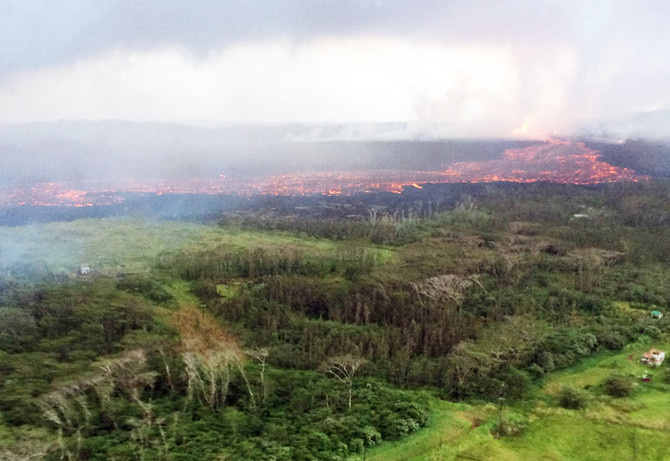
This image obtained May 31, 2018 from the US Geological Survey shows lava flow erupting from fissure 8, during HVO's early morning overflight on May 30, 2018 as the lava channel was estimated to be about 100 30 meters from Kilauea Volcano, Hawaii. (AFP PHOTO / US Geological Survey/HO)
Updated 01 June 2018
Follow

Mandatory evacuation ordered as Hawaii eruption hits 4-week mark

  • The mandatory evacuation zone lies within a slightly larger area that was already under a voluntary evacuation and curfew.
  • Civil defense officials have previously said about 2,000 residents in and around Leilani Estates were displaced at the outset of the current eruption, which began on May 3.

HONOLULU, US: The Hawaii community hardest hit by the Kilauea Volcano was ordered sealed off under a strict new mandatory evacuation on Thursday as the eruption marked its fourth week with no end in sight.
The Big Island’s mayor, Harry Kim, declared a roughly 17-block swath of the lava-stricken Leilani Estates subdivision off-limits indefinitely and gave any residents remaining there 24 hours to leave or face possible arrest.
The mandatory evacuation zone lies within a slightly larger area that was already under a voluntary evacuation and curfew.
The latest order was announced a day after police arrested a 62-year-old Leilani Estates resident who fired a handgun over the head of a younger man from the same community, apparently believing his neighbor was an intruder or looter.
The confrontation on Tuesday was recorded on cell phone video that later went viral.
But the mandatory evacuation was “decided prior to that incident,” said David Mace, a spokesman for the Federal Emergency Management Agency currently assigned to the Hawaii County Civil Defense authority.
Civil defense officials have previously said about 2,000 residents in and around Leilani Estates were displaced at the outset of the current eruption, which began on May 3.
But the total number of evacuees was estimated to have risen to about 2,500 after authorities ushered residents from the nearby Kapoho area as a precaution on Wednesday, as a lava flow threatened to cut off a key access road.
At least 75 homes — most of them in Leilani Estates — have been devoured by streams of red-hot molten rock creeping from about two dozen large volcanic vents, or fissures, that have opened in the ground since Kilauea rumbled back to life four weeks ago. Lava flows also have knocked out power and telephone lines in the region, disrupting communications.
Besides spouting fountains of lava around the clock, the fissures have released high levels of toxic sulfur dioxide gas on a near constant basis, posing an ongoing health hazard. Meanwhile, the main summit crater has periodically erupted in clouds of volcanic ash that create breathing difficulties and other problems for residents living downwind.
The heightened volcanic activity has been accompanied by frequent earthquakes, as magma — the term for lava before it reaches the surface — pushes its way up from deep inside the earth and exerts tremendous force underground.
After a month of continual eruptions at Kilauea’s summit and along its eastern flank, geologists say they have no idea how much longer it will last.
“There’s no sign we’re getting that anything is going to slow down at the moment,” Wendy STOVL, a vulcanologist for the US Geological Survey, told reporters on a conference call on Thursday. “We don’t see any changes occurring.”
The island’s mayor on Wednesday renewed an emergency proclamation for 60 more days, allowing construction of temporary shelters and other relief projects to proceed on an expedited basis, without reviews and permits normally required.
The month-old eruption of Kilauea, one of the world’s most active volcanoes, followed an eruption cycle that had continued almost nonstop for 35 years.
Stovall said geologists now believe the latest upheaval should be classified as a separate volcanic event, though an official determination has yet to be made. 


Winter storm snarls holiday travel across US Northeast, Great Lakes

Updated 8 sec ago
Follow

Winter storm snarls holiday travel across US Northeast, Great Lakes

  • At least 1,500 flights were canceled from Friday night, according to flight-tracking service FlightAware
  • On the other side of the country, California was experiencing a fairly dry weekend after powerful storms battered the state with heavy rains, flash flooding and mudslides

BOSTON: More than a thousand flights were canceled or delayed across the Northeast and Great Lakes regions due to snow as thousands took to roads and airports during the busy travel period between Christmas and New Year’s.
New York City received about 4 inches (10.2 centimeters) of snow Friday night into early Saturday — slightly under what some forecasts had predicted. At least 1,500 flights were canceled from Friday night, according to flight-tracking service FlightAware. But by the morning, both the roads and the skies were clearing.
“The storm is definitely winding down, a little bit of flurries across the Northeast this morning,” said Bob Oravec, a Maryland-based forecaster at the National Weather Service.
Oravec said the storm was moving from the northwest toward the Southeast, with the largest snowfall in the New York City area reaching over 6 inches (15 centimeters) in central eastern Long Island. Farther north in the Catskills, communities saw as much as 10 inches (25 centimeters).
Newark Liberty International, John F. Kennedy International and LaGuardia airports posted snow warnings on the social media platform X on Friday cautioning that weather conditions could cause flight disruptions.
The National Weather Service warned of hazardous travel conditions from the Great Lakes through the northern mid-Atlantic and southern New England, with the potential for tree damage and power outages.

In Times Square, workers in red jumpsuits worked to clear the sludge- and powder-coated streets and sidewalks using shovels and snowblowers.
Jennifer Yokley, who was there on a holiday trip from North Carolina, said she was excited to see snow accumulating as it dusted buildings, trees and signs throughout the city.
“I think it was absolutely beautiful,” she said.
Payton Baker and Kolby Gray, who were visiting from West Virginia, said the snow was a Christmas surprise for their third anniversary trip.
“Well, it’s very cold, and it was very unexpected,” Baker said, her breath visible in the winter air. “The city is working pretty well to get all the roads salted and everything, so it’s all right.”
Ahead of the storm, New York Gov. Kathy Hochul declared a state of emergency for more than half the state. Acting New Jersey Gov. Tahesha Way also declared a state of emergency for that state.
“This storm will cause dangerous road conditions and impact holiday travel,” Way said in a statement. “We are urging travelers to avoid travel during the storm and allow crews to tend to the roads. Drivers should plan their travel accordingly, monitor conditions and road closures, and follow all safety protocols.”
 

Snow covers Brooklyn Bridge Park in New York City on December 27. (AFP)

3 dead in California
On the other side of the country, California was experiencing a fairly dry weekend after powerful storms battered the state with heavy rains, flash flooding and mudslides. At least three people were killed.
Some mountainous areas received 10 to 18 inches (25 to 45 centimeters) of rain over three days, peaking on Christmas Eve, National Weather Service meteorologist Rose Schoenfeld said. There were varied amounts of rain in other populated areas, including up to 4 inches (10 centimeters) across the Los Angeles Basin and many coastal areas.
There was significant damage to homes and cars in Wrightwood, a 5,000-resident mountain town about 80 miles (130 kilometers) northeast of Los Angeles, as floods and mudslides turned roads into rivers and buried vehicles in rock and debris.
Before rain reappears in the forecast later next week, California was expected to experience Santa Ana winds with gusts of over 60 mph (96 kph) in mountainous areas from Sunday night through Tuesday. The winds could uproot saturated trees and cause power outages.