Turkish envoy heads back to US after spat over Jerusalem

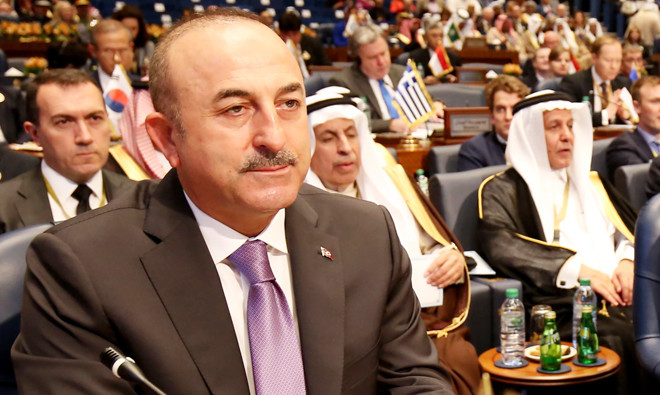
Turkish Foreign Minister Mevlut Cavusoglu Kilic would be back at work by Monday. (AFP)
Updated 31 May 2018
Follow

Turkish envoy heads back to US after spat over Jerusalem

  • Turkish Foreign Minister Mevlut Cavusoglu meanwhile told the Hurriyet daily that Kilic would be back at work by the time he meets his US counterpart Secretary of State Mike Pompeo on Monday

Turkey’s ambassador to Washington was on Thursday heading back to the US after a spat over the official inauguration of the new US Embassy in Jerusalem.

State TRT television said Serdar Kilic had left Ankara to resume his post after an absence of over two weeks from Washington.

Turkish Foreign Minister Mevlut Cavusoglu meanwhile told the Hurriyet daily that Kilic would be back at work by the time he meets his US counterpart Secretary of State Mike Pompeo on Monday.

Turkey recalled its ambassadors to Washington and Tel Aviv early this month for consultations after dozens of Palestinians were killed by Israeli fire along the Gaza border on the same day the US celebrated the opening of its embassy in Jerusalem.

In Washington, Pompeo and Cavusoglu are expected to try and agree terms for the withdrawal of US-backed Kurdish militia from the Syrian town of Manbij, a move long sought by Turkey.

Relations between the two NATO allies Turkey have become increasingly bitter in recent months over issues including US support for the Kurdish People’s Protection Units (YPG) militia.

Ankara argues the YPG is a branch of the outlawed Kurdistan Workers’ Party which has been fighting against Turkey state since 1984 while Washington insists they are part of a legitimate opposition group called the Syrian Democratic Forces.

Manbij hosts a US military presence with American soldiers providing military support to the YPG in the fight against militants.

Turkish President Recep
Tayyip Erdogan threatened to expand an incursion inside Syria to Manbij after clearing the western enclave of Afrin of YPG militia in January.

Cavusoglu told Hurriyet that in Washington both foreign ministers would publicize a timetable on the Manbij roadmap.

“We will make a joint statement that day,” he said. “The concrete step is that YPG will be withdrawn from there,” he added.

Cavusoglu said Turkey and the US would decide together who would replace the YPG in Manbij’s administration and security forces.

Pompeo is also expected to raise the case of US pastor Andrew Brunson who has been held in detention in western Turkey since October 2016 on terror and spying charges. Washington has repeatedly denounced his incarceration.

Iran FM criticizes Israel for ‘doctrine of domination’

Updated 8 sec ago
Follow

Iran FM criticizes Israel for ‘doctrine of domination’

  • Doctrine allows Israel to expand its military arsenal while pressuring other countries in the region to disarm
  • His remarks came a day after renewed nuclear talks with Washington in Oman
DOHA: Iran’s Foreign Minister Abbas Araghchi on Saturday criticized what he said was a “doctrine of domination” that allows Israel to expand its military arsenal while pressuring other countries in the region to disarm.
His remarks came a day after renewed nuclear talks with Washington, with previous talks collapsing when Israel launched an unprecedented bombing campaign against Iran last June that triggered a 12-day war.
Araghchi was speaking at the Al Jazeera Forum conference in Qatar but made no reference to Friday’s talks with the United States.
“Israel’s expansionist project requires that neighboring countries be weakened: militarily, technologically, economically and socially,” Araghchi said.
“Under this project Israel is free to expand its military arsenal without limits ... Yet other countries are demanded to disarm. Others are pressured to reduce defensive capacity. Others are punished for scientific progress,” he added.
“This is a doctrine of domination.”
During the 12-day war Israel targeted senior Iranian military officials, nuclear scientists and sites as well as residential areas, with the US later launching its own attacks on key nuclear facilities.
Iran responded at the time with drone and missile attacks on Israel, as well as by targeting the largest US military base in the Middle East, located in Qatar.
On Friday, Araghchi led the Iranian delegation in indirect nuclear talks with US Middle East envoy Steve Witkoff in Muscat.
The top Iranian diplomat later described the atmosphere as having been “very positive,” while US President Donald Trump said the talks were “very good,” with both sides agreeing to proceed with further negotiations.
The talks followed threats from Washington and its recent deployment of an aircraft carrier group to the region following Iran’s deadly crackdown on anti-government protests last month.
The United States has sought to address Iran’s ballistic missile program and its support for militant groups in the region — issues which Israel has pushed to include in the talks, according to media reports.
Tehran has repeatedly rejected expanding the scope of negotiations beyond the nuclear issue.