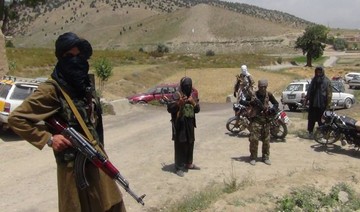
WASHINGTON: Senior Taliban officials have been secretly negotiating with Afghan officials on a possible ceasefire, the Pentagon said Wednesday, even as US forces killed over 50 Taliban leaders in a series of strikes.
“A lot of the diplomatic activity and dialogue is occurring off the stage, and it’s occurring at multiple levels,” General John Nicholson said in a teleconference with reporters at the Pentagon.
He would not identify the figures involved in the negotiations, except to say that they included mid- and senior-level Taliban officials.
“I should point out they met in secret. This is how they were able to advance the talks,” he said, adding that the success of the effort depends in part on the “confidentiality of the process.”
Afghan President Ashraf Ghani in late February proposed peace talks with the Taliban, saying they could be recognized as a political party if they accepted a cease-fire and recognized the country’s 2004 constitution.
The Taliban have not officially responded, but deadly attacks have proliferated since then, particularly in Kabul, which has become the most dangerous place in the country for civilians.
On Wednesday, militants launched a gun and bomb attack on the Interior Ministry in Kabul, killing a policeman in another demonstration of their ability to strike at the heart of the Afghan capital.
The Taliban also claimed responsibility for a predawn attack on a police station in the capital of Logar province, about 70 kilometers southeast of Kabul.
Six police officers were killed and eight civilians were wounded, provincial police spokesman Shapoor Ahmadzai said.
But Nicholson, who has sought to drive the Taliban to the negotiating table by bringing to bear increased US military pressure, maintained that violence and progress can coexist.
He likened the situation in Afghanistan to that of Colombia where the fighting continued up until the FARC guerrilla group and the government signed a peace accord in 2016.
In a statement Wednesday, the US command in Afghanistan said the strikes against those behind a recent attack in the Helmand provincial capital of Farah resulted in “more than 50 casualties.”
After pushing out fighters in Farah, Afghan and US forces continued to pursue them, Nicholson told reporters at the Pentagon via video link.
Under surveillance by the Marines, the Taliban fighters returned to their Helmand stronghold, a center for poppy cultivation.
On May 24, they were spotted in a known Taliban command center in Musa Qala.
Among the dead was the number two Taliban leader in Helmand, Abdul Manan, and several district governors and local leaders in Kandahar, Kunduz, Herat, Farah, Uruzgan and Helmand provinces.


Afghan officials and Taliban in ceasefire talks, Pentagon says

Afghan officials and Taliban in ceasefire talks, Pentagon says


US congresswoman supports censure of colleague over comments against Arabs, Muslims
- Republican Randy Fine ‘spreading hate,’ Democrat Robin Kelly tells Arab News
- ‘Members of Congress should not be targeting Muslims for political gain’
CHICAGO: Illinois Congresswoman Robin Kelly has said she supports calls in the US House to censure Florida Congressman Randy Fine, who has repeatedly made derogatory comments about Muslims and Arabs on his official social media accounts.
Kelly, a Democrat, denounced anti-Muslim and anti-Arab statements made by Fine, a Republican, saying she expects a censure resolution to be put together by House members possibly next week.
“There’s just no room for hate. That’s just the bottom line. I’ve seen hate. It causes people to lose their lives. It causes people to not have the same opportunities as other people. It causes people to have extra stress, extra trauma. And to categorize a whole group of people is so unfair,” Kelly told Arab News.
“I come from a family with a lot of different ethnicities or cultures, and I’ve seen the damage that hate has done in categorizing any one community.
“The Islamic community is just always presented as the bad guy in the movies and on TV … Being a person of color and seeing things that even my own family have gone through, I’m just very sensitive to it.”
Last month, when a supporter of New York’s Muslim Mayor Zohran Mamdani said on social media that dogs have no place in a Muslim home, Fine wrote: “If they force us to choose, the choice between dogs and Muslims is not a difficult one.”
Then on Feb. 20, Fine introduced to Congress the “Protecting Puppies from Sharia Act,” cosponsored by nine Republicans.
Fine has been criticized in the past for making Islamophobic and anti-Arab comments on his social medial pages.
Last May, when Michigan Democrat Rashida Tlaib said it was “a crime to use starvation as a weapon in Gaza,” Fine responded: “Tell your fellow Muslim terrorists to release the hostages and surrender. Until then, #StarveAway.”
During his election campaign in December 2023, in response to an anonymous poster on X who criticized delays in getting food trucks into Gaza, Fine wrote: “Stop the trucks. Let them eat rockets. There are plenty of those. #Bombsaway.”
Before running for Congress, responding to a New York Times report and photo of 67 Arab children killed by Israel, he said: “Thanks for the pic.”
Muslim groups in Florida have been complaining about Fine’s rhetoric since 2021, including after he sent a private Instagram message to a Florida Muslim saying: “Go blow yourself up!”
Kelly said she is also disturbed by the comments of Fine’s allies, citing them as a broader undercurrent of Islamophobia rising in the US.
She insisted that Islamophobia is no different than antisemitism or racism against other groups, including African Americans like herself.
Fine and Tennessee Congressman Andy Ogles “are spreading hate and should be censured,” Kelly wrote on her own Facebook page this past week.
“Our country is already divided enough, members of Congress should not be targeting Muslims for political gain.”
Ogles, a cosponsor of the “Protecting Puppies from Sharia Act,” declared: “Muslims don’t belong in American society. Pluralism is a lie.”
Kelly, who was elected to Congress in 2013, said: “I think they should all be censured. I say to people that feel the Islamophobia, ‘Don’t get weary, don’t get lost in the chaos. That’s what they want you to do. You can’t go in your house and close the door. You have to be a voice. You can’t stay on the sidelines because this isn’t acceptable.’”
Arab News reached out to Fine for comment.


