LONDON: It has crossed continents and passed through the hands of monarchs and merchants. On Thursday, the largest freshwater pearl in the world will find a new owner as it goes on sale at auction in the Netherlands.
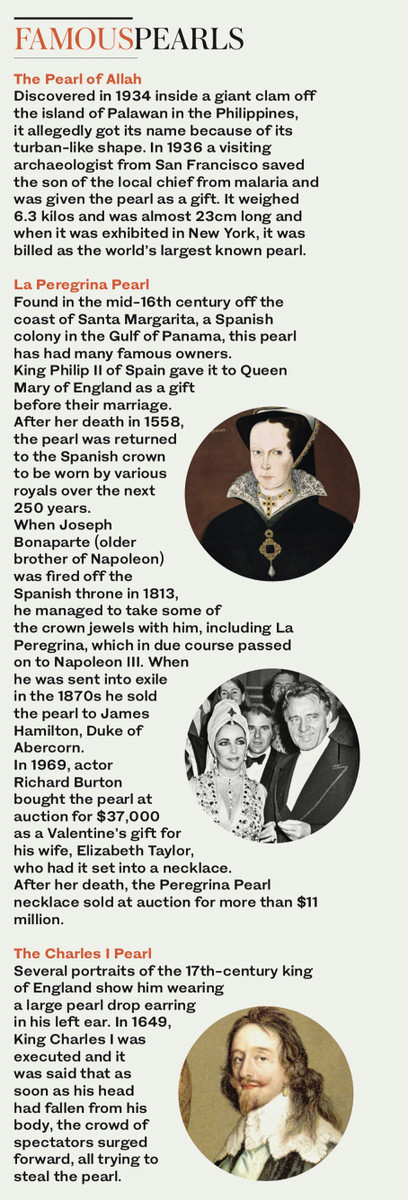
Known as the Sleeping Lion because of its shape, the extremely rare pearl is being sold at the Venduehuis auction house in The Hague on May 31. Top estimates are valuing it at $632,000.
This is not the sort of pearl from which necklaces and earrings are made. For a start, it weighs a hefty 120 grams and measures nearly 7 cm in length.
Rather than the usual lustrous creamy white, its color is probably best described as putty grey with darker blue-grey stripes that give the impression that the poor lion suffers from varicose veins.
Its surface is knobbly and uneven. In gem-trader lexicon this is known as “baroque,” but to a layman it does not look at all pearl-like. In truth, the Sleeping Lion is rather unattractive, but it does come with a great story.
 It begins in China during the reign of Emperor Qianlong, when the pearl is thought to have formed some time between 1700 and 1760.
Pearls formed by molluscs living in freshwater rivers have been recorded in China since 2000 BC. Manchuria was a main supplier of pearls to the imperial court.
By the law of the time, all noteworthy pearls found in Chinese waters became the property of the emperor, and the export of large pearls was banned.
But not all of them reached the imperial court, and the Sleeping Lion was one of them. In 1765, it disappeared.
China in the 17th and 18th centuries was the most important trading partner of the Dutch East India Co., trading in textiles, porcelain, tea, spices and precious metals, with a main depot in Canton by the Pearl River.
The Sleeping Lion was most probably put on a ship there bound for the Dutch East India Co.’s even bigger storage facility in Batavia (now Jakarta), which is where the pearl next turned up in 1769 as the property of merchant Hendrik Coenraad Sander.
Born in Hildesheim, Germany, Sander had been the commercial agent for a duke, but after his wife’s death he moved to Amsterdam and became accountant general of the Dutch East India Co., based in Batavia.
Thanks to judicious investments, by the time his five-year contract ended in 1769, Sander was a wealthy man.
He returned to the Netherlands with a collection of valuable objects, including the Sleeping Lion, for which he had paid £4,500, equivalent to £392,648 ($522,590) today.
Sander died in 1776, and two years later the possessions he had acquired and shipped over from Batavia were sold. 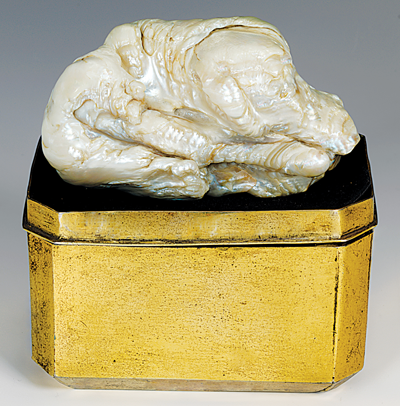
The auction lasted several days and the pearl was one of the last items, along with a diamond. The auction, which was widely advertised around Amsterdam, lasted only minutes, and the Sleeping Lion sold to an anonymous buyer for 2,100 guilders.
It later emerged that the buyer was Hope & Co., an English commercial bank whose most important client was Empress Catherine the Great of Russia, an avid collector of all forms of art.
In the summer of 1779, the pearl was delivered to St. Petersburg by Robert Voute, manager of Hope & Co.’s branch in Moscow.
Contained in a copper box, it is highly likely that the Sleeping Lion was put on display in 1783 in the royal treasury, known as the Gallery of Valuables, which was next to the throne room. But after the death of the empress in 1796, the pearl again disappeared.
It was next heard of in the 1860s as belonging to a ship-owning family named Plonski in the Baltic port of Gdansk, Poland.
With the country beset by uprisings, in 1863 Plonski sent his daughter to Rome for safety. Packed in her luggage was the great pearl.
The choice of Rome was no accident. King Victor Emmanuel II of Italy was known to be building up a new collection of crown jewels as the old ones had been stolen, and Plonski hoped to sell the pearl to him. But the timing was unfortunate.
The king was short of funds, which is how a jeweller named Lodewijk Willem van Kooten, who worked for the king’s jeweller, became the next owner of the Sleeping Lion and took it back to Amsterdam in his rucksack in 1867.
Van Kooten died in 1900 but his son, also named Lodewijk Willem, took over the business. After a meeting with renowned jeweller Peter Carl Faberge at the 1910 World Expo, the Sleeping Lion was set to return to Russia to be fashioned into an “Easter surprise” trinket for the czarina. After an absence of a century, the Sleeping Lion and the Russian eagle were to be reunited.
But that plan was thwarted by the 1917 Russian revolution, so the pearl stayed in Amsterdam, largely forgotten, until 1979.
The van Kooten family firm was closing down and selling off its inventory. The pearl was bought by the Amsterdam Pearl Society, which had just six members.
Over the next 20 years, the Sleeping Lion was examined and scrutinized by a raft of experts, who all judged it to be a natural baroque pearl of unique proportions, the largest freshwater pearl in the world.
Around 70,000 people came to see it on the two occasions it was out on display, in 1999 and 2008.
But it was only when documents relating to the Sander estate auction in 1778 came to light in the Amsterdam City Archives that the pearl’s name was discovered anew.
As to where it will go next, only time and Thursday’s auction will tell. But there can surely be little doubt that for the Sleeping Lion, the journey continues.