

Get your militia out of southern Syria, Russia’s Lavrov tells Iran

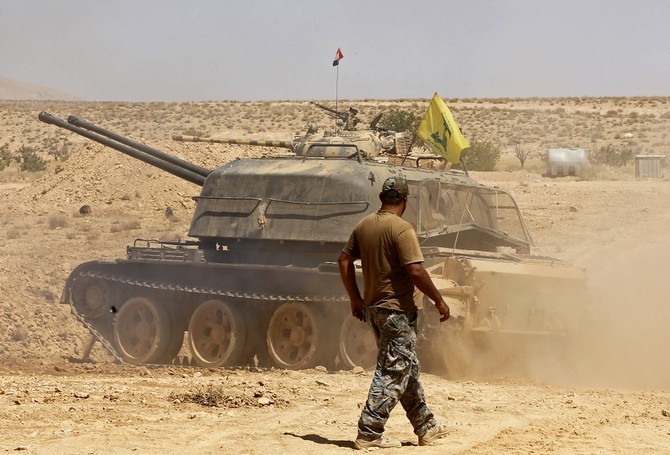
A tank with the Hezbollah banner operating in Syria (AFP)
Updated 29 May 2018
Follow

Get your militia out of southern Syria, Russia’s Lavrov tells Iran

  • Israel and Jordan have repeatedly insisted that the Shiite militias that backed President Bashar Assad in the war, should not be allowed near their borders. 
  • The US has voiced concern about reports of an impending Syrian offensive in the south, warning Damascus it would respond to breaches.

LONDON: Iran came under pressure from both alies and enemies on Tuesday as Russia, Israel and Jordan all insisted there was no place for Tehran-funded militias on Syria’s southern border.

Israel and Jordan have repeatedly insisted that the Shiite militias that backed President Bashar Assad in the war, should not be allowed near their borders. 

A cease-fire brokered last year by the US, Russia and Jordan, reduced fighting in south-west Syria, where rebel fighters still control territory.

With Assad’s forces now in their strongest military position since the war began seven years ago, there are fears he may launch a fresh offensive to seize the area. 

Russian Foreign Minister Sergei Lavrov, said on Monday only Syrian army troops should be on the country’s southern border.

“Of course, the withdrawal of all non-Syrian forces must be carried out on a mutual basis. This should be a two-way street,” Lavrov said.

“The result of this work, which should continue and is continuing should be a situation when representatives of the Syrian Arab Republic’s army stand at Syria’s border with Israel.”

Russia has also backed Assad in the conflict, with its air power regarded as one of the key turning points in the regime’s favor. 

But Moscow was also instrumental in the de-escalation deals that reduced fighting in certain parts of the country last year. 

The US has voiced concern about reports of an impending Syrian offensive in the south, warning Damascus it would respond to breaches.

Jordan said on Monday it was discussing south Syria with Washington and Moscow, and all three agreed on the need to preserve the cease-fire there.

“The de-escalation zone has produced the cease-fire that has held best in all of Syria. The parties to the agreement are all committed to preserving it,” a Jordanian official told Reuters.

Both Israel and Jordan have been seeking understandings with Moscow to push the  Shiite militias away from the area.

Israel has stepped up its military strikes on suspected Iranian targets across Syria in recent weeks.

Israel called for Tehran to be denied any military presence in Syria.

“We believe that there is no place for any Iranian military presence, anywhere in Syria.” 


Sudan paramilitary forces say regret deadly Chad border clash

Updated 11 sec ago
Follow

Sudan paramilitary forces say regret deadly Chad border clash

  • The RSF said it respected Chad’s sovereignty and internationally recognized borders and was committed to “continuing ongoing investigations” and “taking the necessary measures” to hold those responsible accountable

PORT SUDAN, Sudan: Sudan’s paramilitary Rapid Support Forces expressed regret on Monday over what they described as “unintentional” clashes with Chadian troops along the border, after Chad said seven of its soldiers were killed in the incident.
In a statement on its official Telegram channel, the RSF said the clashes “resulted from an unintentional mistake during field operations” targeting forces from the Sudanese army who had entered from Chadian territory “to stir discord and then fled back” into Chad.
Sudan has been gripped by conflict since April 2023. Fighting between the army and the RSF has killed tens of thousands of people and displaced 11 million.
Around one million Sudanese refugees have fled to Chad, according to the United Nations.
The RSF said it respected Chad’s sovereignty and internationally recognized borders and was committed to “continuing ongoing investigations” and “taking the necessary measures” to hold those responsible accountable.
Chad’s government had earlier blamed the RSF for the violence.
Government spokesman Gassim Cherif told a news conference that armed fighters from Sudan had crossed into Chad on Thursday, prompting a clash when Chadian troops ordered them to leave.
A government official later told AFP that the Sudanese fighters were “RSF elements.”
Sudan’s army has repeatedly accused the United Arab Emirates of supplying weapons to the RSF and hiring mercenaries routed through Chad, Libya, Kenya or Somalia — claims denied by Abu Dhabi.
Border tensions have risen since October, when the RSF seized El-Fasher, the army’s last stronghold in Darfur, prompting international condemnation over reports of mass killings, summary executions and systematic rape.