NATO, Russia to hold first talks since Skripal attack

1 / 2
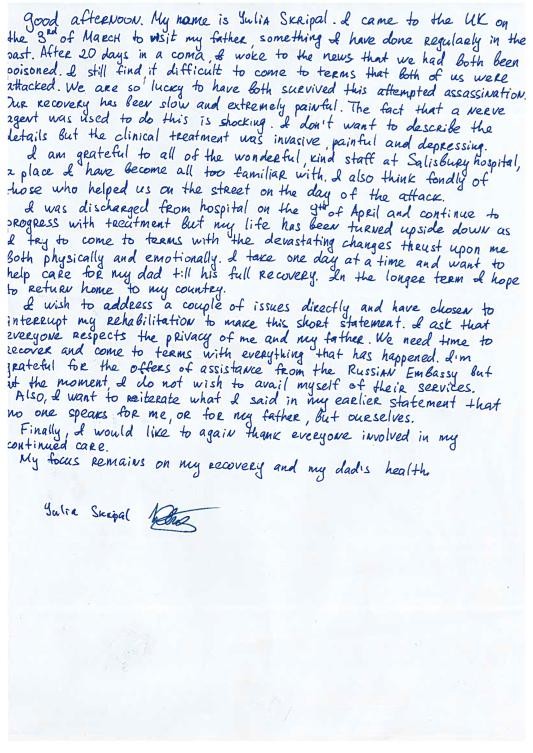
A scan of a detail of a signed handwritten statement by Yulia Skripal, who was poisoned in Salisbury along with her father, Russian spy Sergei Skripal, is pictured in London. (AFP)
2 / 2
A scan of a signed handwritten statement in English by Yulia Skripal, who was poisoned in Salisbury along with her father, Russian spy Sergei Skripal, is pictured in London. (AFP)
Updated 28 May 2018
Follow

NATO, Russia to hold first talks since Skripal attack

BRUSSELS: NATO will on Thursday hold its first formal talks with Russia since the nerve agent attack on a former Kremlin double agent in Britain, as the alliance seeks to counter Moscow’s increasing assertiveness.
Tensions between the transatlantic alliance and Russia have hit post-Cold War highs in recent years over Moscow’s annexation of Crimea and more recently the attempted assassination of former spy Sergei Skripal and his daughter in the British city of Salisbury.
NATO vehemently criticized Moscow over the attack in March, the first hostile use of a nerve agent in Europe since World War Two, and expelled seven Russian diplomats as part of a coordinated international response.
“A meeting of the NATO-Russia Council will take place on 31 May 2018,” a NATO official said.
“This is part of NATO’s twin-track approach of strong defense and meaningful dialogue with Russia.”
The meeting — the seventh of the NATO-Russia council in the last two years — will be held at the alliance’s brand-new headquarters in Brussels and is expected to cover the ongoing conflict in Ukraine, where Moscow is accused of backing pro-Russian separatists in the restive east.
Transparency around military exercises is also expected to be discussed. At the last meeting in October, NATO chief Jens Stoltenberg said alliance members had challenged Russia over its controversial “Zapad” drills which caused concern in Poland and the Baltic states.
The meeting comes as NATO builds up to its summit in July, which Stoltenberg on Monday said would focus on five key areas from deterrence to modernization and EU relations, with measures to “manage” ties with Russia a priority.
Last week NATO and the EU urged Moscow to take responsiblity for the 2014 downing of flight MH17 over eastern Ukraine after international investigators concluded that a missile which destroyed the plane came from a Russian military brigade.
The NRC met regularly until the Ukraine crisis plunged relations between the West and Moscow into a deep freeze in 2014 but the meetings resumed in 2016 after months of debate within the alliance over whether it would send the wrong signal to Moscow.
US-led NATO has suspended all practical cooperation with Russia over its role in Ukraine but has kept political channels of communication open.


Left homeless by blaze, Muslims in southernmost Philippines observe Ramadan as month of trial

Updated 23 February 2026
Follow

Left homeless by blaze, Muslims in southernmost Philippines observe Ramadan as month of trial

  • Thousands lost their homes when parts of Bongao in Tawi-Tawi were burnt to ashes
  • Many trying to fully observe the fasting month say they are grateful to be alive

Manila: As Annalexis Abdulla Dabbang was looking forward to observing the month of Ramadan with her family, just days before it began they lost everything when an enormous fire tore through whole neighborhoods of their city in the southernmost province of the Philippines.

Bongao is the capital of Tawi-Tawi, an island province, forming part of the country’s Muslim minority heartland in the Bangsamoro region. The city experienced its worst fire in years in early February, when flames swept through the coastal community, leaving more than 5,000 people homeless.

“We were swimming for our lives. We had to swim to escape from the fire ... We swam in darkness, and (even) the sea was already hot because of the fire,” Dabbang, a 27-year-old teacher, told Arab News.

“Everything we owned was gone in just a few hours — our home, our memories, the things we worked hard for, everything turned to ashes.”

Trying to save their 2-year-old daughter and themselves, she and her husband left everything behind — as did hundreds of other families that together with them have since taken shelter at the Mindanao State University gymnasium — one of the evacuation centers.

Unable to secure a tent, Dabbang’s family has been sleeping on the bleachers, sharing a single mat as their bed. When Ramadan arrived a few days after they moved to the makeshift shelter, they welcomed it in a different, more solemn way. There is no family privacy for suhoor, no room or means to welcome guests for iftar.

“Ramadan feels different now. It’s painful but at the same time more real. When we lost our home, we began to understand what sacrifice really means. When you sleep in an evacuation center, you understand hunger, discomfort in a deeper way,” Dabbang said.

“We don’t prepare special dishes. We prepare our hearts.”

While she and thousands of others have lost everything they have ever owned, she has not lost her faith.

“Our dreams may have turned to ashes, but our prayers are still alive,” she said.

“This Ramadan my prayers are more emotional than ever. I pray for strength, not just for myself, but for my family and for every neighbor who also lost their family home. I pray for healing from the trauma of fire. I pray that Allah will replace what we lost with something better. I pray for the chance to rebuild not just our house, but our sense of security.”

Juraij Dayan Hussin, a volunteer helping the Bongao fire victims, observed that many of them were traumatized and the need to cleanse the heart and mind during Ramadan was what kept many of them going, because they are “thankful that even though they lost their property, they are still alive.”

But the religious observance related to the fasting month is not easy in a cramped shelter.

“It’s hard for Muslims to perform their prayers when they do not have their proper attire because they usually have specific clothes for prayer,” he said. “Sanitation in the area is also an issue ... when you fast and when you pray, cleanliness is essential.”

For Abdulkail Jani, who is staying at a basketball court with his brother and more than 70 other families, this Ramadan will be spent apart from their parents, whom they managed to move to relatives.

“The month of Ramadan this year is a month of trial ... there will be a huge change from how we observed Ramadan in the past, but we will adjust to it and try to comfort ourselves and our family. The most important thing is that we can perform the fasting,” he told Arab News.

“Despite our situation now, despite everything, as long as we’re alive, we will observe Ramadan. We’ll try to observe it well, without missing anything.”