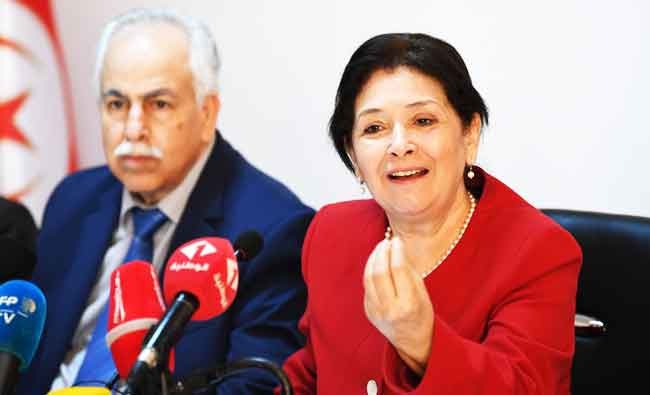
TUNIS: The head of Tunisia’s truth tribunal, tasked with examining crimes under the country’s dictatorship, said on Friday the government has allowed its work to continue.
The Truth and Dignity Commission (IVD) was set up to investigate human rights violations going back six decades, following the 2011 ousting of President Zine El-Abidin Ben Ali.
In February the tribunal extended its own mandate to the end of 2018, but the IVD faced an uncertain future after lawmakers voted in March to end its work.
Sihem Ben Sedrine, the body’s president, said the government had granted the IVD time to wrap up after the tribunal’s mandate formally ends on May 31.
“It’s a gesture of appeasement which signifies that the government is committed to finishing the process. But they want the IVD to speed up a bit,” Sedrine said.
“We will speed up. We don’t have any interest in playing for extra time.”
Sedrine estimated the IVD would need “several months” to finish its work.
Mehdi Ben Gharbia, a minister responsible for relations with constitutional bodies and civil society, said the tribunal’s mandate would legally come to an end at the end of May.
The following months would allow for a handover period to ensure “persecutors are brought to justice, the victims compensated and the reports handed to the authorities,” he said.
“The government cares about bringing the process to a conclusion,” Gharbia added.
The tribunal has faced resistance from those within the former regime who have returned to power, while it has also struggled with internal disagreements and a lack of cooperation from state bodies.
It was tasked with investigating human rights violations between 1957, when Habib Bourguiba became president, and 2013, when the IVD was set up in the wake of the uprising.
Since March the tribunal has referred at least 32 cases of “serious violations” of human rights to Tunisian courts.
The first court case is due to open on Tuesday in the coastal town of Gabes, examining the case of Kamel Matmati who was tortured to death in October 1991.
Since the tribunal began work, it has received more than 62,000 allegations of human rights violations and interviewed close to 50,000 people.


![]()


Tunisia govt allows truth tribunal to continue its work
Tunisia govt allows truth tribunal to continue its work
- The tribunal has faced resistance from those within the former regime who have returned to power
- The tribunal has referred at least 32 cases of “serious violations” of human rights to Tunisian courts


Ex-diplomats defend UN Palestinians expert Francesca Albanese against France FM
- More than 150 European ex-diplomats and lawmakers urge Jean-Noel Barrot to retract ‘inaccurate’ comments about Albanese
- UN expert says claims she referred to Israel as a “common enemy” are completely false
PARIS: More than 150 European ex-diplomats and lawmakers on Wednesday urged France’s foreign minister to retract “inaccurate” comments about a UN expert on Palestinians rights who he wants to resign.
France and Germany have called for Francesca Albanese to step down over remarks in which she referred to a “common enemy of humanity” after criticizing “most of the world” and the media for enabling Israel’s “genocide” in Gaza.
Critics and Israel have accused the UN Special Rapporteur of referring to Israel as a “common enemy,” while Albanese has denounced this as a “manipulation” and “completely false.”
In response to a question about the comments, French Foreign Minister Jean-Noel Barrot on February 11 told parliament she should step down.
In an open letter sent to AFP, the former diplomats criticized what they called “the use of inaccurate and manipulated elements to discredit a holder of an independent UN mandate.”
They called on Barrot to “retract his inaccurate statements about Ms Albanese and correct them.”
“This controversy must not divert attention from the massacres of civilians, nor from the humanitarian crisis and the massive human rights violations taking place in Gaza,” said the signatories.
The letter, written in French, was signed by mostly former foreign ministers and diplomats from the Netherlands.
More than a dozen current members of parliament and senators from Europe were also among the signatories, along with a former foreign minister of South Africa.
Albanese had spoken via videoconference at a forum in Doha on February 7 organized by the Al Jazeera network.
“The fact that instead of stopping Israel, most of the world has armed, given Israel political excuses, political sheltering, economic and financial support — this is a challenge,” she had said.
Albanese said that “international law has been stabbed in the heart” but added that there is an opportunity since “we now see that we as a humanity have a common enemy.”
France and Germany have called for Francesca Albanese to step down over remarks in which she referred to a “common enemy of humanity” after criticizing “most of the world” and the media for enabling Israel’s “genocide” in Gaza.
Critics and Israel have accused the UN Special Rapporteur of referring to Israel as a “common enemy,” while Albanese has denounced this as a “manipulation” and “completely false.”
In response to a question about the comments, French Foreign Minister Jean-Noel Barrot on February 11 told parliament she should step down.
In an open letter sent to AFP, the former diplomats criticized what they called “the use of inaccurate and manipulated elements to discredit a holder of an independent UN mandate.”
They called on Barrot to “retract his inaccurate statements about Ms Albanese and correct them.”
“This controversy must not divert attention from the massacres of civilians, nor from the humanitarian crisis and the massive human rights violations taking place in Gaza,” said the signatories.
The letter, written in French, was signed by mostly former foreign ministers and diplomats from the Netherlands.
More than a dozen current members of parliament and senators from Europe were also among the signatories, along with a former foreign minister of South Africa.
Albanese had spoken via videoconference at a forum in Doha on February 7 organized by the Al Jazeera network.
“The fact that instead of stopping Israel, most of the world has armed, given Israel political excuses, political sheltering, economic and financial support — this is a challenge,” she had said.
Albanese said that “international law has been stabbed in the heart” but added that there is an opportunity since “we now see that we as a humanity have a common enemy.”
Latest updates



Recommended


© 2026 SAUDI RESEARCH & PUBLISHING COMPANY, All Rights Reserved And subject to Terms of Use Agreement.