Lebanon President Michel Aoun has designated Saad Al-Hariri as PM: Presidency Office

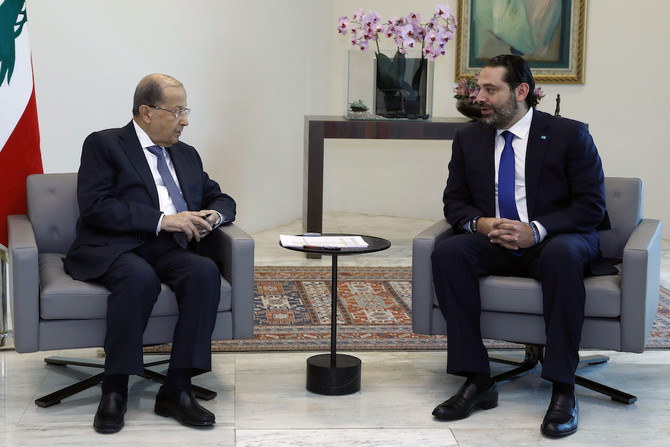
President Michel Aoun on Thursday designated Saad Al-Hariri to be Lebanon's next prime minister. (Dalati Nohra/Lebanese Government via AP)
Updated 24 May 2018
Follow

Lebanon President Michel Aoun has designated Saad Al-Hariri as PM: Presidency Office

BEIRUT: Lebanese lawmakers designated Prime Minister Saad Hariri for a third term in office Thursday, less than three weeks after elections that saw his movement lose ground in parliament.
"The head of state summoned prime minister Saad Hariri and tasked him with forming a government," said a statement posted on social media by the office of President Michel Aoun.
The presidency made the announcement after Hariri, 48, was endorsed by a vast majority of members of parliament after only a few hours of consultations.
Hariri said in a statement that he would seek to form a new government as quickly as possible in order to implement some of the reforms pledged earlier this year to secure key foreign aid.
"I thank all my fellow deputies who entrusted me with forming a new government, hoping we will do so as soon as possible for the benefit of Lebanon and the Lebanese," he said.
Speaking to reporters before leaving the presidential palace, he reaffirmed his policy of "disassociation", a term used to describe efforts to keep Lebanon out of the region's conflicts.
"The new government will need to consolidate its policy of disassociation and continue efforts to face the refugee crisis," he said.
The small Middle eastern country has seen its population increase by a third with the influx of refugees pouring in from neighbouring Syria, which has been torn by war for seven years.
A conference dubbed CEDRE and held in Paris in April raised $11 billion in low-interest loans and aid for Lebanon, whose public debt stands at 150 percent of gross domestic product, the world's third highest rate behind Japan and Greece.
Hariri's Future movement lost a third of its seats on May 6, when Lebanon held its first legislative election in nine years and voters reinforced the weight of the Shiite group Hezbollah and its allies.
The Iran-backed party, the only group to have kept its weapons after Lebanon's 1975-1990 civil war, and its allies control more than half of parliament's 128 seats.
That is expected to protect the US terror-listed organisation from attempts to push for its disarmament, a cause long championed by Hariri and his Sunni-dominated bloc.
While Hezbollah had been content in recent years exercising its influence on the government via second-tier portfolios and its political allies, observers predict it will this time ask for bigger ministries.
The movement's leader Hassan Nasrallah is scheduled to give a televised speech on Friday.
Lebanon's unique sectarian power-sharing arrangements provide for parliament to be split equally between Christians and Muslims and stipulate that the president be Maronite, the premier Sunni and the speaker Shiite.
Speaker Nabih Berri, who has held the position since 1992, was given a new term on Wednesday.
Hariri has been prime minister since December 2016 and served his first term from 2009 to 2011. His father, who was assassinated in 2005, also served two terms between 1992 and 2004.


Bangladesh sets February date for first vote since 2024 mass uprising

Updated 5 sec ago
Follow

Bangladesh sets February date for first vote since 2024 mass uprising

  • At least 1,400 protesters were killed in violent crackdown under ex-PM Hasina’s rule
  • Interim government promises ‘all necessary support’ for upcoming elections

DHAKA: Bangladesh will hold national elections on Feb. 12, its chief election commissioner has announced, setting the timeline for the nation’s first vote since a student-led uprising that ousted long-serving Prime Minister Sheikh Hasina.

Hasina, whose Awami League party-led government was marred by allegations of human rights violations, rigged elections and corruption, was removed from office in August last year after 15 uninterrupted years in power.

Bangladesh has since been led by interim leader Muhammad Yunus, a Nobel Prize-winning economist, who took over governance after Hasina fled to India, where she is now in self-exile.

In a televised address on Thursday, chief election commissioner A.M.M. Nasir Uddin confirmed the voting date to elect 300 lawmakers and said a national referendum on political reforms would also be held on the same day.

“It’s a relief for the voters; it’s a relief for the country. It’s a relief for the investors, it’s a relief for the development partners and for the political parties and the people who did a massive job in July 2024 by sacrificing their lives and limbs to oust a tyranny,” said Prof. A.S.M. Amanullah, political analyst and vice chancellor of the National University in Dhaka.

Mass protests that broke out in 2024 began in early July as peaceful demonstrations, triggered by the reinstatement of a quota system for the allocation of civil service positions.

Two weeks later, they were met with a communications blackout and a violent crackdown by security forces.

A special tribunal in Dhaka found Hasina guilty of allowing lethal force to be used against the protesters, at least 1,400 people of whom died, according to estimates from the UN’s human rights office.

After a months-long trial, she was sentenced to death in November for crimes against humanity.

The February elections will take place in the aftermath of Hasina’s reign, with the Yunus-led administration banning all activities of Awami League, meaning the former ruling party would not be able to join the race next year.

Minor political tensions now revolve around the more than 40 million voters of the Awami League, as the public speculate “how they would move, in which party they would support or whether they would remain silent,” Amanullah said.

“(But) if you consider other than Awami League, if we consider the other political parties, I think the other political parties are sufficient, you know, to make the next poll participatory, and free and fair.”

Bangladesh last held elections in January 2024, which saw Hasina return to office for a fourth consecutive term. That vote was boycotted by the country’s main opposition parties, which accused her administration of rigging the polls.

“There is a growing demand within the society and in the community that they would cast their first vote after almost 15, 16 years. And that would be an (occasion) of big national celebration,” Amanullah said.

In February, more than 127.6 million Bangladeshis will be eligible to cast their vote. It will be Bangladesh’s 13th election since the country gained independence in 1971.

The long-awaited election process now begins with the filing of nominations from Dec. 12 to 29, which will then be reviewed over the following six days. The last date for withdrawing nominations is Jan. 20.

After the voting date was announced, Yunus pledged to “provide all necessary support” to encourage festivity, participation and fairness in the upcoming polls.

“After the historic mass uprising (last year), the country is now moving toward a new path,” he said in a statement. “This election and referendum will consolidate that trajectory, prioritize the will of the people and further strengthen the foundation of a new Bangladesh.”

For Malaika Nur, a 24-year-old Dhaka University student who took part in the 2024 protests, the elections are an opportunity for young people to formally take part in politics.

“Young people have been showing much interest in politics since July 2024. They showed us how the youth can reshape a country’s political condition. If they have a few seats in the parliament, it can be a game-changer for the future of politics in Bangladesh,” she said.

“I hope this election will be different from the last three elections held in the previous regime. There will be a festive mood, people will cast their valuable votes and will get to choose their representative … I hope the elected government will ensure safety and basic rights of every citizen, and will hold fair elections in the future and will not become another fascist.”