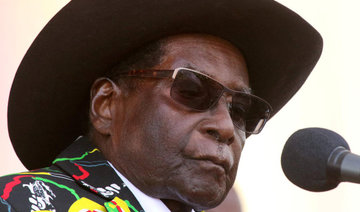
HARARE: Former Zimbabwean president Robert Mugabe on Wednesday failed to turn up for a parliamentary hearing where he was due to give evidence on corruption in the diamond mining industry.
The 94-year-old, who is in frail health, had been summoned to a session at 9:00am, but when he did not show up, lawmakers rescheduled the session for Monday.
Committee head Temba Mliswa, an independent lawmaker, told reporters that the parliamentary committee was “cognizant of the fact that 9:00 am was a bit too early” for the former president to show up.
He said the Monday session had been set for 2:00 pm, although no-one in Mugabe’s office would say whether or not he would attend.
Lawmakers want to question him over his 2016 claim that Zimbabwe lost $15 billion in revenue due to corruption and foreign exploitation in the diamond sector.
“We are not here to humiliate him, we expect him to have enough time to prepare. So on Monday at 2:00 p.m. we expect him here,” Mliswa said, although he admitted that Mugabe was not legally obliged to attend.
Mugabe ruled Zimbabwe from 1980 until he was ousted from office in November following a brief military takeover. He denounced his ouster as a coup and has not been seen in public since.
His authoritarian regime has been accused of syphoning off diamond profits.
He was replaced by his former deputy Emmerson Mnangagwa, a veteran loyalist in the ruling ZANU-PF party who was backed by senior military officers.
Zimbabwe discovered alluvial diamonds in Chiadzwa, in the east of the country, more than 10 years ago.
Rights groups have accused security forces of using brutal methods to control the scattered deposits.
The parliamentary committee has already interviewed former ministers, police and intelligence chiefs about the mining industry in Chiadzwa.
Zimbabwe has allowed several diamond companies to mine the area — most of them as joint ventures between the government and Chinese firms. But there have been widespread allegations of mass looting.
In July, Zimbabwe is to hold elections, the first since Mugabe was unseated, with ZANU-PF widely predicted to retain power.
Mnangagwa has vowed to hold a fair and free vote and has pledged to revive the moribund economy by repairing international ties and attracting foreign investment.


![]()

Mugabe a no-show at Zimbabwe parliament hearing
Mugabe a no-show at Zimbabwe parliament hearing
Latest updates


© 2026 SAUDI RESEARCH & PUBLISHING COMPANY, All Rights Reserved And subject to Terms of Use Agreement.