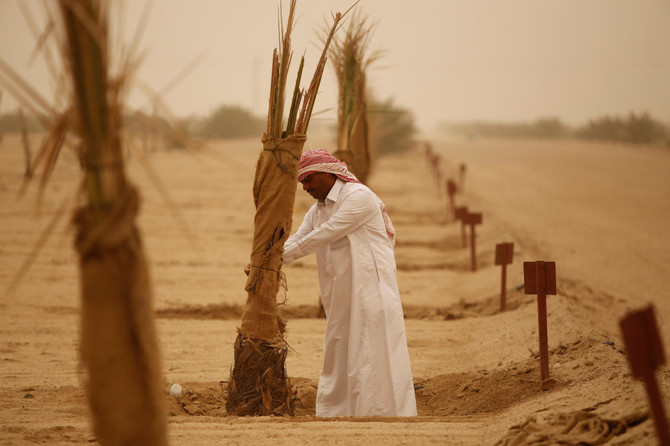
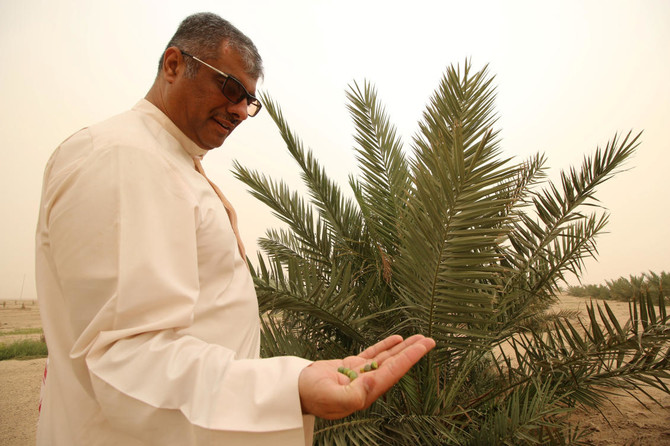
SOUTHERN BADIA, Iraq: On a former battlefield of the 1991 Gulf War, deep in Iraq’s southern desert, a Kuwaiti investor is looking to grow 100,000 date palms and build a nature reserve complete with ostriches and deer.
Few Kuwaiti firms have returned to do business in Iraq since Saddam Hussein’s 1990 invasion of its smaller neighbor and its UN-led liberation a year later.
But businessman Abdul-Aziz Al-Babtain is pouring $58 million into a date farm project in southern Badia, some 150 km from the port city of Basra, officials said.
“We hope to have 100,000 (trees) in the next five to six years,” said Diyah Sharadeh, Babtain’s representative in Iraq, adding that the dates would first be sold in Iraq and later exported.
So far 5,000 date trees have been planted.
Iraq once produced three-quarters of the world’s output of dates but now accounts for 5 percent after decades of conflict, despite being home to around 350 types of date tree.
Babtain had begun the farm in the 1980s, a sign at his office shows.
But Iraq seized it after the 1990 invasion, and due to its proximity to the Kuwaiti border it turned the area into a military zone, digging trenches for heavy guns.
These were then bombed in air strikes as part of Kuwait’s liberation campaign, but authorities never cleaned up the trenches, leaving bullets and parts of tank turrets rusting away just outside the field.
In a bid to turn a new leaf, Iraq returned the farm to Babtain and granted his business tax exemptions.
“This will be the first private (date) investment project in Iraq,” said Ali Ghasseb, head of the Basra Investment Commission. “It was a farm, then became a battlefield and is now again a farm.”
The farm has created some 50 jobs in this desolate area and will need up to 500 workers once the trees begin producing.
In a second step, Babtain plans to set up a natural reserve for which ostriches and deer will be imported, Sharadeh said.
THAW
Ties between Kuwait and Iraq remained strained, but they have improved since the US-led invasion in 2003 that toppled Saddam Hussein, with the Gulf state hosting in February a donor conference to rebuild Iraq.
But Kuwaiti firms have been reluctant to return, demanding guarantees that their business will not be taken away again. There is only one other Kuwaiti investor in Basra, involved in a shopping mall, Ghasseb said.
But trade has picked up in recent years as foreign firms use Kuwait’s port to ship goods to Iraq due to its better security. Up to 200 vehicles cross the border at the Safwan post every day, an Iraqi officer said.
Kuwaiti visitors are also trickling back to the Shiite Muslim holy cities of Najaf and Kerbela. A third of Kuwaitis are Shiites.
In the other direction there is little private traffic as Kuwait rarely grants visitor visas for Iraqis for security reasons.
“I come twice a year. There are no problems for Kuwaitis now,” said a Kuwaiti who gave his name as Mohamed after crossing the border to make a pilgrimage to Nawaf.

On former battlefield, Kuwaiti investor plans date palm groves, ostrich and deer reserve
UNCTAD, Social Development Bank launch fellowship to power Saudi entrepreneurs
RIYADH: The Social Development Bank has signed a memorandum of understanding with UN Trade and Development to launch the “Empretec Saudi Fellowship,” a new initiative aimed at equipping high-potential Saudi entrepreneurs with advanced training and tools to scale their ventures.
The agreement was signed on the sidelines of the second edition of the DeveGo 2025 forum, held on Dec. 21–22 at the King Abdulaziz International Conference Center in Riyadh. The event brought together entrepreneurs, policymakers, and representatives from regional and international organizations, alongside public and private sector leaders.
Featuring more than 150 exhibitors, 85 speakers, and 45 workshops, the forum focused on sharing local and global best practices and strengthening the Kingdom’s entrepreneurial ecosystem.
The Empretec Saudi Fellowship is part of UNCTAD’s flagship capacity-building program to promote entrepreneurship and support micro, small, and medium-sized enterprises and startups. Active in more than 40 countries, the program seeks to develop personal entrepreneurial behaviors through intensive training, access to international experts, and technical tools that help transform promising ideas into scalable, high-impact businesses.
Rebeca Grynspan, UNCTAD secretary-general, said Saudi Arabia offers fertile ground for entrepreneurial growth.
“Saudi Arabia has a wonderful platform to bring everybody up, and the entrepreneurs here are so eager. They have ideas, creativity, and energy,” she told Arab News. “If they come through our program with the Social Development Bank, which does a wonderful job, they will be more successful — because that’s what we want.”
In his opening remarks, Saudi Minister of Human Resources and Social Development Ahmed Al-Rajhi, who also chairs the SDB board, highlighted the rapid evolution of the Kingdom’s startup landscape.
“The Kingdom is witnessing a qualitative transformation in the entrepreneurship and freelance ecosystem, enabling young men and women to enter new promising sectors such as artificial intelligence, renewable energy, advanced technologies, and venture capital,” he said. “This provides broader opportunities to contribute to innovation, expansion, and global competitiveness.”
During a tour of the exhibition alongside Al-Rajhi, Grynspan met a wide range of small and medium-sized businesses and handicraft makers, praising the depth of local talent. She noted that participants spanned the full spectrum of enterprises — from early-stage ventures to more established and sophisticated companies — reflecting a rich diversity of experience.
Al-Rajhi said the Social Development Bank invests more than SR8 billion annually to support enterprises and entrepreneurs, helping raise employment in bank-financed businesses from about 12,000 in 2021 to more than 140,000 in 2025.
Beyond financing, the bank runs several non-financial programs, including the Jada 30 business communities, which have incubated more than 4,300 enterprises across 13 cities, and the Dulani Business Center, which has delivered over 67,000 consultations benefiting more than 150,000 male and female entrepreneurs.
Speaking on the broader economic outlook, Grynspan added: “This is a wonderful place to come. Now is an economy that is thriving, is a population that is hopeful. And you have these young, talented people that are only waiting for an opportunity to make it happen for everybody.”
During the forum, the bank also signed multiple cooperation agreements spanning key sectors such as finance, education, energy, healthcare, heritage, the nonprofit sector, and freelance work. The partnerships align with SDB’s strategy to build an integrated system of financial and non-financial empowerment tailored to the needs of entrepreneurs, startups, and micro-enterprises.


