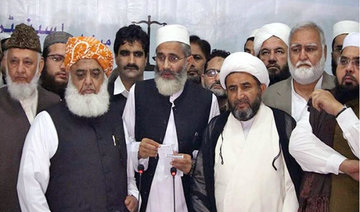
PESHAWAR: The chief of the FATA chapter of religious-politico party Jamiat Ulema-e-Islam-Fazlur Rahman (JUI-F) has announced protests against the merger.
As different stakeholders welcome the move to merge Federally Administered Tribal Areas (FATA) with Khyber Pakhtunkhwa (KP) province, Mufti Abdul Shakoor told Arab News that party workers would block Pak-Afghan Highway and the Indus Highway on May 22.
“KP has to pay a loan of 356 billion rupees ($3 billion). How can it develop FATA region (when it is) merged with the province?” said Shakoor. “FATA has abundant natural resources and it is not in debt.”
He said the party will decide during the protest on Tuesday whether to march toward the federal capital Islamabad to stage a sit-in outside the Parliament House and the army’s General Head Quarter (GHQ), as the army chief is also in favor of FATA-KP merger, Shakoor said.
“FATA currently has eight senators. In a merger with KP, the region would lose these eight Senate seats,” said Shakoor, denying that a merger would politically benefit FATA electorates.
“Pashtuns would have greater representation in the Parliament if FATA is turned into a separate province.”
Awami National Party (ANP) central information secretary and former senator, Zahid Khan, said ANP had always wanted the merger as it would unite the Pashtuns.
“Under the 18th Constitutional Amendment, provinces are autonomous. In case of a merger, the province can use its own resources such as forests, water, minerals. Water can produce much electricity and we have plenty of water.”
Zahid added that geographically, FATA and KP should become one province. “People of all tribal agencies interact with the people of the bordering settled districts of KP. The FATA agencies cannot be turned into a provincial entity separate from KP.
“KP’s southern districts and FATA’s Waziristan region have oil and gas. In case of merger, the province would have enough resources and it will benefit the entire Pashtun population,” he told Arab News.
FATA Grand Alliance chairmanMalik Khan Marjan Wazir said that they also supported the JUIF’s call for a protest on May 22.
“We should be taken on board over decisions on FATA. The tribals are not illiterate, we are educated people. Before deciding on the status of FATA, the government first needs to bring it on a par with other developed areas by setting up schools, hospitals and the like in the region,” he said.
He added that FATA has always been ruled by governors, mostly not from the FATA region. “Even the incumbent governor is not from FATA.”
The KP government spokesman, Shaukat Yousafzai, told Arab News that all stakeholders including the federal and provincial governments, the army, and the tribal people agree want KP and FATA to merge into one province.
Asked if certain tribal elders and others wanted separate province, he said: “They are very few people. Most of the others want merger. Now that peace has been restored, it should not be disturbed and all should work to mainstream FATA. The extra money that would be given to FATA would be enough for its development in case of merger.”
FATA Lawyers’ Forum president, Rahim Shah, said that almost 90 percent of the stakeholders are interested in merging FATA with KP.
“People of FATA and KP speak one language and also geographically people of all tribal agencies interact with people of nearby settled districts of KP. Had FATA been merged with KP 70 years ago when Pakistan came into being, there would be no sense of deprivation among tribals today,” he added.
Prominent Peshawar-based analyst, Rahimullah Yusufzai, told Arab News that there has been no proper study to prove that a separate province would benefit the tribal areas more.
“The point of some tribal elders who say that KP itself is an underprivileged province is also valid. But the prime minister also says that 100 billion rupees would be given to FATA region for 10 years in the case of a merger to develop it.”
He added that in case of separate province, only a few of the entire FATA population would benefit.
“A separate FATA province would share in the National Finance Commission on the basis of population and FATA population may not even receive 100 billion rupees, which is already being assured to be given to it in case of its merger with KP,” he added.
He added that a proper democratic mechanism had not been adopted. “The authorities should have sought opinion of the tribals, whether through a referendum, Jirga or other means,” he added.


![]()

JUI-F plans to block highways in protest at FATA-KP merger
JUI-F plans to block highways in protest at FATA-KP merger

Latest updates




Recommended


© 2026 SAUDI RESEARCH & PUBLISHING COMPANY, All Rights Reserved And subject to Terms of Use Agreement.