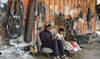
GENEVA: The UN agency for Palestinian refugees is fueling “unrealistic” hopes of return after 70 years of exodus and is therefore helping keep the Mideast conflict alive, Switzerland’s foreign minister said Thursday.
The United Nations Relief and Works Agency (UNRWA)was established after the war surrounding Israel’s creation in 1948, when around 700,000 Palestinians fled or were expelled.
But Swiss Foreign Minister Ignazio Cassis pointed out that the number of Palestinian refugees living in Lebanon, Jordan, Syria, the West Bank and Gaza has swelled to more than five million.
“It is unrealistic that this dream (of return) will be fulfilled for all,” he said in an interview given to several German-language papers owned by the Swiss NZZ group.
“But UNRWA maintains this hope. For me, the question is whether UNRWA is part of the solution or part of the problem,” he said, concluding that “it is both.”
The UN agency, he said, “worked as a solution for a long time, but today it has become part of the problem.”
“It provides ammunition to continue the conflict. For as long as Palestinians live in refugee camps, they will want to return to their homeland,” he said.
“By supporting UNRWA, we are keeping the conflict alive.”
His comments came after a month and a half of mass protests and clashes along the Gaza border, calling for Palestinian refugees to be able to return to their homes now inside Israel.
The largest demonstrations coincided with the move of the US embassy in Israel from Tel Aviv to Jerusalem on Monday, which saw Israeli forces kill some 60 Palestinians, pushing the overall toll well over 100.
UNRWA is meanwhile struggling to cover a massive budget shortfall, after major donor Washington slashed its 2018 funding.
The administration of US President Donald Trump has opted to cut the $360 million offered in 2017 to a commitment of just $60 million this year, leaving UNRWA scrambling to raise nearly half a billion dollars to guarantee services until the end of the year.
Switzerland is among a group of countries who together pledged about $100 million in March to help fill the shortfall.
Despite his skepticism of the role UNRWA is playing in the Middle East, Cassis warned the sudden funding cut facing the agency posed “a big risk.”
“Millions of Palestinians could take to the streets,” he said, cautioning that lacking funds could cause the breakdown of a “machinery that provides stability.”
“This is a risk that Switzerland cannot afford,” he said.
Cassis said his country would continue funding UNRWA, but he also called for a heavier focus on integrating Palestinian refugees into their host communities.
He said for instance that “instead of supporting UNRWA schools and hospitals, we could help the Jordanian institutions promote integration of Palestinian refugees.”

UN Palestinian refugee agency ‘part of the problem’: Swiss minister
Washington presses Syria to shift from Chinese telecom systems
- Syria is exploring the possibility of procuring Chinese technology
- It was unclear whether the United States pledged financial or logistical support to Syria to do so
DAMASCUS: The United States has warned Syria against relying on Chinese technology in its telecommunications sector, arguing it conflicts with US interests and threatens US national security, according to three sources familiar with the matter.
The message was conveyed during an unreported meeting between a US State Department team and Syrian Communications Minister Abdulsalam Haykal in San Francisco on Tuesday. Washington has been coordinating closely with Damascus since 2024, when Syria’s now President Ahmed Al-Sharaa ousted longtime leader Bashar Assad, who had a strategic partnership with China.
Syria is exploring the possibility of procuring Chinese technology to support its telecommunications towers and the infrastructure of local Internet service providers, according to a Syrian businessman involved in the procurement talks.
“The US side asked for clarity on the ministry’s plans regarding Chinese telecom equipment,” said another source briefed on the talks.
But Syrian officials said infrastructure development projects were time-critical and that Damascus was seeking greater vendor diversity, the source added.
SYRIAN OFFICIALS CITE US EXPORT CONTROLS AS TELECOMS BARRIER
Syria is open to partnering with US firms but the matter was urgent and export controls and “over-compliance” remained an issue, according to person familiar with the meeting in San Francisco.
A US diplomat familiar with the discussions told Reuters that the US State Department “clearly urged Syrians to use American technology or technology from allied countries in the telecoms sector.”
It was unclear whether the United States pledged financial or logistical support to Syria to do so.
Responding to Reuters questions, a US State Department spokesperson said: “We urge countries to prioritize national security and privacy over lower-priced equipment and services in all critical infrastructure procurement. If it seems too good to be true, it probably is.”
The spokesperson added that Chinese intelligence and security services “can legally compel Chinese citizens and companies to share sensitive data or grant unauthorized access to their customers’ systems” and promises by Chinese companies to protect customers’ privacy were “entirely inconsistent with China’s own laws and well-established practices.”
China has repeatedly rejected allegations of it using technology for spying purposes.
The Syrian Ministry of telecommunications told Reuters any decisions related to equipment and infrastructure are made “in accordance with national technical and security standards, ensuring data protection and service continuity.”
The ministry said it is also prioritizing the diversification of partnerships and technology sources to serve the national interest.
Syria’s telecom infrastructure has relied heavily on Chinese technology due to US sanctions imposed on successive Assad governments over the civil war that grew from a crackdown on anti-government protests in 2011.
Huawei technology accounts for more than 50 percent of the infrastructure of Syriatel and MTN, the country’s only telecom operators, according to a senior source at one of the companies and documents reviewed by Reuters. Huawei did not immediately respond to a request for comment.
Syria is seeking to develop its private telecommunications sector, devastated by 14 years of war, by attracting foreign investment.
In early February, Saudi Arabia’s largest telecom operator, STC, announced it would invest $800 million to “strengthen telecommunications infrastructure and connect Syria regionally and internationally through a fiber-optic network extending over 4,500 kilometers.”
The ministry of telecommunications says that US restrictions “hinder the availability of many American technologies and services in the Syrian market,” emphasizing that it welcomes expanding cooperation with US companies when these restrictions are lifted.
Syria has inadequate telecommunications infrastructure, with network coverage weak outside city centers and connection speeds in many areas barely exceeding a few kilobits per second.