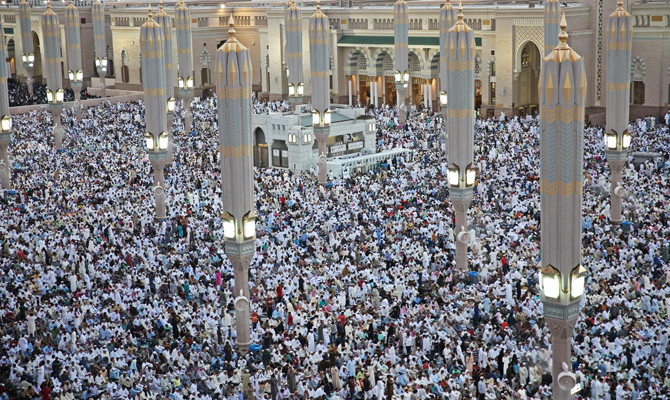
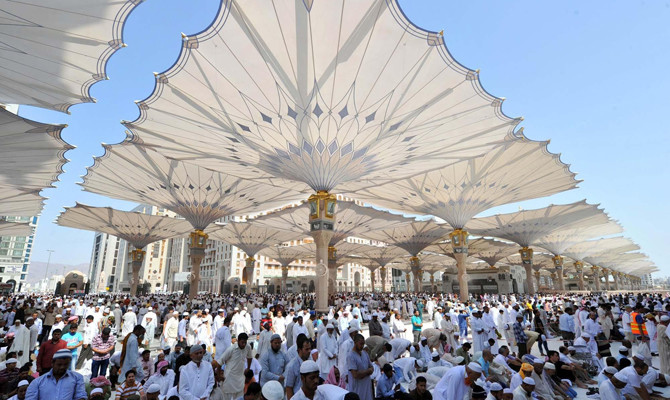
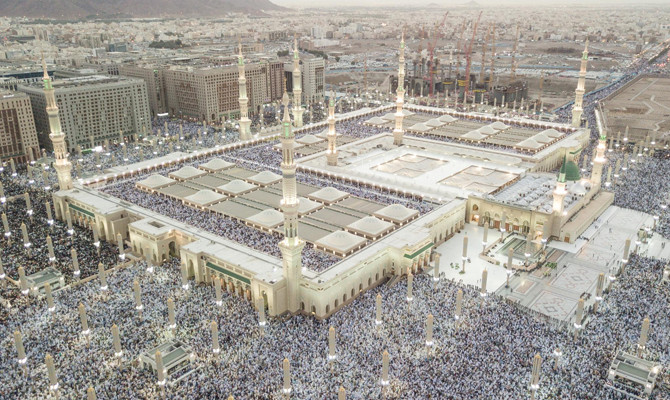

JEDDAH: As Muslims in Saudi Arabia on Thursday start their first day of fasting for Ramadan, they might notice the weather is a bit cooler at the start of the holy month than it has been for several years, at least in the mornings and evenings.
Many will be relieved to know that the blazing hot Ramadans of recent memory may be over for another generation. According to Dr. Khalid Al-Zaaq, a member of the Arab Union for Astronomy and Space Sciences, the hottest Ramadan periods are over.
“Saudis last fasted during a hot Ramadan in the summer of 2014,” said the renowned astronomer. “Since then, temperatures began to gradually come down and to be noticeably low starting from 2015.”
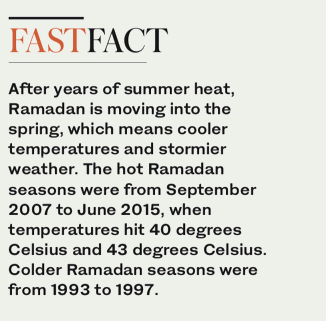
According to Dr. Abdullah Al-Misnid, geography professor at Qassim University, Saudis experienced hot Ramadan seasons from September 2007 through to June 2015, when temperatures hit 40 degrees Celsius and 43 degrees Celsius, respectively.
The highest temperature recorded in Saudi Arabia during the past 45 years was 53 degrees Celsius, which was reached in both Al-Ahsa and Al-Kharj during the summer of 2015.
However, temperatures in Saudi Arabia differ from one region to another. The average summer temperature in the coastal cities of Makkah and Jeddah might be only 37 degrees Celsius, but these costal areas are far more humid than the country’s inland cities.
This year the beginning of Ramadan coincides with the spring, when Saudi Arabia normally has sandstorms, ranging from mild, dusty days to moderate or severe low visibility and terrible winds. The minimum temperature in Riyadh is 33 degrees Celsius.
This brings to mind colder Ramadan seasons, from 1988 to 1997. Al-Zaaq told Arab News that in 1988, central parts of the Kingdom experienced very low temperatures. “However, the northern parts of the country witnessed the lowest recorded temperatures in 1992. In that year the mercury went to down to critical levels,” he said.
 On the other hand, he added, some of the highest temperatures in the Kingdom were recorded in 1986, 2007 and 2012. “Such heat waves reoccur once every four years, and this is normal.”
Al-Zaaq pointed out that this year’s Ramadan comes at the end of a “hot spring,” and the holy month will fall in the spring for the next three years.In 2023, Ramadan will fall in the end of the winter. He said that seven years from now, Ramadan will take place at the beginning of the winter and will continue to fall during that season for nine years.
Salih Farhah, a 46-year-old government sector employee, said people used to rejoice when knowing that Ramadan would be in the winter, because the shorter days and cooler temperatures made the fast easier.
He added that his mother was strict when it came to religious matters, and she would not have allowed him to drink water in Ramadan during the day except when she feared her son would fall unconscious.
“I remember when I was approximately 9 or 10 in Al-Hindawiyah neighborhood, my late mother just started to encourage me to refrain from eating or drinking during the daytime of Ramadan. One day she noticed that I was parched. Her affectionate heart forced her to allow me to have only a sip of water,” Farhah said.
Recalling his fasting memories throughout the different seasons of Ramadan, schoolteacher Ahmed Rabea, 54, told Arab News that some of the most difficult days to fast were during the period from 2008 to 2015, when the temperatures were high and the daytime was longer than the night.
Rabea remembered when he had to work for about 19 days in 2008, describing that experience as “real torture” because he did not have enough time to sleep well and had to stand before his students in a state of attentiveness. “It is a custom that we spend Ramadan nights in praying Taraweeh, visiting relatives and even hosting guests, but that year, I suffered a lot as I had to get up at nine in the morning for work,” Rabea said.
He added he found it difficult to go out during those years because the heat in Jeddah was unbearable. “I spent most of the daytime sleeping,” he said.