PARIS: Most dinosaurs buried their eggs and hoped for the best, but some species — including a few hefty ones — built nests and pampered unhatched offspring much as birds do today, researchers reported Wednesday.
Which raises an intriguing question: How did creatures nearly as heavy as a hippo brood eggs without squashing them?
“Large species may have not sat directly on their eggs,” explained Kohei Tanaka, a researcher at Nagoya University Museum and lead author of a study in Biology Letters that details the incubation strategy of feathered carnivores called oviraptorosaurs.
“Eggs are arranged in a circular pattern with a large central opening,” he told AFP, describing clutches of potato-shaped eggs found in China up to half-a-meter (20 inches) long and weighing up to seven kilos (15 pounds) each.
“The dinosaurs likely sat in the middle of the nest so that they didn’t crush the eggs.”
That didn’t keep the unborn dinos warm, but it may have protected them from predators and the elements, Tanaka speculated.
Modern birds descend from a large group of mostly carnivorous dinosaurs called theropods, all of which — including the fearsome T-rex — are thought to have laid eggs.
But very few theropods built nests, which is why the brooding displayed by oviraptorosaurs — a clade of several dozen species ranging from the turkey-sized Caudipteryx to the 1.4-ton Gigantoraptor — is so important.
“The incubation behavior of birds — such as adults sitting in the nest and possibly brooding — likely evolved from theropod dinosaurs,” said Tanaka. “Our research provides additional evidence.”
Oviraptorosaurs lived during the Cretaceous period, the 80 million years leading up to the asteroid or comet strike blamed for wiping out non-avian, terrestrial dinosaurs.
They had short snouts and beak-like jaws with few or no teeth, and some sported bony crests on their heads. Evidence of generous plumage — especially on the tail — has been found on several species.
Besides the spoke-like arrangement of the fossilized eggs, the eggshell itself provided further evidence that large oviraptorosaurs sat near their unborn progeny, not on top of them.
The eggs of big dinos, the researchers discovered, were more fragile than the eggs of smaller ones, which were clearly designed to carry more weight.
How big is too big to park a dino butt on top of unhatched eggs?
“That’s hard to say,” said Tanaka. “There is a gap in the data, but the threshold should be between 200 and 500 kilos (440 and 1,110 pounds).”
Oviraptorosaurs were falsely accused by early paleontologists of stealing the eggs so often found along side their fossil remains, giving rise to their name: “egg-thief lizards.”


![]()

How does a one-ton dino hatch its eggs? Carefully
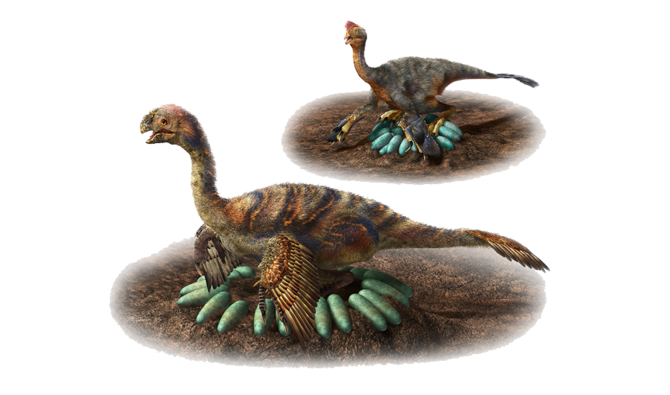
How does a one-ton dino hatch its eggs? Carefully
- Large species may have not sat directly on their eggs
- The incubation behavior of birds — such as adults sitting in the nest and possibly brooding — likely evolved from theropod dinosaurs

Latest updates


Recommended


© 2026 SAUDI RESEARCH & PUBLISHING COMPANY, All Rights Reserved And subject to Terms of Use Agreement.