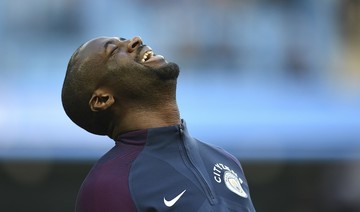
With the title race done, dusted and even relegation and Champions League qualification as good as resolved, the final week in the Premier League feels as though it has been dedicated to farewells. Arsene Wenger left the Emirates for the final time and, the same day, there came at the Etihad a rather less reported goodbye as Yaya Toure was given an emotional send-off by Manchester City.
There was something surprisingly low-key about his departure. City did their best, and there is no doubt that Toure ranks high in the affection of City fans, yet to the wider public and media, Wenger was the only story of that weekend. Yet Toure won as many league titles in his eight years at the Etihad as Wenger did in 22 at Arsenal and, more than that, he radically changed the nature of the club.
His was a career that took a long time to blossom. It began, as the footballing lives of so many players from Ivory Coast do, at ASEC, then he moved in 2001 to Beveren in Belgium. From there it was a long, hard journey through Metalurh Donetsk and Olympiakos to Monaco and then Barcelona.
Toure was never quite a regular there, but he was part of Pep Guardiola’s first two league titles before being offloaded for Manchester City in 2010. The City he joined were in the first flush of their second enormously rich owner. Sheikh Mansour had replaced Thaksin Shinawatra and big signings were turning up almost daily. The year Toure arrived, they also signed David Silva, James Milner, Aleksandar Kolarov, Edin Dzeko, Jerome Boateng and Mario Balotelli.
Milner, Kolarov and Dzeko would all play their parts in transforming City into the club it has become. David Silva remains a key figure, one of the greatest midfield creators in Premier League history. But it was Toure who transformed the club.
In part it was his ability, a languid playing style that meant he never quite appeared as quick as he was, a capacity to eat up the ground in a few effortless strides, a sumptuous first touch and an ability to craft passes and shots with barely any backlift. Guardiola had often used him as a central defender at Barca and he arrived as a holding midfielder, but Toure scored 59 league goals at City. Many of them were vital, many scored when City seemed to have run out of ideas.
His strike in the League Cup final in 2014 was a case in point. Sunderland were leading 1-0 and seemed comfortable when, from nowhere, with no warning he was about to unleash anything out of the ordinary, Toure placed a long-range shot on the top corner. Finding the right verb is almost impossible: He didn’t hammer it or smack it or lash it or any of the things that are usually done to strikes from range; he just, with almost casual grace, sent the ball at astonishing velocity into the top corner. The game was transformed as Toure had transformed so many others and city went on to win 3-1.
There is a quality in sport that is very difficult to define and is almost impossible to chart in numbers, the capacity to win. It is that edge, that ability not merely to perform but to perform when it really matters, to seize games that are drifting and turn them in the right direction.
It’s a quality City have arguably lacked this season: Their excellence has been systemic. They have largely just gone out and played, and that has been enough to win games, often beautifully. When they came under pressure, as they did, for instance, against Liverpool three times and against Manchester United in the league at the Etihad, they have lacked a little of that steel, the necessary toughness to change the course of a game.
Toure had that in abundance. He is, of course, a prodigiously talented footballer, but his importance to City has been more than that. He is a footballer who wins and, as such, he as much as anybody can be said to have transformed City from the newly wealthy ingénues they were into the champions they are today.


![]()

Outgoing Yaya Toure did more than most to transform the fortunes of Manchester City
Outgoing Yaya Toure did more than most to transform the fortunes of Manchester City
- Ivorian midfielder will play his last game for the club on Sunday
- He won as many league titles in eight years at the Etihad as Wenger did in 22 at Arsenal


Latest updates


Recommended


© 2026 SAUDI RESEARCH & PUBLISHING COMPANY, All Rights Reserved And subject to Terms of Use Agreement.