MOSCOW: Following Israeli strikes on Iranian targets in Syria, Russia has positioned itself as a mediator between the Middle Eastern rivals as it has maintained good relations with both countries.
“The Kremlin is sitting on two chairs,” Russian analyst Alexei Malashenko told AFP.
“It is a complex and difficult situation for Russia that has links with both of the sworn enemies.”
Israel carried out raids on dozens of Iranian military targets on Thursday after it said around 20 rockets were fired from Syria at its forces in the occupied Golan Heights.
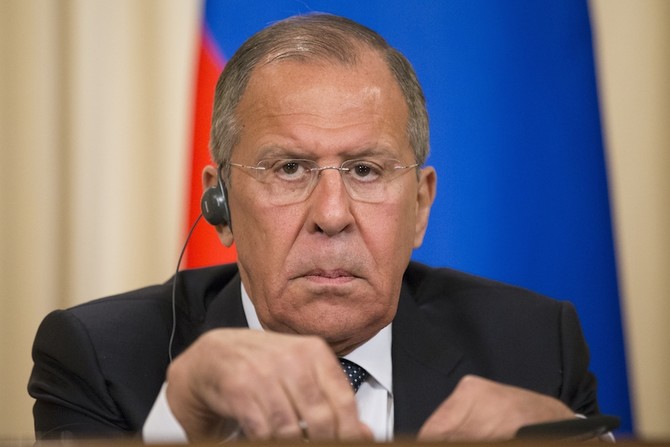
Russia was quick to call for restraint, with Russian Foreign Minister Sergei Lavrov saying on Thursday that “all issues should be solved through dialogue.”
He added that Russia had warned Israel to avoid “all actions that could be seen as provocative” the day before the strikes, when Israeli Prime Minister Benjamin Netanyahu was in Moscow for talks with President Vladimir Putin.
Russian analyst Fyodor Lukyanov said relations between Putin and Netanyahu were “very good” and that the meeting, on the eve of the strikes, showed Russia could play a major role in the Israel-Iran dispute.
“Moscow could use its good relations with the two countries to help them communicate and make sure confrontation does not exceed certain limits,” Lukyanov said.
Russia has become a major player in the Middle East since intervening in the Syrian war on the side of the Damascus regime in September 2015. Analysts also highlight its role as mediator in other conflicts in the area.
“The role of Russia as a mediator is strongly appreciated in the region. This role will be reinforced if the crisis between Israel and Iran worses,” said Alexander Krylov, a foreign policy expert at the Moscow State Institute of International Relations.
Krylov told AFP that Russia’s “additional value” is that it has good relations with forces that other actors refuse to speak to such as with Hamas, Hezbollah, Iran and the Kurds.
Russia’s good ties to Israel were demonstrated by Netanyahu’s visit, he said.
“I do not rule out the idea that Israel gave some clues to Russia about the strikes,” Krylov said.
But even if Russia considers Israel’s security concerns over Iran legitimate, Lukyanov said, it sees Iran as an “indispensable partner on many issues, especially in Syria.”
Russia, Iran and Turkey regularly meet to discuss the regulation of the Syrian war, where the three countries have positioned themselves as major players.
Unlike Turkey, Iran and Moscow are unflinching allies of the Bashar Assad regime and often maintain a united diplomatic front.
Analyst Alexei Malashenko said Russia would do everything possible to maintain relations with both Israel and Iran without taking a stand, especially since Israel’s strikes “do not threaten” Moscow’s position in Syria.
“If Israel were to defy Russia’s dominant role, Russia would react and take a stand. This is unlikely to happen because Israel knows Russia defines the rules in Syria,” said Lukyanov.
But if escalation continues, Moscow will find it difficult to keep playing a mediator’s role.
“Even with the best intention, nobody can bring Iran and Israel to the same table,” said Malashenko.
He added that Russia is also closely watching Washington’s exit from the Iran nuclear deal, which the Kremlin has opposed. On Thursday Moscow said it would continue a “close collaboration” with Iran on the agreement.
Lukyanov said it may not have been coincidental that the Israeli strikes took place shortly after US President Donald Trump announced his country’s withdrawal from the deal.
“Iran’s enemies can only be inspired by this decision: there is a very strong anti-Iranian sentiment,” Lukyanov said. “Increased US pressure on Iran has certainly helped Israel fulfill its agenda.”

Russia seeks to take mediator role between Israel and Iran
Bangladesh mourns Khaleda Zia, its first woman prime minister
- Ousted ex-premier Sheikh Hasina, who imprisoned Zia in 2018, offers condolences on her death
- Zia’s rivalry with Hasina, both multiple-term PMs, shaped Bangladeshi politics for a generation
DHAKA: Bangladesh declared three days of state mourning on Tuesday for Khaleda Zia, its first female prime minister and one of the key figures on the county’s political scene over the past four decades.
Zia entered public life as Bangladesh’s first lady when her husband, Ziaur Rahman, a 1971 Liberation War hero, became president in 1977.
Four years later, when her husband was assassinated, she took over the helm of his Bangladesh Nationalist Party and, following the 1982 military coup led by Hussain Muhammad Ershad, was at the forefront of the pro-democracy movement.
Arrested several times during protests against Ershad’s rule, she first rose to power following the victory of the BNP in the 1991 general election, becoming the second woman prime minister of a predominantly Muslim nation, after Pakistan’s Benazir Bhutto.
Zia also served as a prime minister of a short-lived government of 1996 and came to power again for a full five-year term in 2001.
She passed away at the age of 80 on Tuesday morning at a hospital in Dhaka after a long illness.
She was a “symbol of the democratic movement” and with her death “the nation has lost a great guardian,” Bangladesh’s interim leader Muhammad Yunus said in a condolence statement, as the government announced the mourning period.
“Khaleda Zia was the three-time prime minister of Bangladesh and the country’s first female prime minister. ... Her role against President Ershad, an army chief who assumed the presidency through a coup, also made her a significant figure in the country’s politics,” Prof. Amena Mohsin, a political scientist, told Arab News.
“She was a housewife when she came into politics. At that time, she just lost her husband, but it’s not that she began politics under the shadow of her husband, president Ziaur Rahman. She outgrew her husband and built her own position.”
For a generation, Bangladeshi politics was shaped by Zia’s rivalry with Sheikh Hasina, who has served as prime minister for four terms.
Both carried the legacy of the Liberation War — Zia through her husband, and Hasina through her father, Sheikh Mujibur Rahman, widely known as the “Father of the Nation,” who served as the country’s first president until his assassination in 1975.
During Hasina’s rule, Zia was convicted in corruption cases and imprisoned in 2018. From 2020, she was placed under house arrest and freed only last year, after a mass student-led uprising, known as the July Revolution, ousted Hasina, who fled to India.
In November, Hasina was sentenced to death in absentia for her deadly crackdown on student protesters and remains in self-exile.
Unlike Hasina, Zia never left Bangladesh.
“She never left the country and countrymen, and she said that Bangladesh was her only address. Ultimately, it proved true,” Mohsin said.
“Many people admire Khaleda Zia for her uncompromising stance in politics. It’s true that she was uncompromising.”
On the social media of Hasina’s Awami League party, the ousted leader also offered condolences to Zia’s family, saying that her death has caused an “irreparable loss to the current politics of Bangladesh” and the BNP leadership.
The party’s chairmanship was assumed by Zia’s eldest son, Tarique Rahman, who returned to Dhaka just last week after more than 17 years in exile.
He had been living in London since 2008, when he faced multiple convictions, including an alleged plot to assassinate Hasina. Bangladeshi courts acquitted him only recently, following Hasina’s removal from office, making his return legally possible.
He is currently a leading contender for prime minister in February’s general elections.
“We knew it for many years that Tarique Rahman would assume his current position at some point,” Mohsin said.
“He should uphold the spirit of the July Revolution of 2024, including the right to freedom of expression, a free and fair environment for democratic practices, and more.”