Coal mine deaths climb to 23 in southwest Pakistan – officials

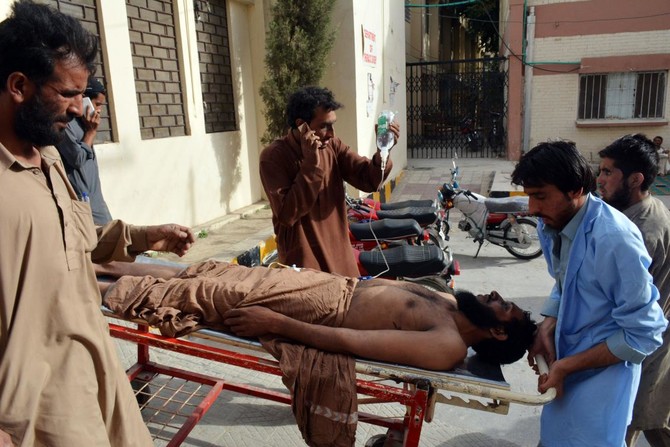
Pakistani miners carry an injured colleague on a stretcher to the hospital after the collapse of coal mine in Quetta on May 5, 2018. Sixteen miners were killed and nine others were wounded on May 5 when a coal mine collapsed due to a gas explosion in southwestern Pakistan, officials said. (AFP/Banaras Khan)
Updated 06 May 2018
Follow

Coal mine deaths climb to 23 in southwest Pakistan – officials

QUETTA, Pakistan: The death toll from Saturday's coal mine blast and landslides in southwest Pakistan climbed to 23 on Sunday, officials said, after ending their rescue operation.
At least 16 miners died on Saturday and more than a dozen were trapped after an explosion in a mine in the Marwar coalfields in Baluchistan province, Director of Disaster Management Attaullah Khan said.
A methane gas build-up inside the mine caused the blast, Khan said. Chief inspector of mines Iftikhar Ahmad said the rescue operation overnight pulled out 11 injured miners.
He said two labourers died in a landslide on Saturday in another mine in Surrang coalfields.
It was not immediately clear if that was caused by the explosion.
"Rescuers retrieved five more bodies from this mine," he said.
Another official, Mohammad Atif, said authorities had opened an investigation after sealing both mines.
Accidents are frequent in the province's mines, where safety measures are basic and many of the workforce come from other parts of Pakistan.
The mines are mostly owned by state-run Pakistan Mineral Development Corporation, which leases many of them to private contractors.
The country has huge coal reserves estimated at more than 184 billion tonnes. It produces 4 million tonnes of coal annually, most of which is consumed by brick-making kilns.
The Marwar and Surrang coalfields lie east of Baluchistan's capital Quetta. 


Pakistanis fleeing Iran describe strikes shaking ground under their feet

Updated 58 min 43 sec ago
Follow

Pakistanis fleeing Iran describe strikes shaking ground under their feet

  • Nearly 1,000 students, businessmen and pilgrims have fled Iran since the war started out of a total 35,000 Pakistanis in the country

QUETTA: Pakistanis fleeing Iran described explosions and missile strikes across Tehran shaking the ground under ​their feet and engulfing buildings in fire and smoke in a city emptied of many of its residents. The conflict has widened sharply, with a US submarine sinking an Iranian warship off Sri Lanka on Wednesday and NATO air defenses destroying an Iranian missile fired toward Turkiye.
Governments have been scrambling to evacuate stranded citizens, with most of the region’s airspace closed due to the risk of missiles hitting passenger planes.
“I was in the classroom when a powerful explosion rocked our university building,” Hareem ‌Zahra, 23, a ‌student at the Tehran University of Engineering, told ​Reuters ‌after ⁠crossing Pakistan’s land ​border with ⁠Iran.
“We saw thick smoke coming from many buildings on fire,” she said, adding Tehran was under attack until the moment she left.

TEHRAN LOOKED DESERTED
Nearly 1,000 students, businessmen and pilgrims have fled Iran since the war started out of a total 35,000 Pakistanis in the country, Mudassir Tipu, Pakistan’s ambassador to Tehran, said.
“There are now serious challenges. As you know there is no Internet in most parts of Iran,” he said. Iran ⁠has retaliated with a barrage of ballistic missiles targeting Israel and ‌Washington’s allies in the Gulf, including Qatar, Kuwait, ‌the UAE, and Saudi Arabia, following US and Israeli ​air strikes that killed Supreme Leader ‌Ayatollah Ali Khamenei on Saturday.
Tehran has looked deserted since the conflict began, said Nadir ‌Abbas, 25, a student of Persian literature at a university in the Iranian capital.
“I saw a drone hit a basketball court where six girl players lost their lives.”
Reuters could not verify his account.

DESTRUCTION EVERYWHERE

Islamabad is walking a diplomatic tightrope as it attempts to maintain warming ‌ties with Washington while expressing solidarity with Iran.
Pakistan is home to the second-largest Shiite population in the world after Iran and ⁠being drawn into ⁠the conflict could lead to instability at home as well as complications evacuating its citizens.
“The first attack happened right next to my hospital,” said Sakhi Aun Mohammad, a student at Tehran University of Medical Sciences. After he reached the border, an Iranian friend called to check if he was safe, saying: “’Thank God, you have gone to Pakistan, all of you are safe, but your hostel has been attacked’.” A Pakistani diplomat who is still in Tehran said attacks took place every four or five hours, adding one missile struck a building next to his office. “At times you will feel as if something exploded right at your feet,” he said. “The last time ​I got out was at night. ​Buildings had collapsed, some others were on fire. There is destruction everywhere.”
He added: “It is almost like a ghost town.”