Saudi energy minister visits South Korea’s Atomic Energy Research Institute

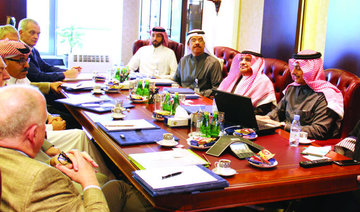
Saudi Arabia’s Minister of Energy, Industry and Mineral Resources Khalid Al-Falih, center, with Saudi and Korean engineers at the Korea Atomic Energy Research Institute (KAERI) in Seoul on Saturday. (SPA)
Updated 05 May 2018
Follow

Saudi energy minister visits South Korea’s Atomic Energy Research Institute

  • Last year, KSA and South Korea entered into a joint venture to prepare engineering designs for the reactor with training programs in a range of nuclear energy fields, including reactor design.
  • 48 Saudi engineers are currently in Daejeon, South Korea to help develop an advance reactor technology for the Kingdom.

JEDDAH: Saudi Arabia’s energy minister, Khalid Al-Falih, visited South Korea’s Atomic Energy Research Institute on Saturday as part of a three-day visit to the country.

Al-Falih met 48 Saudi engineers from King Abdullah City for Atomic and Renewable Energy (KACARE), who are in Daejeon in South Korea to help develop the System-integrated Modular Advanced Reactor Technology (SMART) project.

KACARE entered into a joint venture with the Korea Atomic Energy Research Institute (KAERI) to prepare engineering designs for the reactor with training programs in a range of nuclear energy fields, including reactor design.

Al-Falih also toured the KAERI Institute, visiting the testing center, and the reactor’s control and simulator room.

The reactor scheme is part of a Saudi national atomic energy project approved by the Cabinet last year to develop compact nuclear reactors so that the Kingdom can diversify the energy sources in line with Vision 2030.

KACARE and the Korea Atomic Energy Research Institute signed a pre-project engineering agreement in September 2015 that will remain in effect until November 2018.

Earlier, Al-Falih met South Korean President Moon Jae-in and Minister of Trade, Industry and Energy, Paik Un-gyu, to expand bilateral cooperation in energy and other key sectors.

Al-Falih said the Kingdom hoped to jointly develop small or medium-sized reactors with South Korea. It was also willing to invest in the joint development of electric and other future-oriented vehicles.

Saudi Arabia has received requests for information from five countries — South Korea, China, US, France and Russia — to build two nuclear reactors.

If South Korea wins the bid, it will be their second nuclear export deal in the Middle East. In 2009, a consortium led by state-run utility Korea Electric Power Corp. secured its first nuclear exports deal, a $20 billion contract with the UAE.


Board of Grievances unveils judicial intelligence hackathon to foster innovation

Updated 28 December 2025
Follow

Board of Grievances unveils judicial intelligence hackathon to foster innovation

  • Registration opens on Sunday, Dec. 28, 2025, and continues through Jan. 20, 2026

RIYADH: Saudi Arabia’s Board of Grievances has opened registration for the Judicial Intelligence Hackathon, the institution’s first competition seeking sustainable solutions that harness cutting-edge technology to improve the efficiency of judicial procedures, the Saudi Press Agency reported.

Registration opens on Sunday, Dec. 28, 2025, and continues through Jan. 20, 2026, as part of efforts to cultivate talent and promote innovation in digital transformation and artificial intelligence in the judicial sector.

The board is calling on industry experts, experienced professionals, and university students to form teams of three to five members. Each team must be led by a Saudi citizen or academic staff member at least 18 years old.

Participants register via a dedicated portal on the board’s digital platform and must submit a preliminary proposal demonstrating practical and legal viability, incorporating advanced technology with appropriate quality standards, and showing innovation relevant to the board's operations with transformative impact and long-term sustainability.

Competition unfolds in two distinct tracks. The first addresses AI applications and creative solutions for administrative justice, tackling challenges such as minimizing procedural errors and offenses during virtual court proceedings and streamlining lawsuit filing classifications.

The second track emphasizes digital innovation enhancing user journeys, focusing on simplifying document submission processes when initiating lawsuits and developing accessibility solutions enabling seniors and people with disabilities to navigate board services more effectively.

Finalists are scheduled to be announced on Jan. 23, 2026, followed by virtual project discussion and presentation sessions on Jan. 28. 

According to the SPA, this methodology for sourcing innovative concepts underscores the dedication of the board’s leadership to advance performance across judicial chambers and administrative divisions while pursuing strategic goals of refining administrative court litigation processes, expediting case resolutions, and establishing competitive leadership in the judicial arena.