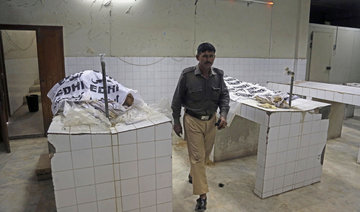
KARACHI: A married couple were shot dead by “unidentified gunmen” on the outskirts of Karachi on Wednesday, police officials said. A Sindh Industrial Trading Estate (SITE) official said that the victims, Amir, 32, and Mukhtiba, 24, were residents of Orangi Town who had wed about two years ago against the will of their families.
While this particular “honor killing” crime was reported to the police and investigations are underway, many similar cases go unreported in this part of Karachi.
One incident that initially went unreported, in the spring of 2013, involved the decision of a makeshift jirga, an alternative method of dispute resolution by the local community that is adopted in Pashtun-dominated areas of the country. A local militant commander convened the gathering at a house in Qaimkhani Colony Ittehad Town, a Tehreek-e-Taliban Pakistan (TTP) stronghold and a no-go area for law-enforcement agencies. The issue the commander was asked to “settle” was a dispute involving a couple and the “honor” of their family.
After a brief, one-sided hearing, the commander handed down his judgment: the couple were condemned to death by stoning. Fazlur Rehman, an eyewitness and relative of the woman who was killed, said the couple was taken into the yard, buried up to their chests and stoned to death.
“It is the responsibility of the state to look after the women who suffer after members of their family are thrown behind bars for committing such gruesome killings,” said Mahnaz Rehman, the resident director of Aurat Foundation, pointing out that that most of these women are housewives who rarely leave their homes. “We have seen how women suffer when male members of their family are arrested in cases of honor killing.”
She added: “Jirgas should not be allowed to function.”
An operation began in Karachi on September 5, 2013, in which officers from law-enforcement agency the Pakistan Rangers conducted targeted raids in Sultanabad, Manghopir, Ittehad Town, Sohrab Goth, Janjal Goth, Gulshan-e-Buner and other areas where the Taliban had taken refuge. Saqib Sagheer, a journalist who covers crime and militancy for a leading Urdu daily, said the Taliban was swiftly and successfully weeded out in these regions.
Despite the Taliban being driven out, the menace of honor killing persists.
On August 14, 2017, 15-year-old Bakhtaj tried to elope with 17-year-old Ghani Rehman. When the families found out, they decided to reach a peaceful settlement and allow the couple to marry quickly. This was unacceptable to Sartaj Khan, a close relative of the TTP’s Khalid Omar Khorasani. Khan assembled a jirga in the eastern Landhi area of Karachi, attended by nearly 40 people. The aim of the meeting was to foil the settlement reached by the families.
Aslam Shah, a neighbor of Bakhtaj, said: “The families, after tracing the teenage couple, decided to get them married, but Sartaj Khan, when informed, gathered elders from Safi tribe, a sub-tribe hailing from Mohmand Agency.”
The male relatives of the girl were the first to implement the jirga’s death sentence and electrocuted her. The boy’s father resisted the decision but, said Shah, “he was threatened by Sartaj Khan, who told him that he would ask Khorasani to blow their houses.”
Fighting back tears, Rehman’s sister told of the family’s ordeal and the final moments she spent with her brother.
“Da Jee [one of the several titles used for father in Pashto] asked the boy to dine with him one last time,” she said. “But Ghani Lala [a title used for older brother] said he was not hungry. Da Jee had his dinner after the night-time prayer. Meanwhile, Lala turned to us, he dug his hands into his pockets and pulled out a few packets of Tasty Gold Supari [areca nuts] and gave one to each of us. He also left one for our older sister, who was not present at the time.”
A few hours later Rehman was electrocuted.
According to the First Information Report (FIR) filed by police on the killings, a copy of which was made available to Arab News, the jirga head, the fathers and uncles of the couple, and 30 to 35 other people were present at the time of the executions.
Shah alleged that the Shah Latif Town Station House Officer, Amanullah Marwat, took a bribe to free the jirga members. Marwat denies this claim and said that the FIR was only an initial report. After investigations, he said he found out that only five people took part in the jirga.
While the court voiced its dismay over the police report in the Landhi honor killing case, another incident emerged. According to reports, the police arrested nine people accused of involvement in the killing of a couple from Kohistan in Khyber Pakhtunkhwa. The pair, Husna and Hadi, had fled to Karachi from Kohistan after they willingly married each other.
Experts said the levels of honor killings in Pashtun and Sindhi areas is higher than in other communities mainly because of the low rate of literacy.
“Convening a jirga in Sindh is illegal,” said Asad Iqbal Butt, vice chairperson of Human Rights Commission of Pakistan’s Sindh chapter. However, a jirga gives added clout to its participants, making it a very lucrative business in the southern province, he added. Landlords, who are political leaders, use them to acquire votes, and those who are not politicians provide those political leaders with votes in return for money, he said.
“The government has shown zero tolerance toward jirgas in Sindh after the High Court banned all trials conducted under the jirga system throughout Sindh in April, 2004,” said Rasheed Channa, a spokesman for the chief minister Sindh.
Butt said that in 2016, 103 honor killings were reported in Sindh, of which 90 occurred in Karachi during the first three quarters of the year.
“While this may be seen as an increase in number, I see it as an increase in the reporting of such incidents,” he said. “In the past, most cases of honor killing would go unreported. Now the trend is changing. It is changing for the better.
“An informed society and better laws can help us prevent the menace in the future.”


![]()

Karachi’s deadly dishonorable secret
Karachi’s deadly dishonorable secret
- Experts say the incidence of honor killing in Pashtun and Sindhi areas is higher than in other communities, mainly because of the low literacy rate
- An informed society and better laws can help curb the practice

Latest updates


© 2026 SAUDI RESEARCH & PUBLISHING COMPANY, All Rights Reserved And subject to Terms of Use Agreement.