Voter apathy triumphs in historic Lebanon poll

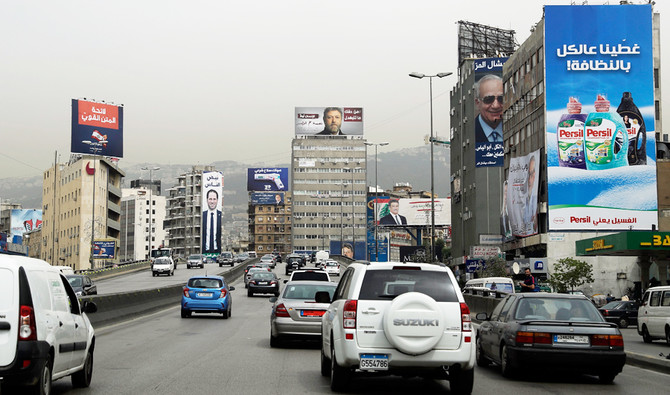
Cars drive past electoral campaign posters on a highway on the northern outskirts of Beirut. (AFP)
Updated 05 May 2018
Follow

Voter apathy triumphs in historic Lebanon poll

  • Voter apathy and distrust of candidates have resulted in poor turnout at the polls in past elections
  • 3,746,483 registered voters in this year’s elections

BEIRUT: Lebanon’s streets and buildings have been swathed in political banners in the lead-up to historic elections on Sunday, but voter turnout is expected to be low, according to observers.

Voter apathy and distrust of candidates have resulted in poor turnout at the polls in past elections.

In the last parliamentary elections, held in 2009, just over half the 3 million registered voters placed their ballots, according to the International Institute for Democracy and Electoral Assistance.

Voter turnout in Sunday’s poll is expected to be slightly higher, but still too low to bring significant political change.

In the 2016 municipal elections, independent group Beirut Madinati lost to Prime Minister Saad Hariri’s Future Movement. Although it amassed 40 percent of the votes, only 20 percent of the registered electorate voted.

“Historically in Lebanon, voter turnout is not high, except in certain places where people are forced to go,” the advocacy group Sabaa’s executive board member Walid Hallassou said.

Lebanese President Michel Aoun has called for public holidays to encourage voting. But Middle East Airlines’ flights to Dubai, London and Paris from Beirut are fully booked at the weekend, suggesting the Lebanese are more interested in spending their long weekend away from the election rather than being part of it.


Sectarian strife and political tension in past years have destroyed the hopes of the country’s citizens.

Since the Taif Agreement was signed signaling the end to the decades-long civil war, Lebanese politics has been ruled by previous warlords and a government formed of the two reigning coalitions.

Lebanon’s new electoral system merges proportional representation with quotas for each religious group to maintain the country’s sectarian balance among the 128 seats in parliament.

Under this arrangement, the majority system has been replaced and the threshold needed to win an election lowered — a plan that should benefit independents and reformers, easing the grip on the power of the country’s main clans.

Voters will cast ballots both for their favored list of candidates and a preferred candidate on that list.

“The new law just complicates things even more with the new system,” Tala Doghman, an artist, told Arab News.

“There’s a lot of barking and not a lot of biting.”


Decoder

Since the last time Lebanon held parliamentary elections

Barack Obama was sworn in as the 44th US president, the first African-American to be president | Swine flu was deemed a global pandemic by the World Health Organization | Terrorist group Boko Haram began its uprising in Nigeria | Rio de Janeiro was awarded hosting rights for the 2016 Olympics | The International Criminal Court issued an arrest warrant for Sudanese President Omar Al-Bashir for war crimes

FASTFACTS

IN NUMBERS

53% voter turnout in the 2009 parliamentary elections | There are 3,746,483 people who have registered to vote in time for this year’s elections | Lebanon's population is 6,229,794 | There are 128 seats in Lebanon’s Parliament


Israel police to deploy around Al-Aqsa for Ramadan, Palestinians report curbs

Updated 17 February 2026
Follow

Israel police to deploy around Al-Aqsa for Ramadan, Palestinians report curbs

  • The Al-Aqsa compound is a central symbol of Palestinian identity and also a frequent flashpoint

JERUSALEM: Israeli police said Monday that they would deploy in force around the Al-Aqsa Mosque during the Muslim holy month of Ramadan, which begins this week, as Palestinian officials accused Israel of imposing restrictions at the compound.
Over the course of the month of fasting and prayer, hundreds of thousands of Palestinians traditionally attend prayers at Al-Aqsa — Islam’s third-holiest site, located in east Jerusalem, which Israel captured in 1967 and later annexed.
Arad Braverman, a senior Jerusalem police officer, said forces would be deployed “day and night” across the compound, known to Jews as the Temple Mount, and in the surrounding area.
He said thousands of police would also be on duty for Friday prayers, which draw the largest crowds of Muslim worshippers.
Braverman said police had recommended issuing 10,000 permits for Palestinians from the occupied West Bank, who require special permission to enter Jerusalem.
He did not say whether age limits would apply, adding that the final number of people would be decided by the government.
The Palestinian Jerusalem Governorate said in a separate statement it had been informed that permits would again be restricted to men over 55 and women over 50, mirroring last year’s criteria.
It said Israeli authorities had blocked the Islamic Waqf — the Jordanian?run body administering the site — from carrying out routine preparations, including installing shade structures and setting up temporary medical clinics.
A Waqf source confirmed the restrictions and said 33 of its employees had been barred from entering the compound in the week before Ramadan.
The Al-Aqsa compound is a central symbol of Palestinian identity and also a frequent flashpoint.
Under long?standing arrangements, Jews may visit the compound — which they revere as the site of their second temple, destroyed by the Romans in 70 AD — but they are not permitted to pray there.
Israel says it is committed to maintaining this status quo, though Palestinians fear it is being eroded.
Braverman reiterated Monday that no changes were planned.
In recent years, a growing number of Jewish ultranationalists have challenged the prayer ban, including far?right politician Itamar Ben-Gvir, who prayed at the site while serving as national security minister in 2024 and 2025.