

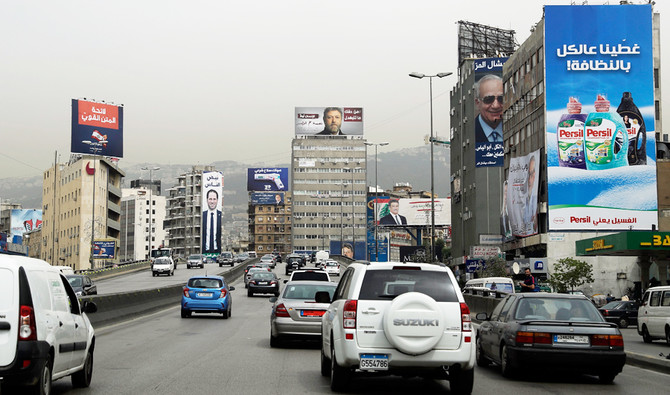
Voter apathy triumphs in historic Lebanon poll

Cars drive past electoral campaign posters on a highway on the northern outskirts of Beirut. (AFP)
Updated 05 May 2018
Follow

Voter apathy triumphs in historic Lebanon poll

  • Voter apathy and distrust of candidates have resulted in poor turnout at the polls in past elections
  • 3,746,483 registered voters in this year’s elections

BEIRUT: Lebanon’s streets and buildings have been swathed in political banners in the lead-up to historic elections on Sunday, but voter turnout is expected to be low, according to observers.

Voter apathy and distrust of candidates have resulted in poor turnout at the polls in past elections.

In the last parliamentary elections, held in 2009, just over half the 3 million registered voters placed their ballots, according to the International Institute for Democracy and Electoral Assistance.

Voter turnout in Sunday’s poll is expected to be slightly higher, but still too low to bring significant political change.

In the 2016 municipal elections, independent group Beirut Madinati lost to Prime Minister Saad Hariri’s Future Movement. Although it amassed 40 percent of the votes, only 20 percent of the registered electorate voted.

“Historically in Lebanon, voter turnout is not high, except in certain places where people are forced to go,” the advocacy group Sabaa’s executive board member Walid Hallassou said.

Lebanese President Michel Aoun has called for public holidays to encourage voting. But Middle East Airlines’ flights to Dubai, London and Paris from Beirut are fully booked at the weekend, suggesting the Lebanese are more interested in spending their long weekend away from the election rather than being part of it.


Sectarian strife and political tension in past years have destroyed the hopes of the country’s citizens.

Since the Taif Agreement was signed signaling the end to the decades-long civil war, Lebanese politics has been ruled by previous warlords and a government formed of the two reigning coalitions.

Lebanon’s new electoral system merges proportional representation with quotas for each religious group to maintain the country’s sectarian balance among the 128 seats in parliament.

Under this arrangement, the majority system has been replaced and the threshold needed to win an election lowered — a plan that should benefit independents and reformers, easing the grip on the power of the country’s main clans.

Voters will cast ballots both for their favored list of candidates and a preferred candidate on that list.

“The new law just complicates things even more with the new system,” Tala Doghman, an artist, told Arab News.

“There’s a lot of barking and not a lot of biting.”


Decoder

Since the last time Lebanon held parliamentary elections

Barack Obama was sworn in as the 44th US president, the first African-American to be president | Swine flu was deemed a global pandemic by the World Health Organization | Terrorist group Boko Haram began its uprising in Nigeria | Rio de Janeiro was awarded hosting rights for the 2016 Olympics | The International Criminal Court issued an arrest warrant for Sudanese President Omar Al-Bashir for war crimes

FASTFACTS

IN NUMBERS

53% voter turnout in the 2009 parliamentary elections | There are 3,746,483 people who have registered to vote in time for this year’s elections | Lebanon's population is 6,229,794 | There are 128 seats in Lebanon’s Parliament


The UN says Al-Hol camp population has dropped sharply as Syria moves to relocate remaining families

Updated 15 February 2026
Follow

The UN says Al-Hol camp population has dropped sharply as Syria moves to relocate remaining families

  • Forces of Syria’s central government captured the Al-Hol camp on Jan. 21 during a weekslong offensive against the SDF, which had been running the camp near the border with Iraq for a decade

DAMASCUS: The UN refugee agency said Sunday that a large number of residents of a camp housing family members of suspected Daesh group militants have left and the Syrian government plans to relocate those who remain.
Gonzalo Vargas Llosa, UNHCR’s representative in Syria, said in a statement that the agency “has observed a significant decrease in the number of residents in Al-Hol camp in recent weeks.”
“Syrian authorities have informed UNHCR of their plan to relocate the remaining families to Akhtarin camp in Aleppo Governorate (province) and have requested UNHCR’s support to assist the population in the new camp, which we stand ready to provide,” he said.
He added that UNHCR “will continue to support the return and reintegration of Syrians who have departed Al-Hol, as well as those who remain.”
The statement did not say how residents had left the camp or how many remain. Many families are believed to have escaped either during the chaos when government forces captured the camp from the Kurdish-led Syrian Democratic Forces last month or afterward.
There was no immediate statement from the Syrian government and a government spokesperson did not respond to a request for comment.
At its peak after the defeat of IS in Syria in 2019, around 73,000 people were living at Al-Hol. Since then, the number has declined with some countries repatriating their citizens. The camp’s residents are mostly children and women, including many wives or widows of IS members.
The camp’s residents are not technically prisoners and most have not been accused of crimes, but they have been held in de facto detention at the heavily guarded facility.
Forces of Syria’s central government captured the Al-Hol camp on Jan. 21 during a weekslong offensive against the SDF, which had been running the camp near the border with Iraq for a decade. A ceasefire deal has since ended the fighting.
Separately, thousands of accused IS militants who were held in detention centers in northeastern Syria have been transferred to Iraq to stand trial under an agreement with the US
The US military said Friday that it had completed the transfer of more than 5,700 adult male IS suspects from detention facilities in Syria to Iraqi custody.
Iraq’s National Center for International Judicial Cooperation said a total of 5,704 suspects from 61 countries who were affiliated with IS — most of them Syrian and Iraqi — were transferred from prisons in Syria. They are now being interrogated in Iraq.