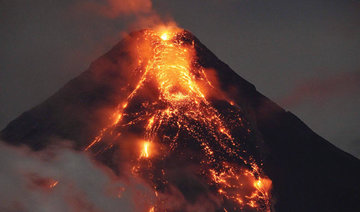
LOS ANGELES: The US state of Hawaii’s Kilauea volcano erupted Thursday, causing lava to spew out of ground fissures in residential areas and prompting thousands of people to seek shelter.
The Pacific island state’s governor David Ige signed an emergency proclamation releasing disaster funds to the Big Island in the eruption’s wake, as local news footage showed streams of lava snaking through forested areas near Kilauea, one of the most active volcanoes in the world.
The Hawaii County Civil Defense Agency reported “steam and lava emissions from a crack in Leilani Subdivision in the area of Mohala Street” following the eruption, prompting a mandatory evacuation of some 1,700 people.
“White, hot vapor and blue fume emanated from an area of cracking in the eastern part of the subdivision,” the US Geological Survey said. The area has about 770 structures.
Local community centers in the broader district, home to some 10,000 people, were open to residents impacted by the threat, Hawaii’s emergency management agency said.
USGS authorities of the Hawaiian Volcano Observatory unit were both on the ground and headed into the air to assess the eruption, which followed hundreds of small earthquakes in recent days and began around 4:45p local time (0245 GMT Friday), according to the agency.
Earlier, at 10:30am, a larger 5.0-magnitude earthquake south of the Puu Oo volcanic cone triggered rockfalls and potential collapse into a crater on the volcano, according to USGS.
Using his drone, area resident Jeremiah Osuna captured video footage of the red-hot lava flow, which he described as the opening of a “fire curtain” that left him feeling “shock and awe.”
“It was like if you put a bunch of rocks into a dryer and turned it on — a lot of earth and pressure and fire just moving around,” said.
After the eruption, authorities warned that “lava inundation,” fire, smoke and additional earthquakes could follow.
The Civil Defense Agency urged those under mandatory evacuation orders to stay away, as fire authorities were detecting “extremely high levels of dangerous sulfur dioxide gas” in the zone.
Governor Ige activated the archipelago state’s National Guard troops, and told residents to pay heed to official warnings.
In his emergency declaration the governor noted the current flow was showing similar characteristics to a 1960 eruption in the Kapoho area that “caused significant damage to public and private property in the lower Puna region” of the county.
Geologist Janet Babb of the Hawaiian Volcano Observatory said that scientists had been following an “intrusion of magma” down the rift zone since Monday afternoon in anticipation of a possible eruption.
She said activity from that particular fissure had stopped, but warned additional eruptions could occur and urged Hawaiians to following advice from authorities.
Yvonne Baur, a lava tour guide, was visiting a friend in a neighborhood of houses scattered across a barren lava flow field when the 5.0 tremor struck — and called the pinkish-grey plume that followed “exciting.”
But Baur calls a less hazardous zone of the region home and — despite her enthusiasm for eruptions — said she “would never build or buy a house” in such high risk areas.
“I want to be close, but not too close.”
US Senator Brian Schatz of Hawaii said the Federal Emergency Management Agency (FEMA) was mobilizing resources, as well as monitoring for forest fires, power outages and water supply issues.
Hawaii Island, or the Big Island, is the largest of the eight main islands that comprise the Pacific US state, an archipelago that includes hundreds of smaller volcanic islands. The affected area is part of the Big Island’s East Rift Zone.
Big Island resident Janice Wei, who moved to Hawaii from California — known for its high earthquake risk — said the eruption was almost a “relief.”
“We’ve been waiting for big movement from the crater, after so many small earthquakes,” she said.
“The Hawaiians and local people have lived here forever,” she said. “You know what’s going on; we have warning systems.”
“Everybody should be prepared.”


![]()

Thousands flee as Hawaii’s Kilauea volcano eruption hits residential areas
Thousands flee as Hawaii’s Kilauea volcano eruption hits residential areas

Latest updates



Recommended


© 2026 SAUDI RESEARCH & PUBLISHING COMPANY, All Rights Reserved And subject to Terms of Use Agreement.