Iran in new crackdown on Arab minority

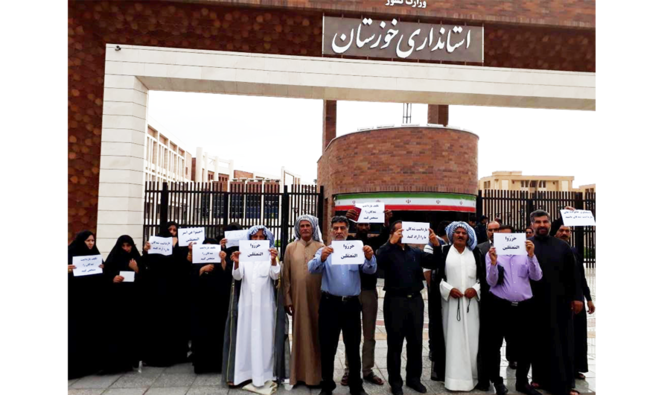
Families of prisoners in Ahvaz protest in front of the governor's office in Ahvaz, Iran, on April 16, 2018. (Handout via REUTERS)
Updated 04 May 2018
Follow

Iran in new crackdown on Arab minority

  • Hundreds detained in city of Ahvaz, the regional capital of Khuzestan, where most of Iran’s Arabs live.
  • Ahvaz rights group says protesters are being held on charges including separatism, militancy or being “agents of Saudi Arabia.”

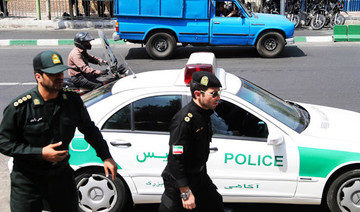
LONDON: Iranian security forces have arrested hundreds of ethnic Arabs as the Tehran regime steps up its repression of protesters in the restive southwestern Khuzestan province.

Police have a launched a new crackdown in the city of Ahvaz amid protests against utility cuts, poverty, discrimination and Iran’s involvement in foreign wars.

Ahvaz Human Rights Organization says that of the hundreds detained, it has identified 70. They are being held on charges including separatism, militancy or being “agents of Saudi Arabia.” Dozens have also been summoned, interrogated and released.

Released prisoners said they had come under pressure from security forces, especially the Islamic Revolutionary Guard Corps, not to talk about their detention. They said they were subjected to routine beatings, threats and torture with electric shocks.

Ahvaz is the regional capital of Khuzestan, where most of Iran’s Arabs live. They joined nationwide protests in January against economic mismanagement and corruption, and clashes broke out between police and demonstrators.

Sporadic protests continued there after they died away elsewhere, as Arabs voiced anger at barriers to fair employment and political rights in a region that accounts for 85 percent of Iran’s oil wealth.

Another cause of unrest is drought, exacerbated by the diversion of water supplies to ethnically Persian provinces such as Isfahan. Protesters say Iran should not be spending money in Syria, Iraq and Yemen while Iranians are struggling.

At a protest in Ahvaz, protesters drew parallels with the Syrian city of Aleppo, where Iran is building power plants.  “Ahvaz is like Aleppo, it has no electricity, no water,” they chanted at the rally before police broke it up.

Among the hundreds arrested in recent weeks was Ma’edeh Shabaninejad, 15, who has been accused of inciting violence through her poetry.  Security forces raided her home and confiscated her poems.

“Resist, my homeland, there is not much left of you,” one of her verses said. “Soon you will hear in your sky the sound of smiles and liberation’s call.” The girl’s father, Sahid Shabaninejad, said: “I am amazed the Iranian government is afraid of a 15-year-old girl.”

UAE to withdraw counter-terrorism units in Yemen, reiterates respect for Saudi sovereignty

Updated 35 min 11 sec ago
Follow

UAE to withdraw counter-terrorism units in Yemen, reiterates respect for Saudi sovereignty

  • Abu Dhabi emphasized its commitment to maintaining close coordination with Riyadh on all matters of mutual concern

ABU DHABI: The UAE announced the withdrawal of its remaining counter-terrorism units in Yemen on Tuesday, citing recent developments and concerns over the safety and effectiveness of ongoing operations.

In a statement issued on Tuesday carried on Emirates News Agency, the Ministry of Defense said the decision was taken voluntarily and in coordination with relevant international partners, ensuring the safety of UAE personnel.

The move follows a comprehensive assessment of current conditions and aligns with the UAE’s broader commitments to regional security and stability, the statement added.

The ministry reiterated that the UAE formally ended its military presence in Yemen in 2019 after completing its agreed missions as part of the Coalition to Restore Legitimacy in Yemen.

Since then, its presence had been limited to specialized counter-terrorism teams operating alongside international partners.

The UAE has been part of the coalition since 2015, contributing to efforts to support legitimacy in Yemen, combat terrorist organizations, and promote security and stability in the country, the statement added.

Earlier on Tuesday, the UAE reaffirmed its unwavering commitment to Saudi Arabia’s security and sovereignty, rejecting any actions that could threaten the Kingdom or undermine regional stability.

In a statement issued in response to recent remarks by Saudi Arabia regarding developments in Yemen, the UAE stressed that it fully respects Saudi Arabia’s national security and considers the fraternal and historical ties between the two countries a cornerstone of regional stability.

Abu Dhabi emphasized its commitment to maintaining close coordination with Riyadh on all matters of mutual concern.

The UAE said its position since the start of events in Yemen’s eastern governorates of Hadramawt and Al-Mahra has been focused on containing tensions, supporting de-escalation, and working toward understandings that preserve security, stability, and the protection of civilians, in coordination with Saudi Arabia.

Abu Dhabi categorically rejected any attempt to implicate it in tensions between Yemeni factions, condemning allegations that it pressured or directed any party to carry out military operations that threaten Saudi Arabia’s security or target its borders.

The UAE also called for recent developments in eastern Yemen to be handled responsibly to prevent escalation, urging reliance on verified facts and coordination among all relevant parties to safeguard shared interests and maintain regional security and stability.