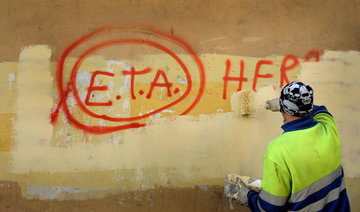
MADRID: The Basque militant group ETA says it has “completely dissolved all its structures” after a 60-year armed independence campaign, but the Spanish government vowed Wednesday not to abandon the investigation of crimes from the group’s violent past.
In a letter sent to Basque institutions and civil society groups, ETA said it acknowledged its responsibility in failing to solve the Basque “political conflict.” The letter was dated April 16, but only made public Wednesday in the Spanish online newspaper eldiario.es,
ETA, whose initials stand for “Euskadi ta Askatasuna” — or “Basque Homeland and Freedom” — killed more than 850 people in its campaign to create an independent Basque state in northern Spain and southern France.
Responding to the announcement, Spanish Interior Minister Juan Ignacio Zoido vowed to keep investigating unresolved crimes attributed to ETA. He said police would “continue to pursue the terrorists, wherever they may be.”
“ETA obtained nothing through its promise to stop killing, and it will obtain nothing by announcing what they call dissolution,” he told reporters.
In the letter, the group said its organization dissolution “doesn’t overcome the conflict that the Basque Country maintains with Spain and with France.”
“The Basque Country is now before a new opportunity to finally close the conflict and build a collective future,” the organization said. “Let’s not repeat the errors, let’s not allow for problems to rot.”
It wasn’t immediately clear why the letter was dated two weeks earlier.
A spokesman for the Basque regional government told The Associated Press that it received ETA’s letter “a few days earlier.” The official, who wasn’t authorized to be named in media reports, declined to elaborate.
Founded in 1958 during Gen. Francisco Franco’s regime, the group grabbed global headlines when it killed the dictator’s anointed successor, Prime Minister Luis Carrero Blanco, in 1973. It remained active long after Franco’s own death in 1975.
The group’s bloodiest period came as Spain transitioned from dictatorship to democracy during the early 1980s. it targeted not only members of the military and police forces, but politicians, entrepreneurs, civilians and some of its own members who wanted to leave ETA.
In all, the group killed 853 people over four decades, according to a tally by the Spanish Interior Ministry. ETA also injured more than 2,600 people, kidnapped 86 and threatened hundreds more, according to the latest government count.
At least another 60 people were killed by death squads set up by members of Spain’s security forces to perform extrajudicial killings of ETA militants, in what became known as Spain’s “dirty war” on terror.
At least 358 crimes believed to involve ETA are unresolved, according to Covite, an association of victims that is campaigning for ETA to end “without impunity.”
At a press conference on Wednesday in San Sebastian, minutes before the militant group’s letter was published, Covite President Consuelo Ordonez criticized a statement last week in which ETA sought forgiveness from victims “who didn*t have a direct participation in the conflict.”
Ordonez’s brother Gregorio, a leading regional figure in the conservative Popular Party, was killed by ETA in 1995.
“This is not the end of ETA we wanted and, above all, is not the end of ETA we deserved,” she said.

Basque separatist group ETA announces it has ‘completely dissolved’
- The Basque militant group ETA says it has “completely dissolved all its structures”
- In all, the group killed 853 people over four decades, according to a tally by the Spanish Interior Ministry
Journalists in Bangladesh demand protection amid rising attacks
- Media industry in the South Asian country is being systematically targeted
- Interim government blamed for failing to adequately respond to the incidents
DHAKA: Journalists, editors and owners of media outlets in Bangladesh on Saturday demanded that authorities protect them following recent attacks on two leading national dailies by mobs.
They said the media industry in the South Asian country is being systematically targeted in the interim government headed by Nobel Peace Prize laureate Muhammad Yunus. They said the administration failed to prevent attacks on the Daily Star, the country’s leading English-language daily, and the Prothom Alo, the largest Bengali-language newspaper, both based in Dhaka, the capital.
In December, angry mobs stormed the offices of the two newspapers and set fire to the buildings, trapping journalists and other staff inside, shortly after the death of a prominent Islamist activist.
The newspaper authorities blamed the authorities under the interim government for failing to adequately respond to the incidents despite repeated requests for help to disperse the mobs. Hours later, the trapped journalists who took shelter on the roof of the Daily Star newspaper were rescued. The buildings were looted. A leader of the Editors Council, an independent body of newspaper editors, was manhandled by the attackers when he arrived at the scene.
On the same day, liberal cultural centers were also attacked in Dhaka.
It was not clear why the protesters attacked the newspapers, whose editors are known to be closely connected with Yunus. Protests had been organized in recent months outside the offices of the dailies by Islamists who accused the newspapers of links with India.
On Saturday, the Editors Council and the Newspapers Owners Association of Bangladesh jointly organized a conference where editors, journalist union leaders and journalists from across the country demanded that the authorities uphold the free press amid rising tensions ahead of elections in February.
Nurul Kabir, President of the Editors Council, said attempts to silence media and democratic institutions reflect a dangerous pattern.
Kabir, also the editor of the English-language New Age daily, said unity among journalists should be upheld to fight such a trend.
“Those who want to suppress institutions that act as vehicles of democratic aspirations are doing so through laws, force and intimidation,” he said.
After the attacks on the two dailies in December, an expert of the United Nations said that mob attacks on leading media outlets and cultural centers in Bangladesh were deeply alarming and must be investigated promptly and effectively.
“The weaponization of public anger against journalists and artists is dangerous at any time, and especially now as the country prepares for elections. It could have a chilling effect on media freedom, minority voices and dissenting views with serious consequences for democracy,” Irene Khan said in a statement.
Yunus came to power after former Prime Minister Sheikh Hasina fled the country amid a mass uprising in August, 2024. Yunus had promised stability in the country, but global human rights groups including Human Rights Watch and Amnesty International have blamed the government for its failure to uphold human and other civil rights. The Yunus-led regime has also been blamed for the rise of the radicals and Islamists.
Dozens of journalists are facing murder charges linked to the uprising on the grounds that they encouraged the government of Hasina to use lethal weapons against the protesters. Several journalists who are known to have close links with Hasina have been arrested and jailed under Yunus.
They said the media industry in the South Asian country is being systematically targeted in the interim government headed by Nobel Peace Prize laureate Muhammad Yunus. They said the administration failed to prevent attacks on the Daily Star, the country’s leading English-language daily, and the Prothom Alo, the largest Bengali-language newspaper, both based in Dhaka, the capital.
In December, angry mobs stormed the offices of the two newspapers and set fire to the buildings, trapping journalists and other staff inside, shortly after the death of a prominent Islamist activist.
The newspaper authorities blamed the authorities under the interim government for failing to adequately respond to the incidents despite repeated requests for help to disperse the mobs. Hours later, the trapped journalists who took shelter on the roof of the Daily Star newspaper were rescued. The buildings were looted. A leader of the Editors Council, an independent body of newspaper editors, was manhandled by the attackers when he arrived at the scene.
On the same day, liberal cultural centers were also attacked in Dhaka.
It was not clear why the protesters attacked the newspapers, whose editors are known to be closely connected with Yunus. Protests had been organized in recent months outside the offices of the dailies by Islamists who accused the newspapers of links with India.
On Saturday, the Editors Council and the Newspapers Owners Association of Bangladesh jointly organized a conference where editors, journalist union leaders and journalists from across the country demanded that the authorities uphold the free press amid rising tensions ahead of elections in February.
Nurul Kabir, President of the Editors Council, said attempts to silence media and democratic institutions reflect a dangerous pattern.
Kabir, also the editor of the English-language New Age daily, said unity among journalists should be upheld to fight such a trend.
“Those who want to suppress institutions that act as vehicles of democratic aspirations are doing so through laws, force and intimidation,” he said.
After the attacks on the two dailies in December, an expert of the United Nations said that mob attacks on leading media outlets and cultural centers in Bangladesh were deeply alarming and must be investigated promptly and effectively.
“The weaponization of public anger against journalists and artists is dangerous at any time, and especially now as the country prepares for elections. It could have a chilling effect on media freedom, minority voices and dissenting views with serious consequences for democracy,” Irene Khan said in a statement.
Yunus came to power after former Prime Minister Sheikh Hasina fled the country amid a mass uprising in August, 2024. Yunus had promised stability in the country, but global human rights groups including Human Rights Watch and Amnesty International have blamed the government for its failure to uphold human and other civil rights. The Yunus-led regime has also been blamed for the rise of the radicals and Islamists.
Dozens of journalists are facing murder charges linked to the uprising on the grounds that they encouraged the government of Hasina to use lethal weapons against the protesters. Several journalists who are known to have close links with Hasina have been arrested and jailed under Yunus.
© 2026 SAUDI RESEARCH & PUBLISHING COMPANY, All Rights Reserved And subject to Terms of Use Agreement.