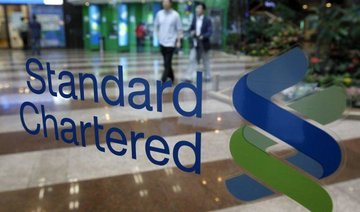
Standard Chartered first-quarter profit beats estimates as recovery gathers pace

StanChart in February unveiled a new medium-term goal of an 8 percent return on equity, as it recovers from a restructuring that saw the key profitability metric fall into the negative. (Reuters)
Updated 02 May 2018
Follow

Standard Chartered first-quarter profit beats estimates as recovery gathers pace

HONG KONG: Standard Chartered Plc posted a better-than-expected 20 percent rise in pretax profit for the first three months of the year, helped by a surge in loan demand and improvement in asset quality.
The first-quarter profit jump on Wednesday builds on early signs of success, including a return to dividend payments, for StanChart, which, under the leadership of Chief Executive Bill Winters since 2015, has undergone a sweeping restructuring.
Pretax profit for the bank, which focuses on Asia, Africa and the Middle East, rose to $1.26 billion in the quarter ended March 31 from $1.05 billion in the same period a year ago, it said in a statement to the stock exchange.
That was above an average estimate of $1.21 billion drawn from nine analysts in a poll collated by the bank.
The bank’s operating income in the quarter rose 7 percent to $3.9 billion.
Net impairment on financial assets in the quarter was at a similar level to the same period last year and 29 percent lower than in the fourth quarter, the bank said.
StanChart in February unveiled a new medium-term goal of an 8 percent return on equity, as it recovers from a restructuring that saw the key profitability metric fall into the negative. It has not announced the timetable for achieving the goal.
It posted an annualized return on equity of 7.6 percent in the March quarter, compared to 6.3 percent in the first quarter of 2017.
“This encouraging start to the year shows that we are firmly on the path laid out in February that will take us above an 8 percent return on equity in the medium term,” Winters said in the statement.
Losses from bad debts had plagued StanChart in the recent past, but the bank has since tightened limits on who can make decisions about such big loans and decreased internal limits for exposure to a single client.


Kuwait to boost Islamic finance with sukuk regulation

Updated 05 February 2026
Follow

Kuwait to boost Islamic finance with sukuk regulation

  • The move supports sustainable financing and is part of Kuwait’s efforts to diversify its oil-dependent economy

RIYADH: Kuwait is planning to introduce legislation to regulate the issuance of sukuk, or Islamic bonds, both domestically and internationally, as part of efforts to support more sustainable financing for the oil-rich Gulf nation, Prime Minister Sheikh Ahmad Abdullah Al-Ahmad Al-Sabah said on Wednesday.

Speaking at the World Governments Summit in Dubai, Al-Sabah highlighted that Kuwait is exploring a variety of debt instruments to diversify its economy. The country has been implementing fiscal reforms aimed at stimulating growth and controlling its budget deficit amid persistently low oil prices. Hydrocarbons continue to dominate Kuwait’s revenue stream, accounting for nearly 90 percent of government income in 2024.

The Gulf Cooperation Council’s debt capital market is projected to exceed $1.25 trillion by 2026, driven by project funding and government initiatives, representing a 13.6 percent expansion, according to Fitch Ratings.

The region is expected to remain one of the largest sources of US dollar-denominated debt and sukuk issuance among emerging markets. Fitch also noted that cross-sector economic diversification, refinancing needs, and deficit funding are key factors behind this growth.

“We are about to approve the first legislation regulating issuance of government sukuk locally and internationally, in accordance with Islamic laws,” Al-Sabah said.

“This enables us to deal with financial challenges flexibly and responsibly, and to plan for medium and long-term finances.”

Kuwait returned to global debt markets last year with strong results, raising $11.25 billion through a three-part bond sale — the country’s first US dollar issuance since 2017 — drawing substantial investor demand. In March, a new public debt law raised the borrowing ceiling to 30 billion dinars ($98 billion) from 10 billion dinars, enabling longer-term borrowing.

The Gulf’s debt capital markets, which totaled $1.1 trillion at the end of the third quarter of 2025, have evolved from primarily sovereign funding tools into increasingly sophisticated instruments serving governments, banks, and corporates alike. As diversification efforts accelerate and refinancing cycles intensify, regional issuers have become regular participants in global debt markets, reinforcing the GCC’s role in emerging-market capital flows.

In 2025, GCC countries accounted for 35 percent of all emerging-market US dollar debt issuance, excluding China, with growth in US dollar sukuk issuance notably outpacing conventional bonds. The region’s total outstanding debt capital markets grew more than 14 percent year on year, reaching $1.1 trillion.